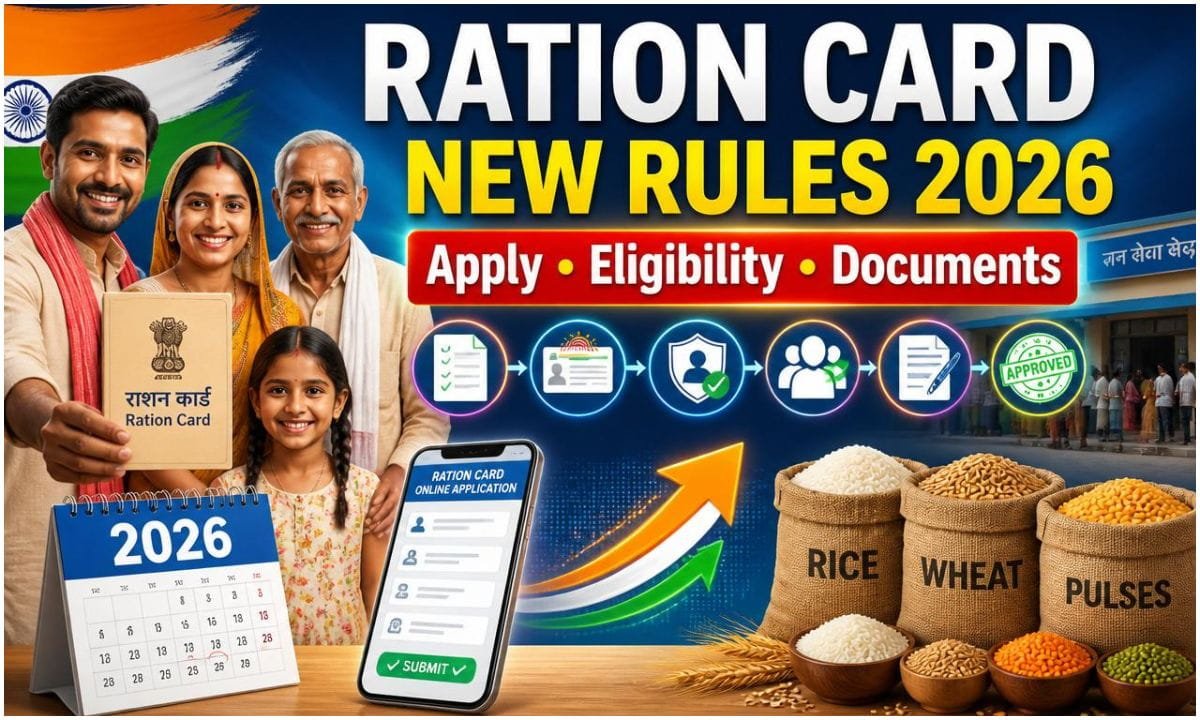
Ration Card New Rules 2026: The ration card has long been one of India’s most important welfare documents. For decades, it has served two purposes at once: it is the ticket to subsidised food grains under the Public Distribution System (PDS), and it is one of the most widely accepted proofs of identity and residence for everything from school admissions to LPG connections. In 2026, the system has entered a new phase. State governments, working under the umbrella of the National Food Security Act (NFSA) and the One Nation One Ration Card (ONORC) scheme, have introduced a set of changes that every existing cardholder and every new applicant needs to understand.
These changes are not cosmetic. They touch how you apply, who qualifies, what documents you need, and even how you use your card once you have it. Mandatory e-KYC, recalibrated income thresholds, digital-first applications, and a stronger version of the ONORC portability system are reshaping the ration card landscape this year. This article walks through everything you need to know about the Ration Card New Rules 2026 — the application process, eligibility criteria, required documents, category-wise entitlements, and the practical steps you should take right now to avoid losing your benefits.
Why the Rules Are Changing in 2026?
Before getting into the specifics, it helps to understand why the government has pushed for these reforms. Three problems have driven the changes.
- First, duplication and fraud. Over the years, many households ended up holding more than one ration card, sometimes across different states, sometimes within the same family. This inflated the number of beneficiaries on paper and diverted subsidised grain away from genuinely eligible families.
- Second, outdated income data. Many of the income thresholds used to sort households into Above Poverty Line (APL), Below Poverty Line (BPL), Antyodaya Anna Yojana (AAY), and Priority Household (PHH) categories had not been revised in years. Meanwhile, wages, inflation, and cost of living had moved substantially. This meant some households that no longer needed subsidised food were still receiving it, while others who genuinely needed help had slipped through the cracks because their card details or category had never been updated.
- Third, migration. India has a large population of interstate migrant workers — people who move from one state to another for employment but whose ration card is tied to their home state. Before the ONORC upgrades, a worker registered in Uttar Pradesh who took up work in Karnataka effectively lost access to subsidised grain while away from home. The 2026 reforms specifically target this gap.
Taken together, these three issues explain the direction of this year’s changes: tighter identity verification, updated income and eligibility checks, and a stronger, technology-driven portability system.
The Core Change: Mandatory e-KYC for Every Family Member
If there is one rule change that affects almost everyone, it is this one. Under the 2026 ration card rules, every family member listed on a ration card now needs to link their Aadhaar and complete e-KYC. This is not limited to the head of the household — every single name on the card, including children and elderly dependents, must be verified.
The logic behind this rule is straightforward. By tying every beneficiary’s identity to their Aadhaar number, the government can cross-check ration card databases against other government records, weed out duplicate or fake entries, and ensure that the grain quota reaching a Fair Price Shop is actually being claimed by real, eligible people.
Under the new Mandatory e-KYC rule, every member listed on the ration card must authenticate their identity using Aadhaar, and this authentication can typically be completed at the Fair Price Shop using a biometric device, through the state’s PDS mobile application, or via the official state food department portal. Failure to complete e-KYC may lead to suspension of benefits until verification is done, so this is not a step you can afford to postpone.
e-KYC Deadlines Vary by State
One point of confusion for many families is the deadline. There is no single national deadline for ration card e-KYC — each state sets its own, with some states requiring completion by April 1, 2026 while others have extended their deadlines to later in the year. Because of this variation, you should not rely on generic information you may have read online or heard from a neighbour in a different state. The safest approach is to check your state’s Food Department website or visit your local Fair Price Shop directly to find the specific deadline that applies to you, and not to wait, because if the deadline passes without completion, benefits stop automatically.
How to Complete Ration Card e-KYC?
While the exact interface differs from state to state, the general process for completing e-KYC in 2026 usually involves one of the following routes:
- Visit your Fair Price Shop (FPS): The shopkeeper or dealer typically has access to a biometric verification device linked to the state PDS server. You can walk in with your Aadhaar card and complete fingerprint or iris verification on the spot.
- Use the Mera Ration App or state PDS app: Most states now support Aadhaar-linked e-KYC through a mobile application. New applications and updates are increasingly routed through the official state PDS portal or the Mera Ration App, with digital uploads of identity proof, income certificate, and residence documents.
- Visit the Food and Civil Supplies office or a Common Service Centre (CSC): For households facing technical issues or lacking smartphone access, in-person assistance is available at these designated centres.
- Online self-service via the state portal: In several states, you can log in with your ration card number, enter your Aadhaar details, and complete OTP-based verification without leaving home.
Understanding One Nation One Ration Card (ONORC) in 2026
The ONORC scheme is not new, but 2026 has brought it a significant upgrade. The scheme, which allows beneficiaries to purchase their subsidised quota from any Fair Price Shop anywhere in India, has received a meaningful technological upgrade this year, which is especially important for migrant workers who move between states for employment and who previously faced the practical impossibility of using, for example, a Uttar Pradesh Ration Card while working in Karnataka.
The scheme works through a central system connected with Aadhaar to check entitlements, reducing the need for multiple ration cards and helping people who move between states access their benefits easily, and in 2026 the government has strengthened ONORC further by linking it with digital verification and cash transfer systems, making it easier to use and reducing the chances of benefits being lost or misused.
For migrant families, this means:
- You do not need to apply for a fresh ration card just because you have relocated for work.
- Your subsidised grain quota can be collected from any Fair Price Shop that is on the ONORC network, provided your Aadhaar is linked and e-KYC is complete.
- The system automatically checks your entitlement against the central database, so there is no need to carry physical proof beyond your Aadhaar-linked card.
Talk of Direct Cash Transfers
One of the more closely watched proposals in the 2026 reform discussions is a potential shift toward direct financial assistance alongside food grain subsidies. The government of India has been considering significant changes for ration card holders, under which eligible families could receive around one thousand rupees every month directly in their bank accounts as financial help, extending support beyond just cheaper food to make it easier for families to manage daily expenses. If implemented, families would continue receiving their regular food supplies while also getting additional cash assistance for other needs.
It is important to treat this as a proposal under discussion rather than a confirmed, nationwide, already-implemented benefit. Because such announcements evolve quickly and can vary by state, always verify the current status through your state’s official Food and Civil Supplies Department website or a trusted government source before making financial plans around it.
Ration Card Categories and Entitlements in 2026
India’s ration cards continue to be organised around a few broad categories under the NFSA framework, though the exact grain quantities and prices can vary slightly by state.
Antyodaya Anna Yojana (AAY)
This category is meant for the poorest of the poor — destitute households, daily wage labourers, and families without any fixed or stable source of income. Under this category, households are entitled to 35 kilograms of food grain per month, with wheat priced at around two rupees per kilogram and rice at around three rupees per kilogram, and the 2026 change requires e-KYC to be mandatory for all listed members.
Priority Household (PHH) / Below Poverty Line (BPL)
This is the largest category under the NFSA’s Targeted Public Distribution System. Households identified as Below Poverty Line under the NFSA’s Targeted PDS receive a grain entitlement of 5 kilograms per person per month, and the 2026 changes require income re-verification along with compulsory e-KYC.
Above Poverty Line (APL) and State-Defined Categories
Some categories remain state-defined, with eligible households varying by state; for example, in Uttarakhand, eligible households receive 7.5 kilograms of rice per month at around eleven rupees per kilogram. APL cardholders in many states receive smaller or no subsidies but continue to use the card primarily as an identity and residence document, along with limited access to fair-price commodities depending on state policy.
Non-NFSA Cards
Some states also issue Non-NFSA cards for households above the NFSA income limits, which are often used mainly for identification purposes rather than for claiming subsidised grain.
Who Is Eligible for a Ration Card in 2026?
Eligibility criteria are set primarily by state governments, but there is a common national framework that most states follow.
General Eligibility Conditions
- The applicant must be an Indian citizen residing in the state where they are applying.
- The applicant’s family should not already possess another ration card in any state, and income proof must match the category being applied for, whether APL, BPL, AAY, or PHH.
- A valid Aadhaar number is required for each family member listed on the application.
- The applicant should not already hold a valid ration card, and duplicate applications from the same address are not permitted.
Who Should Apply for a New Card?
New applications are typically appropriate for families not yet holding a ration card, families who have recently migrated to a new state or district, families formed after marriage, and families that need to add new members such as children.
Who Should Not Apply for a New Card?
Households that already hold a valid ration card should not submit a new application, and duplicate applications from the same address are not permitted under the rules. Instead of a fresh application, such households should use the “modify” or “update” functions on their state portal to add new members, correct details, or change their address.
Income-Based Eligibility in 2026
Income thresholds for ration card eligibility have been recalibrated across India in 2026 to better reflect current economic realities, because the previous income benchmarks, in many cases fixed years earlier, had not kept pace with inflation or changing wage patterns. This recalibration means that households that were previously classified as BPL might now be reassessed as APL if their income has risen above the revised threshold, and vice versa.
Because these thresholds differ by state and are subject to periodic revision, applicants should check the current income limit applicable in their state before applying, rather than relying on older figures.
Documents Required for a Ration Card in 2026
While the exact list can vary slightly from state to state, most applications call for the following categories of documents.
Identity Proof
- Aadhaar card of the head of the family and all members to be listed (this is now effectively mandatory in most states)
- Voter ID card
- PAN card, where applicable
- Passport, if available
Address / Residence Proof
- Aadhaar card (if it carries the current address)
- Recent electricity, water, or telephone bill
- Rent agreement, for tenants
- Property tax receipt or house ownership documents, for owners
- Domicile certificate, in certain states
Income Proof
- Income certificate issued by a competent authority (Tehsildar or equivalent)
- Salary slip, for salaried applicants
- Self-declaration form, in some states, for informal or daily wage workers
Family and Personal Details
- Passport-sized photographs of the head of the family and, in many states, of all adult members
- Marriage certificate, where a new card is being sought after marriage
- Birth certificates of children being added to the household
Additional Documents in Specific Cases
- Surrender certificate or deletion proof, if the applicant previously held a ration card in another state and has since migrated
- Bank account details, particularly relevant given the increasing linkage between ration cards and direct benefit transfers
- Category-specific certificates, such as caste certificates, where these affect eligibility for certain state-level quota categories
It is worth noting that document requirements can vary meaningfully by state, and while Aadhaar is often mandatory, some states do accept alternative documents if a household does not yet have Aadhaar.
Step-by-Step: How to Apply for a New Ration Card in 2026?
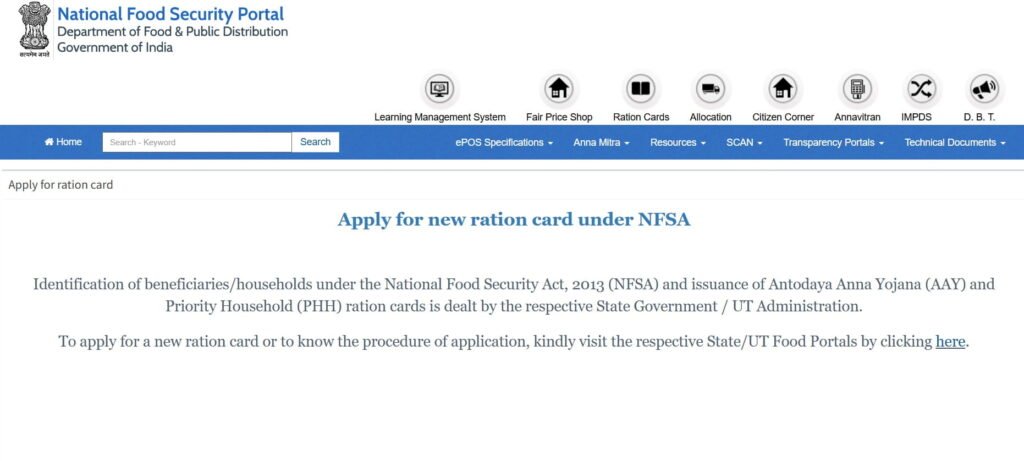
Because India does not have a single central portal for Ration Card, with each state managing its own system, the exact screens and steps will differ depending on where you live. However, the general process across most states follows this pattern.
Step 1: Identify the Correct State Portal
Search for your state’s official Food and Civil Supplies Department, Food Corporation, or PDS website. You can visit your State Food and Civil Supplies Department portal directly for this purpose. Avoid third-party websites that ask for payment or promise “guaranteed approval,” since these are not official channels and may be fraudulent.
Step 2: Register or Log In
Most portals require you to register using your mobile number, which is verified through an OTP. Once registered, you will typically be asked to log in before starting a fresh application.
Step 3: Select “Apply for New Ration Card”
Look for an option such as “Apply for New Ration Card 2026” on the homepage or dashboard. This will open the application form.
Step 4: Fill in Household Details
Fill in details including your name, address, family members, income, and the Aadhaar numbers of each member to be listed on the card. Double-check spellings and numbers against your Aadhaar card, since mismatches are one of the most common reasons applications get delayed or rejected.
Step 5: Upload Supporting Documents
Upload the required documents, which commonly include PAN, Aadhaar, income certificate, and a recent photograph. Make sure scanned copies are clear, correctly oriented, and within the file size limits specified by the portal.
Step 6: Submit and Save Your Reference Number
Submit the completed form and make sure to note the application reference number that is generated. This number is essential for tracking your application and for any future correspondence with the department.
Step 7: Track Your Application Status
You can track the status of your application online under an option such as “Application Status Check.” Processing times vary by state, and some applications may require a field verification visit by a local official before final approval.
Step 8: Receive Your Ration Card
Once your new ration card is issued, a physical card will typically be delivered by post, you may be able to download a digital ration card if your state supports it, your details will be stored in the state database, and you will be able to use the card for subsidised food grain collection. While formats differ from state to state, many states now provide a digital version, often as a downloadable PDF that you can save or print.
Updating an Existing Ration Card
If you already hold a ration card and simply need to make changes — adding a newborn, updating an address, removing a deceased member, or correcting a spelling error — you do not need to apply afresh. The application process has become significantly easier compared to the past following the implementation of the digital system, with benefits including the convenience of applying from home, a reduced need for repeated visits to government offices, the ability to track application status online, the option to upload documents digitally, and savings in both time and money.
If you have not yet completed your e-KYC, or if you wish to add a new family member’s name to your ration card, it is advisable to complete this process immediately, since in many states the Food and Civil Supplies Department has significantly simplified both the application and modification processes through online portals and Smart PDS systems. It is also worth remembering that the Aadhaar cards of all family members must be updated at the time of application or modification.
Why the Ration Card Still Matters Beyond Food Subsidies?
Even for households that do not heavily rely on the subsidised grain quota, the ration card remains a useful document. It commonly serves purposes such as subsidised food grain access, LPG subsidy linkage and LPG customer verification, school admission proofs, PAN and bank account verification in places where it is accepted, pension and scholarship applications, and, in some cases, voter ID or general identity confirmation. This is one reason the government is placing so much emphasis on cleaning up the database in 2026 — an inaccurate or duplicate ration card doesn’t just affect food subsidies, it can create downstream complications across several other services that rely on it as a proof of identity or address.
Finding Your State’s Official Portal
Because ration cards are administered independently by each state, one of the most practical challenges applicants face is simply locating the correct website. A general web search for “ration card apply online” often surfaces a mix of official state government pages, news aggregator articles, and unofficial third-party portals that may charge unnecessary fees or request more personal information than needed. To avoid confusion, look specifically for URLs ending in official government domains, and cross-check the portal name against what is mentioned on your state’s Food and Civil Supplies Department page.
Names to look for typically include phrases like “Food, Civil Supplies and Consumer Affairs Department,” “Public Distribution System,” or the state name followed by “PDS portal.” If you are ever unsure whether a website is genuine, your local Fair Price Shop dealer or the Food and Civil Supplies office in your district can confirm the correct link, and many states also list their official portal address on ration card packaging, notices at the FPS, or on the back of the physical card itself.
| Food, Civil Supplies and Consumer Affairs Department (UP) | CLICK HERE |
| Food, Civil Supplies and Consumer Affairs Department (DELHI) | CLICK HERE |
| Food, Civil Supplies and Consumer Affairs Department (HARYANA) | CLICK HERE |
Digital Ration Cards vs Physical Ration Cards
One of the more noticeable shifts in 2026 is the growing acceptance of the digital ration card as the primary, legally valid version of the document. In earlier years, most transactions at a Fair Price Shop required presenting a physical card, and losing it meant navigating a cumbersome duplicate-issuance process. Today, many states allow beneficiaries to download a digital copy of Ration Card directly from the state portal or mobile app, print it if needed, or simply present a QR code or Aadhaar-linked verification at the point of sale. This shift offers several practical advantages: a digital card cannot be physically lost or damaged, updates such as adding a family member are reflected immediately rather than requiring a fresh printed card, and the risk of duplication across states is reduced because the underlying database is centrally cross-verified through Aadhaar.
That said, not every state has fully transitioned to a digital-only system, and rural areas with limited internet connectivity or smartphone penetration may still rely more heavily on physical cards and in-person verification at the Fair Price Shop. If your state offers both formats, it is generally a good idea to keep both — a downloaded or printed digital copy as backup, along with the physical card if one is issued to you by post.
What Fair Price Shop Dealers Are Expected to Do Differently in 2026?
The reforms are not limited to what beneficiaries must do; Fair Price Shop dealers themselves face tighter compliance requirements this year. Many states now require dealers to conduct biometric or Aadhaar-based verification at the point of grain distribution, rather than relying solely on physical card presentation. Dealers are also expected to flag inconsistencies, such as a beneficiary attempting to claim a quota that does not match their registered household size, and to report non-functional biometric devices promptly so that beneficiaries are not denied their entitlement due to technical failures. For beneficiaries, this means it is worth carrying your Aadhaar card (or a linked mobile number for OTP-based verification) even after your ration card has been issued, since point-of-sale verification is becoming a standard part of the monthly collection process rather than an occasional check.
Special Considerations for Migrant Workers and Seasonal Labour
Given how central migration has been to this year’s reforms, it is worth spelling out what the changes mean in practical terms for workers who move frequently between states or regions for employment. Under the strengthened ONORC framework, a worker registered under a ration card in their home state should, in principle, be able to walk into any participating Fair Price Shop in a different state and claim their entitled quota, provided their Aadhaar is linked and e-KYC is complete. This removes the earlier requirement of either leaving family members behind to collect the ration or forfeiting the benefit entirely while working elsewhere.
For seasonal agricultural labourers, construction workers, and others who move for short stints throughout the year, this portability is one of the most tangible benefits of the 2026 upgrades, since it reduces the financial strain of buying food at market rates while away from home. Workers in this situation are strongly encouraged to complete their e-KYC before travelling for work, since attempting to verify identity remotely while away from your home state’s registered Fair Price Shop can be more difficult depending on local infrastructure.
Common Mistakes to Avoid in 2026
As states roll out these updated rules, a number of avoidable errors are causing delays and, in some cases, suspension of benefits. Keep the following in mind:
- Do not delay e-KYC. Since deadlines differ by state and benefits are cut off automatically once a deadline passes, check your specific state deadline as early as possible rather than assuming you have more time.
- Do not hold multiple ration cards. Having more than one card, even unintentionally due to an old card from a previous state of residence, can lead to disqualification. If you have migrated, get your old card formally surrendered or deleted before or while applying in your new state.
- Do not use unofficial or third-party websites. Since there is no single central national portal, always locate your specific state’s official Food and Civil Supplies Department website rather than trusting search results that link to unofficial intermediaries.
- Do not submit mismatched details. Errors between your Aadhaar details and your ration card application, such as a misspelled name or an incorrect date of birth, are a leading cause of application rejection or delay.
- Do not ignore family updates. Failing to add a newborn or remove a deceased member can create discrepancies during e-KYC verification, potentially triggering benefit suspension until it is corrected.
Final Thoughts
The Ration Card New Rules 2026 mark one of the more significant tightening exercises the Public Distribution System has seen in recent years. At the centre of the changes is a simple goal: making sure that subsidised food and the benefits tied to the ration card reach the people who are actually entitled to them. For existing cardholders, the priority right now is straightforward — confirm your state’s e-KYC deadline and complete verification for every family member without delay. For new applicants, the process has become considerably more digital and, in many states, faster than before, provided your documents are in order and your Aadhaar details match exactly across all records.
Because rules, deadlines, and income thresholds are set and revised individually by each state government, the single most reliable step you can take is to visit your own state’s official Food and Civil Supplies Department portal or your nearest Fair Price Shop and confirm the current requirements directly, rather than relying solely on general information. Staying proactive about e-KYC, keeping your family details updated, and applying only through official channels will ensure that your household continues to receive the benefits it is entitled to under the 2026 reforms.
Official Sources
| ONORC | CLICK HERE |
| Apply for New Ration Card | CLICK HERE |
| National Food Security Act | CLICK HERE |
Ration Card – Frequently Asked Practical Questions
Is e-KYC compulsory for every member, or just the head of the household?
Every member listed on the card is expected to complete e-KYC individually, not just the head of the family.
What happens if I miss my state’s e-KYC deadline?
Benefits are typically suspended automatically once the deadline passes, and you will need to complete verification afterward to have benefits reinstated.
Can I use my ration card in a state other than the one I registered in?
Yes, under the ONORC scheme, as long as your Aadhaar linkage and e-KYC are complete, you can generally collect your entitlement from participating Fair Price Shops anywhere in India.
Do income limits differ between states?
Yes. Since ration cards are largely administered at the state level, income thresholds and category definitions are set and periodically revised by each state government individually.
Will everyone get a physical card, or only a digital one?
This varies by state. Many states now issue a digital card as the primary official document while still offering a physical card either by default or on request.