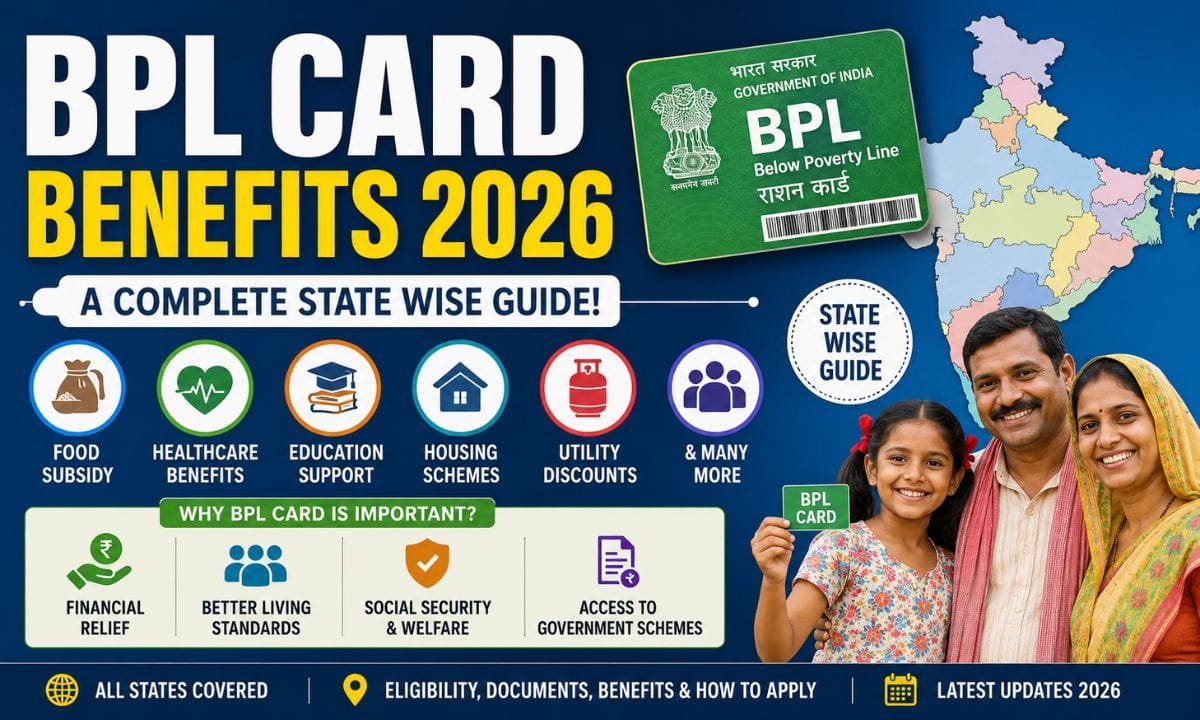
BPL Card Benefits 2026: The Below Poverty Line, or BPL, card remains one of the most important documents for economically weaker households in India. Even as the country’s welfare architecture has evolved into a more layered system of Priority Household, Antyodaya Anna Yojana, and Non-Priority Household ration cards, the term “BPL card” continues to be used popularly to describe any card that identifies a family as poor and unlocks access to subsidised food, healthcare, housing, education and pension benefits.
In 2026, the BPL Card is no longer just a ticket to cheaper rice and wheat. It has become a gateway document that determines whether a family qualifies for a long list of central and state schemes, from Ayushman Bharat health cover to free cooking gas connections, housing subsidies, old-age pensions and scholarships for children. This article explains what a BPL Card means today, how eligibility is determined, what benefits are available at the national level, and how these benefits differ from state to state across India.
What Is a BPL Card and Why It Still Matters?
A BPL Card is a government-issued document that identifies a household as living below the poverty line as defined by state or central authorities. Historically, it was primarily a ration card variant used to access subsidised food grains through the Public Distribution System. Over the years, most states have folded BPL classification into the ration card system itself, issuing cards under categories such as Priority Household or Antyodaya Anna Yojana rather than printing “BPL” directly on the card. Even so, the underlying idea has not changed: families identified as poor under state criteria continue to receive a distinct card, usually colour-coded, that separates them from Above Poverty Line households.
It is worth clarifying a common misunderstanding. Not every ration card is a BPL card. Ration cards are issued to households across income groups, including Above Poverty Line families, and their main purpose is to enable access to the Public Distribution System. A BPL card, on the other hand, is reserved for households that meet a poverty threshold, and it typically opens the door to a wider basket of welfare schemes beyond food subsidies, including healthcare coverage, housing assistance and education support. A family holding a Priority Household ration card in one state might receive only food benefits, whereas a family with formal BPL status could be eligible for a broader range of central and state support.
How Eligibility Is Determined in 2026?
BPL Card status in India is still largely rooted in the Socio-Economic Caste Census of 2011, which remains the most recent large-scale national survey used to identify poor and deprived households. On top of this base data, individual states apply their own inclusion and exclusion criteria, income ceilings, and asset-based tests to decide who qualifies.
At a broad national level, families with an annual income below roughly sixty thousand rupees in rural areas and seventy-five thousand rupees in urban areas are generally considered for BPL classification, though the exact figures vary depending on the state and the year of assessment. Land ownership is also factored in: households owning more than one and a half acres of irrigated land under major or medium irrigation schemes, two and a half acres of other irrigated wet land, three acres of dry land used for commercial crops, or five acres of dry land under other cultivation are typically excluded from BPL status, since such landholding is treated as an indicator of relative economic security.
Certain categories of households are automatically prioritised regardless of strict income calculations. These include landless agricultural labourers, marginal farmers, rural artisans such as potters, weavers, tanners and blacksmiths, slum dwellers, and people earning a livelihood through informal daily-wage work. Households headed by widows, terminally ill persons, single women, senior citizens above sixty with no assured means of support, persons with disabilities, transgender individuals, and Primitive Tribal Groups also receive priority consideration. States retain the power to add further categories as they see fit, which is one reason BPL eligibility can look quite different depending on where a family lives.
Because of this state-level flexibility, the most reliable way to check current eligibility is to consult the official State Food and Civil Supplies Department portal or the National Food Security Portal, since income thresholds and documentation requirements are periodically revised.
Types of Ration Cards Linked to BPL Status
India’s Public Distribution System uses a tiered card structure to route subsidies to the right households. Antyodaya Anna Yojana cards are reserved for the poorest of the poor, covering families with no stable income source, including landless labourers, marginal farmers and terminally ill persons; these households receive up to thirty-five kilograms of food grain per family every month regardless of family size. Priority Household cards, which cover a large share of the rural and urban population, provide five kilograms of food grain per person each month, with entitlement scaling according to family size.
Non-Priority Household and Above Poverty Line cards are issued to relatively better-off families who may still use the card for identity and residence proof but do not receive the same level of food subsidy. Many states continue to describe their poorer-household cards simply as “BPL cards,” coloured yellow, green or saffron depending on the state, to distinguish them from the white or blue cards issued to wealthier households.
Core National Benefits Available to BPL Cardholders
Regardless of which state a family lives in, BPL or equivalent Priority Household and Antyodaya cardholders are entitled to a common set of central government benefits.
The National Food Security Act guarantees subsidised food grains, with wheat priced at around two rupees per kilogram, rice at about three rupees per kilogram and coarse grains at roughly one rupee per kilogram for Priority Household families, while Antyodaya households receive their higher fixed quota at similarly low rates. Under the Pradhan Mantri Garib Kalyan Anna Yojana, which has been extended into 2026 and is expected to run through December 2028, tens of crores of beneficiariesreceive free food grains on top of the regular NFSA allocation, with five kilograms per person for Priority Household families and thirty-five kilograms per family for Antyodaya households.
The One Nation One Ration Card scheme is now operational in nearly every state and union territory, allowing beneficiaries to collect their subsidised grain from any Fair Price Shop in the country rather than being tied to the shop where their card was originally issued. This has proved especially valuable for migrant workers from states such as Bihar, Uttar Pradesh and West Bengal who move to cities like Mumbai, Delhi or Bengaluru for work, since it lets them access food security benefits without returning home or transferring their card.
Beyond food, BPL status is increasingly used as an eligibility marker for other flagship schemes. Ayushman Bharat, the Pradhan Mantri Jan Arogya Yojana, offers eligible poor and vulnerable families cashless hospitalisation cover of up to five lakh rupees per family per year across thousands of empanelled hospitals nationwide. The Pradhan Mantri Awas Yojana provides housing subsidies of up to roughly two and a half lakh rupees to help BPL families construct or improve a pucca house. The Ujjwala Yojana offers free liquefied petroleum gas connections to women from poor households, reducing dependence on unsafe cooking fuels. Old-age pension support through the Indira Gandhi National Old Age Pension Scheme provides a base payment to BPL seniors aged sixty to seventy-nine, which many states significantly top up. A BPL card is also commonly required as supporting proof for education scholarships, fee waivers, subsidised electricity connections, and priority allocation in various livelihood and skill-development missions.
BPL Card Benefits: A State-wise Breakdown
While the schemes above form a common national floor, the real difference in what a BPL Card actually delivers shows up at the state level, since food subsidy rates, health insurance top-ups, pension amounts and additional welfare schemes are all shaped by individual state governments.
Uttar Pradesh
Uttar Pradesh issues BPL, Above Poverty Line and Antyodaya cards to residents based on state-defined income thresholds, and the card continues to double as both an identity document and proof of residence useful for opening bank accounts, applying for loans, and linking with Aadhaar. Food grain is distributed through Fair Price Shops under the state’s own Targeted Public Distribution System Control Order, which lays down family composition rules and verification procedures alongside the national NFSA framework.
On the health side, the state-specific version of Ayushman Bharat gives BPL families cashless cover of up to five lakh rupees across more than nineteen hundred treatment packages, usable at any empanelled hospital in India. The state government has, at times, paused mandatory e-KYC re-verification requirements after implementation difficulties left many cardholders temporarily unable to collect their monthly quota, reflecting the ongoing tension between tightening verification and maintaining smooth access to entitlements.
Bihar
Bihar administers its ration and BPL card system through its state food portal, and the state has a particularly large share of Antyodaya and Priority Household beneficiaries given its high rural poverty incidence. Because Bihar sends a substantial number of migrant workers to other states, the One Nation One Ration Card facility is especially significant here, letting Bihar-origin workers collect their entitlement from Fair Price Shops in cities such as Delhi, Mumbai or Bengaluru using Aadhaar-based biometric authentication rather than having to travel home. Bihar BPL families are also priority beneficiaries for central housing and cooking-gas schemes, and the state periodically runs its own top-up programmes for pensions and disability support layered on top of the central schemes.
Maharashtra
In Maharashtra, ration cards are administered through the state’s food and civil supply department portal, and BPL families receive subsidised food grain in line with National Food Security Act norms. A useful distinction in Maharashtra is that a Priority Household ration card mainly secures food benefits, while formal BPL status is what unlocks the broader set of welfare schemes covering healthcare, education and housing subsidies. The state’s income threshold for BPL classification has historically hovered in a similar range to Uttar Pradesh, though exact figures are revised periodically, so checking the current state notification is advisable. Maharashtra’s BPL cardholders are also linked into the state’s own health assurance scheme, which works alongside Ayushman Bharat to widen cashless treatment coverage for poor households.
Rajasthan
Rajasthan applies asset and landholding criteria closely aligned with the national framework, factoring in irrigated and dry landholding limits when assessing BPL eligibility. The state runs its own food security scheme in parallel with the NFSA, and BPL or Antyodaya families can access food grain through Fair Price Shops linked to their Aadhaar-seeded ration card. Rajasthan has also been active in linking BPL status to its health assurance scheme, which offers cashless treatment at government and empanelled private hospitals, and the state periodically extends additional cash transfer or insurance top-ups to its poorest households during periods of economic stress.
Madhya Pradesh
Madhya Pradesh classifies ration cardholders into BPL, Antyodaya and APL categories, with BPL and Antyodaya households receiving food grain at concessional NFSA rates through the public distribution system. The state has its own health assurance scheme that runs alongside Ayushman Bharat, extending cashless hospitalisation benefits to BPL families, and it also offers various housing and pension top-ups for the poorest households, particularly in tribal-dominated districts where poverty incidence tends to be higher than the state average.
West Bengal
West Bengal presents one of the more dynamic examples of how state-level politics can reshape BPL benefits. With BPL status determined using Socio-Economic Caste Census 2011 data and cross-checked against the state’s own NFSA ration card and MGNREGA job card records, the state has recently begun rolling out several central schemes that had previously been delayed. Among the most significant is a monthly cash benefit of around three thousand rupees targeted specifically at women aged twenty-five and above from BPL, Antyodaya or Priority Household families, replacing an earlier lower-value state scheme.
West Bengal farmers are also expected to begin receiving the central Pradhan Mantri Kisan Samman Nidhi payout of six thousand rupees a year in three instalments, with an additional state top-up under discussion that could push the total annual support for small and marginal farmers considerably higher. These changes illustrate how BPL Card families in a state can see their benefit basket expand sharply following shifts in state government priorities.
Karnataka
Karnataka’s Anna Bhagya scheme is one of the country’s most visible BPL food benefit programmes, entitling BPL families to ten kilograms of rice per person every month, either as physical grain or as a cash equivalent when supply is constrained. Karnataka has around a crore BPL cardholders covering a very large share of its population, a scale that has periodically triggered debate about whether card issuance has kept pace with actual poverty levels, prompting the state to periodically clean up its BPL rolls and remove ineligible or deceased beneficiaries.
On healthcare, Karnataka’s Vajpayee Arogyashree scheme, now integrated with the central Ayushman Bharat programme under the combined Arogya Karnataka framework, offers BPL families cashless treatment cover of up to five lakh rupees, while Above Poverty Line families receive partial cover of up to one and a half lakh rupees. Each BPL family member can also obtain a printed Universal Health Card carrying a unique identification number linked to their ration card, which is used for verification at empanelled hospitals.
Tamil Nadu
Tamil Nadu operates its ration card system through the state’s public distribution portal, with distinct colour-coded cards separating BPL and APL households, and BPL families receiving food grain at subsidised rates comparable to national NFSA pricing. On health coverage, Tamil Nadu’s Chief Minister’s Comprehensive Health Insurance Scheme gives poor families cashless medical cover of up to five lakh rupees, including maternity and neo-natal benefits, with no waiting period before beneficiaries can make a claim. Tamil Nadu also tops up the central old-age pension for BPL seniors, adding roughly a thousand rupees to the base central payment, which meaningfully increases the monthly support available to elderly cardholders.
Kerala
Kerala runs the Karunya Arogya Suraksha Padhathi, offering health insurance cover for critical illnesses to poor families, with cashless treatment available at both government and empanelled private hospitals. Kerala also provides one of the more generous state top-ups to the central old-age pension, adding around sixteen hundred rupees on top of the base central amount, giving BPL seniors a noticeably higher monthly pension than in many other states. Kerala’s ration card system continues to distinguish Priority Household and Antyodaya beneficiaries, and the state has generally maintained relatively high standards of PDS delivery and digitisation compared to national averages.
Andhra Pradesh and Telangana
In Andhra Pradesh, the Aarogyasri scheme extends up to five lakh rupees a year in medical expenditure cover, including day-care, outpatient and inpatient benefits, to BPL families from the very first day of enrolment, without an extended waiting period. Telangana, which shares administrative roots with undivided Andhra Pradesh, runs an even higher-value scheme offering free cashless treatment of up to ten lakh rupees per BPL family for critical illnesses, with a specific higher cover of six and a half lakh rupees reserved for cochlear implant procedures. Both states also maintain their own agricultural and livelihood support schemes that BPL and small-farmer households can access alongside their food security entitlements.
Odisha
Odisha’s Biju Swasthya Kalyan Yojana, referenced in some sources as the GJAY programme, provides free cashless treatment to residents, with BPL families receiving particularly favourable coverage terms compared to APL households. Odisha also runs the KALIA scheme, a farmer welfare initiative that offers direct income support to small and marginal farmers, landless agricultural households and sharecroppers, many of whom also hold BPL cards.
Food grain distribution in Odisha follows NFSA norms, with Antyodaya and Priority Household families receiving their monthly entitlement through Fair Price Shops linked to the state’s own public distribution monitoring system.
Punjab, Haryana and Delhi
Punjab and Haryana both maintain state PDS portals through which BPL, Antyodaya and APL cardholders can check their status and entitlement, with food grain distributed largely along national NFSA lines. Delhi, given its large migrant population, has been an important beneficiary of the One Nation One Ration Card system, and BPL or Priority Household families in the capital who fall into the sixty-to-seventy-nine age bracket for old-age pension receive one of the highest state top-ups in the country, pushing their effective monthly pension well above the levels available in many other states. Delhi’s ration card system also continues to serve as key supporting documentation for various municipal and state welfare applications, including school admissions and fee concessions for children from BPL households.
Assam and Himachal Pradesh
Assam’s Atal Amrit Abhiyan scheme supports poorer families with a health cover of up to two lakh rupees per person for a defined set of costly disease categories, including cardiovascular and renal conditions, which is especially significant given the high out-of-pocket burden such treatments typically impose on low-income households. Himachal Pradesh runs the HIMCARE scheme, offering BPL families a cover of up to five lakh rupees for hospitalisation needs not already covered under Ayushman Bharat, effectively acting as a bridge scheme that fills gaps left by the central programme, with cashless treatment available both within and outside the state at empanelled hospitals.
Gujarat and Other States
Gujarat maintains a state PDS portal for ration card management, and BPL households there continue to be classified using colour-coded cards, with yellow generally reserved for the poorest households. The state also participates fully in the One Nation One Ration Card network and offers its own state-level top-ups to central housing and health schemes, though the exact quantum tends to be revised through periodic budget announcements.
Smaller states and union territories, including those in the Northeast, the hill states, and island territories, generally follow the national NFSA framework closely for food benefits, while layering in more localised schemes for housing, education and healthcare based on local poverty patterns and administrative capacity. Because these smaller states often have lower overall beneficiary numbers, the respective State Food and Civil Supplies Department remains the most reliable source for precise entitlement figures.
Documents Required to Apply for or Renew a BPL Card
Across most states, the basic documentation needed to apply for a BPL Card or an equivalent Priority Household or Antyodaya ration card includes proof of identity such as an Aadhaar card, proof of residence such as a rental agreement, utility bill or residence affidavit, income certificate issued by the relevant revenue authority, family composition details including the number of dependents, and in many states a caste certificate where caste-based inclusion criteria apply.
Landless or asset-poor applicants may need to submit a self-declaration regarding the absence of landholding or other qualifying assets. Importantly, applicants do not need to own land or property to qualify; renters and those without fixed assets can apply using a rental agreement or residence affidavit, provided household income falls below the applicable state threshold.
How to Apply for BPL Card?
Applications can generally be submitted online through the relevant State Public Distribution System portal, such as the food and civil supplies portals used in Uttar Pradesh, Maharashtra, Karnataka, Tamil Nadu, Delhi and Bihar, or offline through the local Tehsildar, Mamlatdar, Circle Inspector or Gram Panchayat office. After submission, a field verification is usually carried out by a local revenue official, commonly referred to as a Lekhpal in several northern states, and this process typically takes anywhere from thirty to sixty days.
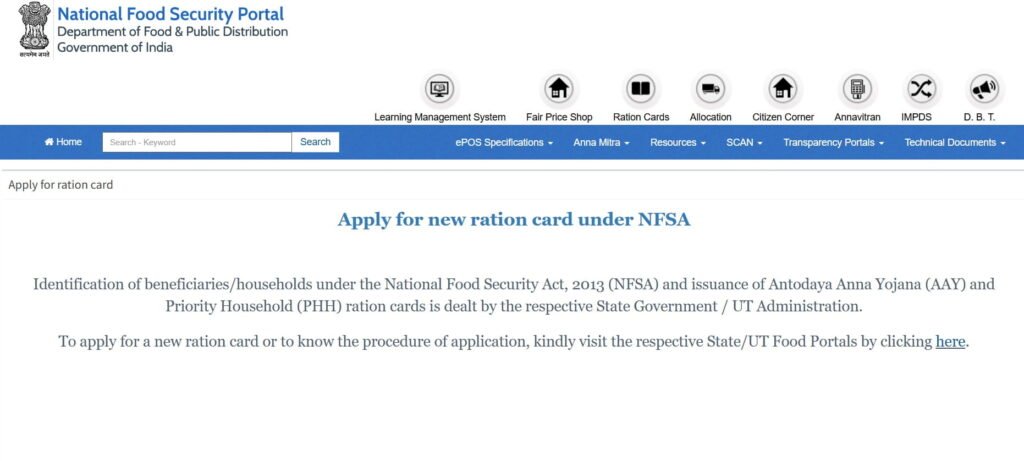
Once verification is complete, the card is generally sanctioned and physically or digitally issued within thirty to ninety days, after which it is linked to a specific Fair Price Shop for monthly entitlement collection, authenticated through biometric verification at the point of sale.
The Push Toward Mandatory e-KYC in 2026
A major administrative theme running through 2026 has been the push for mandatory Aadhaar-linked e-KYC verification for all ration card members. Several major states, including Uttar Pradesh, Bihar and West Bengal, have set deadlines around the end of the first quarter of the year for all listed family members to complete biometric authentication at a Fair Price Shop or Common Service Centre, with non-compliance risking suspension of the card. While the goal is to weed out duplicate, fraudulent or deceased entries from BPL rolls, and states such as Karnataka have already removed lakhs of “dead beneficiaries” identified through birth and death registry cross-checks, the rollout has not been without friction.
In Uttar Pradesh, for instance, implementation challenges meant that less than half of consumers were able to receive their food grain by the intended deadline, prompting a temporary suspension of the mandatory requirement in some areas. Anyone holding a BPL card in 2026 should treat e-KYC compliance as a priority, since failure to complete it remains the single most common reason for a card being frozen or an entitlement being denied.
Common Challenges and Practical Tips
One recurring issue is confusion between simply holding a ration card and holding formal BPL status; not every ration card automatically confers BPL benefits, so families should confirm their specific classification rather than assume eligibility based on card possession alone. Another frequent problem is outdated income or asset records, since many households experience income changes that are not immediately reflected in official BPL data drawn from the 2011 Socio-Economic Caste Census.
Families whose circumstances have changed, for better or worse, should proactively update their records through the state portal rather than waiting for a periodic survey. Migrant workers should make full use of the One Nation One Ration Card facility rather than assuming they must return to their home state to collect entitlements. Finally, given how frequently state governments revise pension top-ups, health cover limits and food grain quotas, cardholders should periodically check their respective state food department website or the national food security portal for the latest applicable figures rather than relying on older information, since benefit values described in this article reflect the general position through mid-2026 and are subject to further revision.
Conclusion
The BPL Card in 2026 continues to function as far more than a food ration document. It is the entry point to a wide and steadily expanding ecosystem of welfare support that spans food security, healthcare, housing, pensions, education and livelihood assistance. What makes the system genuinely complex, and genuinely important to understand correctly, is the degree of variation between states. A family in Telangana can access up to ten lakh rupees in critical illness cover, while a family in Himachal Pradesh relies on a five lakh rupee bridge scheme layered over Ayushman Bharat; a senior citizen in Kerala or Delhi may receive a substantially higher monthly pension top-up than one in a state that has not enhanced the central base amount.
For any BPL Card holder, the most valuable habit in 2026 is treating the local State Food and Civil Supplies Department portal, along with the National Food Security Portal, as the primary and most current source of truth, since eligibility criteria, benefit values and compliance deadlines such as e-KYC continue to be revised through the year.
Official Sources
| National Food Security Portal | CLICK HERE |
| One Nation One Ration Card | CLICK HERE |
FAQ’s on BPL Card Benefits 2026
What is a BPL card?
A BPL (Below Poverty Line) card is a ration card issued by the government for economically weaker families. It enables eligible families to obtain subsidized food grains and avail themselves of various welfare schemes offered by both central and state governments. Under the National Food Security Act (NFSA), the identification of beneficiaries and the issuance of cards are handled by the respective state governments.
What benefits can BPL cardholders avail in 2026?
Depending on the state, BPL cardholders may receive:
Subsidized rice, wheat, and other essential food items, Free or low-cost healthcare under eligible schemes, Scholarship benefits for students, Assistance under housing schemes, LPG subsidies under eligible schemes, Pension and social security benefits, Financial assistance through state welfare programs. The actual benefits vary from state to state.
Is the BPL card valid across all states in India?
Yes, the card remains valid as an official welfare document. For food grain benefits, eligible families can use the ‘One Nation One Ration Card’ (ONORC) system to obtain subsidized food from any fair price shop in participating states. However, eligibility for state-specific welfare schemes generally depends on the rules of that particular state.
How can I apply for a BPL card in 2026?
You can apply through your state’s Department of Food and Civil Supplies or the designated online portal. Generally, applicants require the following documents: Aadhaar card, Proof of residence, Income certificate, Family details, Passport-sized photographs, Other documents required by the respective state government. The application undergoes verification before approval.
Can a BPL card be cancelled?
Yes. If an investigation reveals that a family no longer meets the eligibility criteria or has provided incorrect information, the state government may cancel the card or change its category. If beneficiaries believe the cancellation was unjustified, they can generally file an appeal or request a re-verification.
Where can I check the benefits and eligibility for a BPL card in my state?
Visit the website of your state’s Food and Civil Supplies Department or the official National Food Security Portal for the latest information on eligibility criteria, the application process, and scheme details. Since benefits vary by state, always rely on the official state portal for the most up-to-date information.