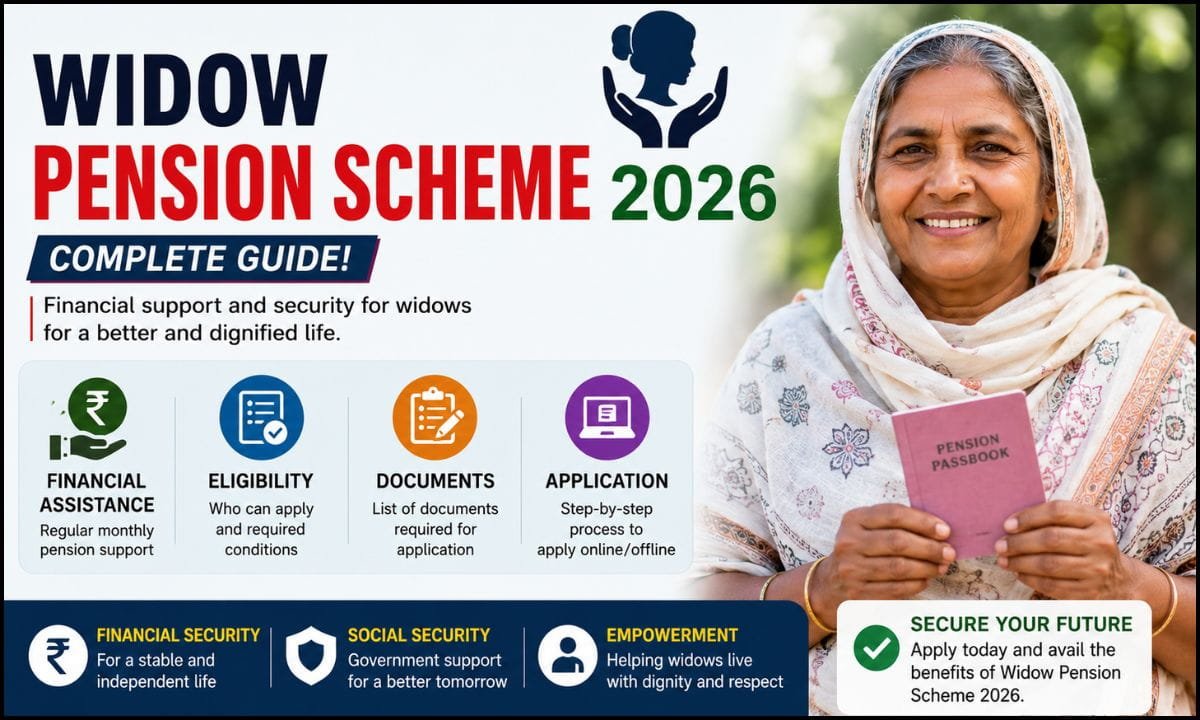
Widow Pension Scheme 2026: The death of a husband often marks not just an emotional turning point in a woman’s life but, for millions of families across India, an economic emergency as well. According to census-based estimates, India is home to more than 4.6 crore widows, and a significant share of them live in households with no other steady earning member. For widows belonging to economically weaker sections, the loss of a spouse frequently means the loss of the household’s primary — or only — source of income, pushing them into financial insecurity at precisely the moment they are also coping with personal loss.
To address this gap, the Government of India, together with individual state governments, operates a network of welfare pension schemes collectively referred to as Widow Pension Schemes, or in Hindi, Vidhwa Pension Yojana. These programmes are designed to provide a modest but steady monthly income to widowed women from low-income households, helping them meet basic living expenses and retain a measure of financial independence and dignity. This guide offers a comprehensive look at the Widow Pension Scheme 2026 landscape in India as of 2026 — covering the central government’s Indira Gandhi National Widow Pension Scheme (IGNWPS), major state-specific programmes, eligibility criteria, pension amounts, the step-by-step application process, required documents, and the challenges and trends shaping this space going forward.
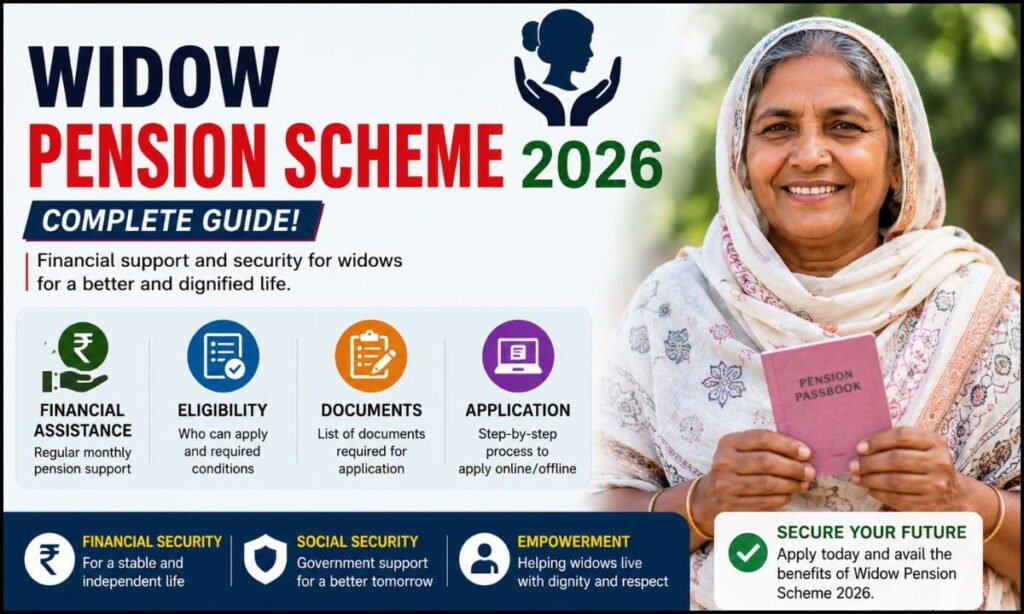
What Is the Widow Pension Scheme 2026?
The Widow Pension Scheme 2026 is not a single, monolithic programme but rather a two-tier system consisting of a central government scheme supplemented by numerous state-level initiatives, each with its own eligibility thresholds and payout structures. At the central level, the scheme is formally known as the Indira Gandhi National Widow Pension Scheme (IGNWPS), and it operates as one of the key components of the National Social Assistance Programme (NSAP), which was launched by the Government of India on 15th August 1995 and is administered by the Ministry of Rural Development.
IGNWPS itself was introduced in 2009 with a clear and specific objective: to provide monthly financial assistance to widows from Below Poverty Line (BPL) households who fall within a defined age bracket. The scheme recognises that widowhood, when combined with poverty, creates a particularly acute form of vulnerability — one that existing family support structures may not always be able to absorb, especially in households where the deceased husband was the primary breadwinner.
Layered on top of this central scheme, individual states run their own widow pension programmes — sometimes as an extension and top-up of IGNWPS, and sometimes as entirely independent state schemes with different eligibility norms, different age brackets, and significantly different pension amounts. This dual structure means that the actual financial support a widow receives, and even whether she qualifies at all, can depend heavily on which state she resides in.
Central Scheme: Indira Gandhi National Widow Pension Scheme (IGNWPS)
Widow Pension Scheme Eligibility Criteria
Under the central IGNWPS, the core Widow Pension Scheme 2026 eligibility requirements are as follows:
- The applicant must be a widow — meaning her husband must be deceased, and this must be verified through a valid death certificate.
- The applicant must not have remarried. In most states, remarriage renders a woman ineligible for further pension payments under the scheme.
- The applicant must generally fall within the age group of 40 to 79 years under the central scheme, though numerous state-specific programmes extend eligibility down to 18 years of age, recognising that the loss of a husband can create financial hardship regardless of a woman’s age.
- The applicant’s household must be classified as living Below the Poverty Line, based on criteria prescribed by the Government of India, or must meet a specified income ceiling under state-run variants of the scheme.
- Once a beneficiary reaches the age of 80, she is typically transitioned automatically from the widow pension into the old-age pension scheme, IGNOAPS, rather than continuing to draw the widow pension separately.
Widow Pension Scheme Pension Amount
- Under the central government’s contribution, IGNWPS currently provides a non-contributory pension of Rs. 300 per month to eligible widows between the ages of 40 and 79. For beneficiaries aged 80 and above — who, as noted, generally transition into the old-age pension category — the monthly amount rises to Rs. 500.
- As with the disability pension and old-age pension components of NSAP, this central contribution is rarely the full amount a beneficiary actually receives. States are expected to supplement the central figure with their own contribution, and the scale of this top-up varies enormously from one state to another — a pattern that has produced significant disparities in the real-world value of the widow pension depending on where a beneficiary lives.
State-Level Variations: How Much Widows Actually Receive?
Because the central contribution of Rs. 300 per month is, on its own, insufficient to meaningfully support a household, the state-level top-ups and independent state schemes are where the real financial substance of the widow pension lies. Below is a look at how a few major states have structured their programmes as of 2026.
Uttar Pradesh
The Uttar Pradesh Widow Pension Scheme, administered by the state’s Women Welfare Department (and, under the broader Social Security Pension umbrella, by the Samajik Kalyan Vibhag), is one of the largest widow pension programmes in the country by sheer number of beneficiaries. As of 2026, eligible widows in Uttar Pradesh receive Rs. 1,000 per month, an amount that was raised from an earlier figure of Rs. 500 following an announcement in the state’s supplementary budget by the state government.
Payments under the Uttar Pradesh Widow Pension Scheme are typically disbursed quarterly, with beneficiaries receiving Rs. 3,000 every three months directly into their Aadhaar-linked bank accounts via Direct Benefit Transfer. Eligibility requires the applicant to be a permanent resident of Uttar Pradesh, to have a deceased husband, to be at least 18 years old, and to belong to a household with an annual income not exceeding Rs. 2,00,000. Applicants must also not be receiving any other pension from a state or central government scheme simultaneously. Uttar Pradesh’s decision toextend eligibility to widows as young as 18, rather than restricting the scheme to the central government’s 40-to-79 age bracket, reflects a broader and more inclusive approach that several other states have also adopted.
Notably, Uttar Pradesh’s Social Security Pension (SSPY) framework groups the widow pension alongside old-age and disability pensions under a single umbrella, with each category currently paying Rs. 1,000 per month, streamlining administration even though the underlying eligibility criteria for each category remain distinct.
Maharashtra
In Maharashtra, the central IGNWPS contribution of Rs. 300 per month is supplemented by the state-sponsored Sanjay Gandhi Niradhar Anudan Yojana, which adds a further Rs. 1,200 per month. Combined, this brings the total monthly financial assistance available to eligible widows in Maharashtra to Rs. 1,500 — a structure that illustrates how central and state contributions are often designed to work in tandem rather than as entirely separate payments.
West Bengal
West Bengal operates widow pension support as one of three linked social security pension categories — alongside old-age and disability pensions — administered by the state’s Panchayat Affairs and Rural Development Department. In the 2026-27 state budget, following commitments made during the 2026 West Bengal Assembly election, the state government proposed to increase the monthly pension for beneficiaries across all three categories, including widows, by an additional Rs. 500. Once implemented, this enhancement raises the total monthly widow pension in the state to Rs. 1,500, up from the earlier amount of Rs. 1,000. The enhanced payments are disbursed via Direct Benefit Transfer directly to beneficiaries’ bank accounts.
Gujarat
Gujarat administers IGNWPS alongside its own state-specific initiatives targeting economically vulnerable widows more broadly, extending eligibility in some cases to widows as young as 18 who belong to Below Poverty Line households. The state also runs supplementary programmes for widows who fall outside the strict BPL classification but are nonetheless considered “economically support-less,” offering a more modest monthly amount to this broader category.
Delhi and Uttarakhand
Both Delhi and Uttarakhand are frequently cited among the states that extend widow pension eligibility down to 18 years of age under their own state schemes, rather than restricting benefits to the 40-to-79 age bracket used by the central IGNWPS. This reflects a growing recognition among several state governments that younger widows, particularly those with children to support, can face financial hardship just as acute as that faced by older widows, and arguably need income support even more urgently given the years of dependent expenses that may lie ahead of them.
The Broader Pattern
Taken together, these state-level examples illustrate a consistent theme: the central government’s Rs. 300 monthly contribution functions as a baseline floor, while the actual, meaningful level of support a widow receives depends overwhelmingly on her state’s own budgetary commitment and policy choices. Depending on the state, total monthly widow pension amounts in 2026 range from as low as Rs. 300 to Rs. 500 in states offering minimal or no top-up, to Rs. 1,000 to Rs. 1,500 in states such as Uttar Pradesh, Maharashtra, and West Bengal that have made more substantial commitments.
Widow Pension Scheme – Step-by-Step Application Process
Although specific procedures vary by state, the general pathway to applying for a Widow Pension Scheme in India in 2026 follows a broadly consistent structure, and can typically be completed either online or offline.
Step 1: Confirm Eligibility
Before applying, the applicant should confirm that she meets the relevant age, income, and residency requirements for her state’s specific scheme, since these can differ meaningfully from the central IGNWPS baseline of 40 to 79 years.
Step 2: Gather Required Documents
The applicant should assemble the necessary supporting documents, which commonly include:
- Husband’s death certificate
- Aadhaar card
- Age proof, such as an educational certificate or a certificate issued by a medical officer
- Income certificate issued by the relevant Tehsil or revenue authority
- Proof of residence within the state
- Bank account passbook or details for Direct Benefit Transfer enrolment
- Passport-sized photograph
- BPL card or ration card, where applicable, to establish household income status
Step 3: Apply Online or Offline
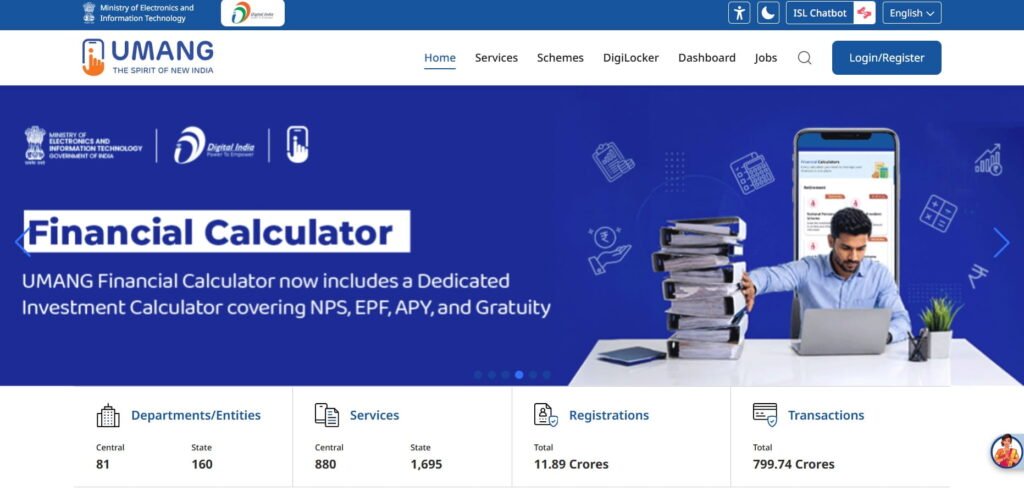
Online: Most states now offer online application through their respective social welfare department portals, or through the central NSAP system, accessible via the UMANG mobile application or website. The typical online process involves logging in using a mobile number and OTP, searching for the relevant NSAP scheme, filling in personal, income, and bank account details, uploading required documents and a photograph, and submitting the completed form.
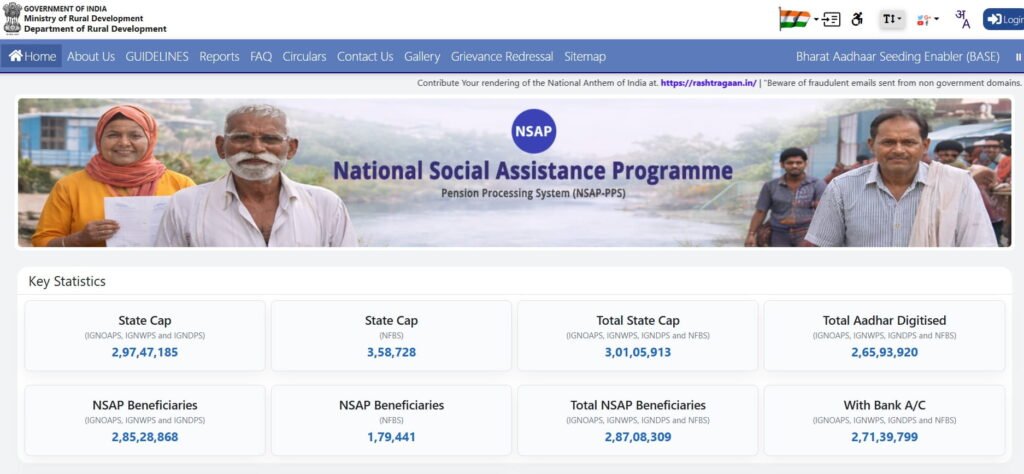
Offline: Applicants who prefer, or who lack reliable internet access, can submit a completed physical application to the Gram Panchayat or Block Office in rural areas, or to the Municipality or Municipal Corporation in urban areas. Many states also allow submission through Common Service Centres (CSCs), which offer assisted digital application services.
Step 4: Verification
Once submitted, the application is reviewed by a Verification Officer or a designated Verification Team, who confirm the facts stated in the application — including the applicant’s widowhood, age, income status, and residency — against supporting documentation and, where necessary, local enquiry.
Step 5: Approval and Enrolment
Following successful verification, the application is approved, and the beneficiary is enrolled for monthly (or, in some states, quarterly) pension disbursement.
Step 6: Receipt of Pension
Pension payments are made primarily through Direct Benefit Transfer directly into the beneficiary’s Aadhaar-linked bank account, in line with the broader NSAP disbursement framework, under which the significant majority of payments nationwide are now made via DBT rather than postal money order.
Applicants can generally track the status of their application and check whether their name appears on the official beneficiary list through their state’s social welfare department website — for instance, Uttar Pradesh maintains its Vidhwa Pension list and status-check tool on the official sspy-up.gov.in portal.
Widow Pension Scheme – Documents Required: A Summary
While specific requirements can vary by state, the documents most commonly requested when applying for a widow pension include:
- Death certificate of the husband
- Aadhaar card of the applicant
- Age proof
- Income certificate
- Proof of residence
- Bank passbook or account details
- Passport-sized photograph
- BPL certification or equivalent income documentation, where applicable
Applicants should verify the precise list required with their local social welfare office, since some states may request additional documentation, such as a family composition certificate or a self-declaration affirming that the applicant has not remarried.
Interaction With Other Schemes
A few important rules govern how the widow pension interacts with other government benefits, and beneficiaries should be aware of these to avoid confusion or missed opportunities.
No Duplication of Central Pensions: Under NSAP guidelines, a beneficiary generally cannot draw more than one central pension scheme simultaneously. A widow receiving IGNWPS cannot also separately draw IGNOAPS while under 80 years of age; instead, she transitions from one to the other upon crossing the relevant age threshold.
Transition to Old-Age Pension: A widow who turns 60 while receiving IGNWPS should proactively check whether shifting to her state’s Indira Gandhi National Old Age Pension Scheme would offer a better combined payout, since in several states the old-age pension amount, inclusive of state top-ups, can exceed what she currently receives under the widow pension. Many eligible beneficiaries are unaware that this comparison is worth making, and simply remain on whichever scheme they were originally enrolled in.
Remarriage: In most states, remarriage disqualifies a woman from continuing to receive the widow pension. Beneficiaries who remarry are generally required to inform the relevant authority, and continuing to draw the pension after remarriage without disclosure can be treated as a case of benefit fraud in some jurisdictions.
Family Pension: Widows of deceased government employees who are separately entitled to a family pension may, depending on state rules, be able to receive both the family pension and the state or central widow pension concurrently, since these are typically administered under different frameworks. However, rules on this vary, and applicants should confirm with their specific pension-disbursing authority.
Scale and Budgetary Context
The Widow Pension Scheme component represents one of the larger segments of the NSAP umbrella by beneficiary count. According to Ministry of Rural Development data, the Indira Gandhi National Widow Pension Scheme covers approximately 67 lakh beneficiaries nationwide, a figure surpassed only by the old-age pension component, which covers roughly 221 lakh beneficiaries. Uttar Pradesh alone accounts for a substantial share of all IGNWPS beneficiaries nationally, a pattern that grew further after the state revised its disbursement structure and raised its monthly pension amount, with a subsequent supplementary budget announcement pushing the figure higher still.
It is worth noting that the NSAP maintains a scheme-wise beneficiary ceiling for each state, meaning states must identify, verify, and enrol beneficiaries within their allocated cap. As a consequence, in some states, eligible widows who have applied but not yet been enrolled may effectively be placed on a waiting list until capacity within the state’s allocation becomes available — a structural constraint that beneficiaries and applicants should be aware of, since eligibility alone does not always guarantee immediate enrolment.
On the funding side, the overall budget allocation for NSAP — covering old-age, widow, disability, and family benefit components together — stood at approximately Rs. 9,652 crore for the 2025-26 financial year, with selection of beneficiaries at the ground level carried out with active involvement from Gram Panchayats and Municipalities.
Challenges and Criticisms
Despite covering tens of millions of women, the widow pension system in its current form continues to face a number of well-documented shortcomings.
Inadequate Amounts Relative to Cost of Living: Even in states offering the more generous end of the spectrum, such as Rs. 1,000 to Rs. 1,500 per month, the pension amount does not cover the cost of running a household — rent, food, utilities, and children’s school fees typically far exceed what any widow pension provides on its own. The scheme functions more as supplementary income than a complete livelihood solution, and disability and elder-welfare advocates alike have long argued that a meaningful revision of the base amounts is overdue.
Fragmented and Inconsistent Eligibility: The considerable variation in age eligibility — from 18 years in several progressive state schemes to 40 years under the strict central IGNWPS criteria — means that a woman’s access to support can depend heavily on her state of residence rather than her actual financial need. A widow in her twenties facing acute financial hardship may be fully covered in one state and entirely excluded in another.
Beneficiary Ceilings and Waiting Lists: Because NSAP imposes scheme-wise caps per state, genuinely eligible applicants can find themselves waiting, sometimes for extended periods, before being formally enrolled and beginning to receive payments — a frustration that is not always well understood or communicated to applicants at the time they apply.
Awareness and Documentation Barriers: Many eligible widows, particularly in rural and economically marginalised communities, remain unaware that these schemes exist, or face difficulty obtaining the necessary documentation — particularly income certificates and death certificates — required to complete an application. Limited digital literacy compounds this challenge as more state processes shift online.
Underuse of Scheme-Switching Opportunities: As noted earlier, many widows who cross into old age while still receiving the widow pension never investigate whether switching to the old-age pension scheme would yield a better combined payout in their state, simply because this comparison is not proactively communicated by administering authorities.
Trends to Watch in 2026 and Beyond
Several developments are likely to shape the widow pension landscape going forward.
Continued State-Level Enhancements: Following West Bengal’s 2026-27 budget commitment to raise pension amounts by Rs. 500 across old-age, widow, and disability categories, and Uttar Pradesh’s earlier doubling of its widow pension from Rs. 500 to Rs. 1,000, other states may face growing political and social pressure to match or exceed these enhancements, particularly ahead of state elections where welfare pension increases have proven to be an effective and popular commitment.
Digitisation and Streamlined Verification: State social welfare departments and the central NSAP system continue to move toward fuller digital integration, using Aadhaar-linked verification, mobile-based OTP login through platforms such as UMANG, and online status-tracking tools to reduce processing delays and improve transparency for applicants.
Greater Alignment Between Age Brackets: Given the growing number of states extending eligibility down to 18 years of age, there may be increasing pressure over time for the central IGNWPS framework itself to reconsider its 40-to-79 age restriction, bringing central policy more in line with the more inclusive approach already adopted by several states.
Improved Cross-Scheme Guidance: As awareness grows around the potential benefit of transitioning from the widow pension to the old-age pension upon turning 60, and around the interaction between widow pensions and family pensions, there is a clear opportunity — and a growing expectation among welfare advocates — for administering authorities to proactively guide beneficiaries toward whichever Widow Pension Scheme offers them the most favourable outcome, rather than leaving this discovery to chance.
Tips for a Smooth Application
A few practical steps can meaningfully reduce delays and rejections when applying for a widow pension:
- Obtain the death certificate early. Since this document anchors the entire application, applicants should register the husband’s death with the local municipal or panchayat authority as soon as possible after the event, rather than waiting until the pension application itself is being prepared.
- Keep Aadhaar and bank details linked and updated. Since disbursement is overwhelmingly done through Direct Benefit Transfer, any mismatch between the name on the Aadhaar card, the bank account, and the application form can delay or block payment.
- Retain copies of everything submitted. Applicants are advised to keep photocopies or scanned copies of every document submitted, along with the application reference number, to make it easier to track status or respond to any query raised during verification.
- Reapply if income status changes. A widow whose household income later falls below the applicable threshold, having previously been ineligible, should consider reapplying rather than assuming her earlier rejection is permanent.
- Ask about both central and state options. Since eligibility and payout amounts differ between the central IGNWPS and state-run schemes, applicants should specifically ask their local social welfare office whether they qualify for both, rather than assuming enrolment in one automatically covers the other.
Widow Pension Scheme – Conclusion
The Widow Pension Scheme, in its combined central and state form, remains one of the most widely used components of India’s social security architecture, reaching tens of millions of women across the country and providing a modest but meaningful measure of financial stability at one of the most difficult junctures of their lives. The system’s two-tier structure — a fixed central baseline supplemented by widely varying state contributions — has produced a landscape of genuine progress in some states, such as Uttar Pradesh, Maharashtra, and West Bengal, alongside persistent gaps in others where support remains limited to the bare central minimum.
For widows and their families navigating this system in 2026, the most practical path forward involves confirming the specific eligibility criteria and pension amount applicable in their state, gathering the necessary documentation — particularly the husband’s death certificate, income certificate, and Aadhaar linkage — and applying through either the online NSAP or state portal, or through the appropriate local Gram Panchayat, Municipal office, or Common Service Centre.
As debates continue around adequacy, age-eligibility consistency, and awareness gaps, the broader trajectory suggests continued incremental improvement — through rising state-level pension amounts, deeper digital integration, and, hopefully, greater proactive guidance to help beneficiaries access the full range of support available to them. For millions of widowed women across India, these ongoing refinements to the scheme are not abstract policy details, but a direct determinant of the dignity and stability with which they are able to rebuild their lives.
Disclaimer: Pension amounts, eligibility criteria, and application procedures for widow pension schemes can vary by state and are subject to periodic government revision. Readers are advised to verify current details with their respective state social welfare or women welfare department, or the official NSAP portal, before applying.
Official sources
| UMANG | CLICK HERE |
| NSAP Scheme | CLICK HERE |
| IGNWPS | CLICK HERE |
Widow Pension Scheme 2026 – Frequently Asked Questions
What is the difference between the central Widow Pension Scheme 2026 and a state Widow Pension Scheme?
The central scheme, IGNWPS, provides a base contribution of Rs. 300 per month to widows aged 40 to 79 from BPL households, funded and governed by the central government. State schemes either top up this central amount or operate as entirely separate programmes, often with broader age eligibility and higher payout amounts, funded from state budgets.
Can a widow below 40 years of age receive a pension under Widow Pension Scheme?
Not under the strict central IGNWPS criteria, but yes, in many states. States such as Uttar Pradesh, Delhi, Uttarakhand, and Gujarat run their own schemes that extend eligibility to widows as young as 18 years of age, provided they meet the applicable income and residency criteria.
Does remarriage affect eligibility?
Yes. In most states, a widow who remarries becomes ineligible to continue receiving the pension, and is generally expected to disclose the change in marital status to the relevant authority.
What happens when a widow pensioner turns 60 or 80?
At 80, beneficiaries typically transition automatically from the widow pension into the old-age pension scheme. At 60, beneficiaries are not automatically transitioned in most cases, but they should proactively check whether switching to the old-age pension in their state would provide a more favourable combined payout, since in several states it does.
Can a widow receive both the Widow Pension and a family pension?
In many cases, yes, since family pensions — typically applicable to widows of deceased government employees — are administered separately from the NSAP-based widow pension. However, rules vary by state and by the specific nature of the family pension involved, so applicants should confirm directly with the relevant pension-disbursing authority.
Is there a minimum household income requirement?
Yes, though the exact threshold varies by scheme. Under several state programmes, including Uttar Pradesh’s, the applicant’s household annual income must not exceed Rs. 2,00,000. Under the central IGNWPS, the applicant’s household must fall under the Below Poverty Line classification as defined by the Government of India.
How can an applicant check the status of her widow pension application?
Most states maintain an online portal where applicants can check their application status or search the published beneficiary list using their application reference number or Aadhaar details. Uttar Pradesh, for instance, maintains this facility on its official sspy-up.gov.in website.