Sukanya Samriddhi Yojana 2026: Every parent of a daughter eventually starts thinking about two big financial milestones, her higher education and, for many families, her wedding. Both of these events tend to arrive with substantial costs, often at a time when other family expenses are also climbing. The Sukanya Samriddhi Yojana was created specifically to help parents prepare for these moments well in advance, through a savings scheme that combines a high, government-guaranteed interest rate with complete tax exemption.
In 2026, the Sukanya Samriddhi Yojana remains one of the most attractive small savings instruments available in India, and this guide covers everything a parent or guardian needs to know — the current interest rate, eligibility, deposit rules, tax treatment, withdrawal conditions, and how the numbers actually add up over the life of an account.
What Is the Sukanya Samriddhi Yojana?
The Sukanya Samriddhi Yojana, commonly abbreviated as SSY, is a government-backed small savings scheme launched in 2015 under the Beti Bachao Beti Padhao initiative. It was designed to encourage parents and guardians to build a dedicated long-term savings corpus for a girl child, with the specific goals of funding her higher education and, later, her marriage-related expenses. The scheme can be opened at any authorised bank or post office across the country and is regulated by the Ministry of Finance through periodic notifications on interest rates and rules.
What sets Sukanya Samriddhi Yojana apart from most other savings instruments is its combination of a notably high interest rate, complete sovereign backing, and full tax exemption on contributions, interest, and maturity proceeds. Because the scheme is backed by the Government of India, the principal invested and the interest earned carry no market risk, making it a dependable long-term option for risk-averse families planning for a daughter’s future.
Sukanya Samriddhi Yojana Interest Rate 2026
Interest rates on Sukanya Samriddhi Yojana are not fixed for life. They are reviewed and notified by the Ministry of Finance every quarter, based on prevailing government security yields, alongside the rates for other small savings schemes such as the Public Provident Fund, National Savings Certificate, and post office term deposits.
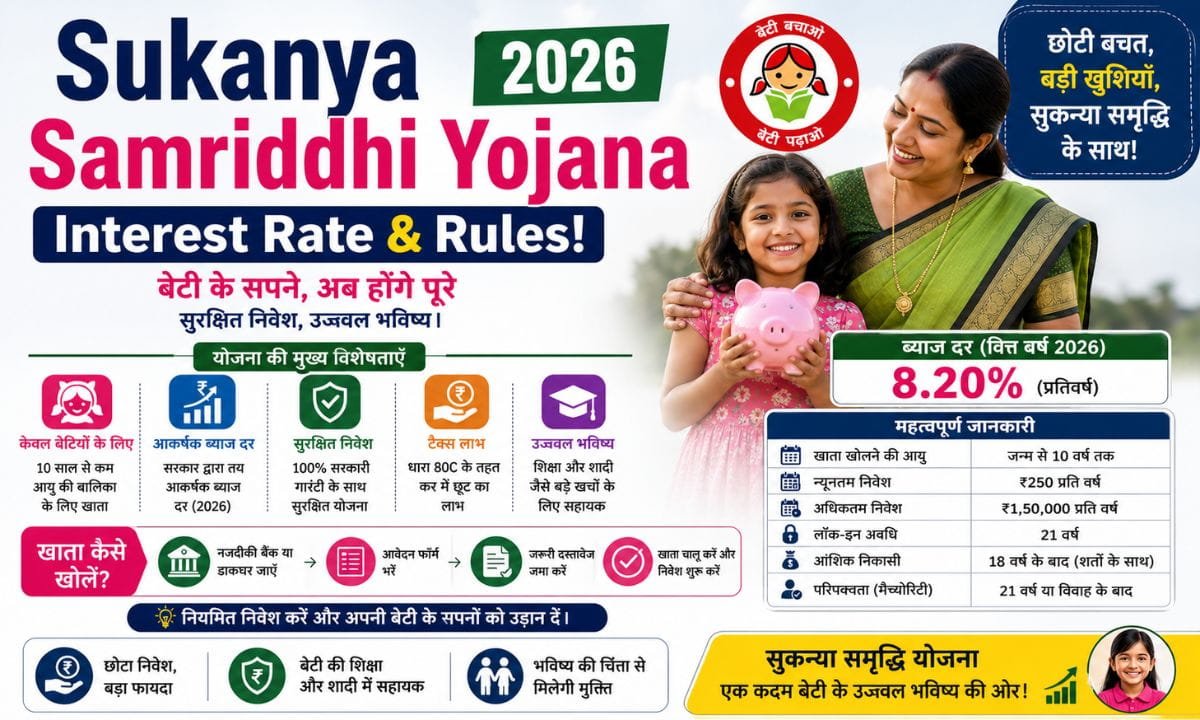
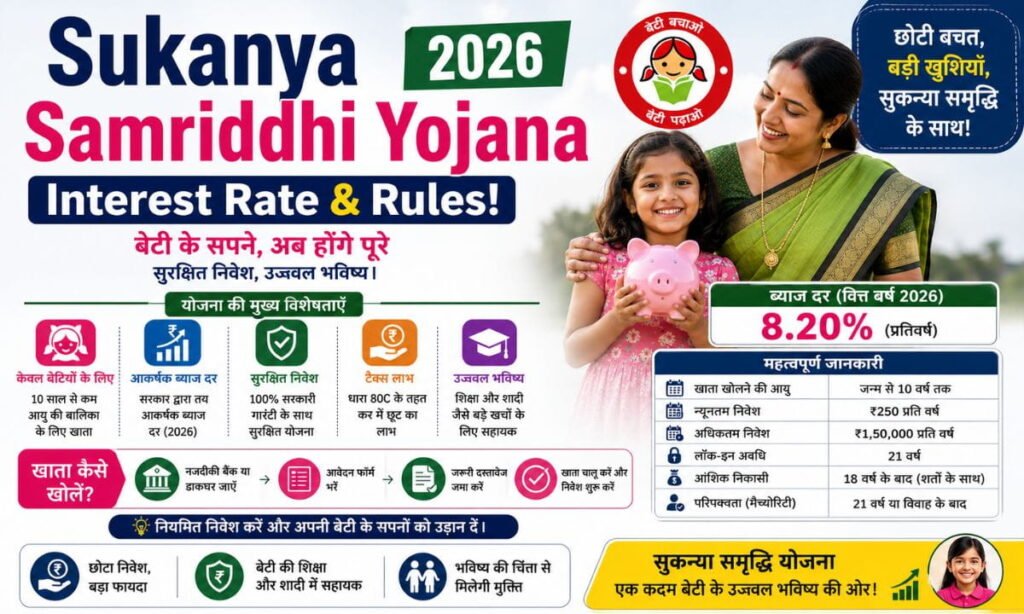
For the first quarter of financial year 2026-27, covering April to June 2026, the Ministry of Finance confirmed on March 30, 2026 that the Sukanya Samriddhi Yojana interest rate remains unchanged at 8.2 percent per annum, compounded annually. This marks a notably stable stretch for the scheme, since this is the eighth consecutive quarter at 8.2 percent, with the rate unchanged since January 2024.
This 8.2 percent rate places Sukanya Samriddhi Yojana well ahead of most comparable savings instruments. The scheme has historically offered a rate roughly 0.5 to 1.1 percentage points higher than the Public Provident Fund throughout its history since 2015. As of the current quarter, SSY’s 8.2 percent guaranteed rate compares favourably against typical bank fixed deposit rates in the 6.25 to 6.5 percent range, post office five-year term deposits at around 7.5 percent, and the Public Provident Fund at 7.1 percent, making it the highest-yielding scheme among all sovereign-backed small savings options currently available to Indian households.
Interest under SSY is compounded annually and credited to the account at the end of each financial year. For any given month, the interest calculation is based on the lowest balance present in the account between the close of the tenth day and the last day of that month. This calculation method means that depositing early in the month, ideally before the fifth, helps maximise the interest earned for that period, since a deposit made after the tenth would not count toward that month’s interest computation until the following cycle.
It’s important for parents to understand that while 8.2 percent is the prevailing rate for the current quarter, it is not a rate locked in for the entire 21-year tenure of the account. The government revises the rate quarterly, so the actual return generated over the life of an SSY account will depend on the path of rates notified across all the years the account remains open. Historical data shows the rate has generally hovered in a fairly narrow band, but it is still subject to change based on macroeconomic conditions and government bond yields.
Who Is Eligible to Open an Sukanya Samriddhi Yojana Account?
The eligibility rules for Sukanya Samriddhi Yojana are built around protecting the interests of a girl child and ensuring the account is opened and managed by someone with a legitimate guardianship relationship to her.
Age of the girl child: An Sukanya Samriddhi Yojana account can be opened for a girl child from the time of her birth up until she turns 10 years old. Once a girl crosses the age of 10, a fresh account can no longer be opened in her name, though existing accounts continue to run as per the normal schedule.
Who can open the account: The account must be opened and operated by a parent or a legal guardian of the girl child. Grandparents generally cannot open an SSY account for their granddaughter unless they hold legal guardianship over her, since the scheme is specifically restricted to natural parents or court-appointed legal guardians.
Number of accounts per child: Only one Sukanya Samriddhi Yojana account can be opened for a single girl child.
Number of accounts per family: A family can open SSY accounts for a maximum of two girl children. An exception is made in the case of twins or triplets born after the first girl child, or in cases of multiple births in the first delivery itself, where documentary proof such as a medical certificate may allow a third account to be opened.
Citizenship and residency: The girl child must be a resident Indian citizen at the time the account is opened. If the account holder later becomes a non-resident or gives up Indian citizenship, interest stops accruing on the account from that date, so families need to be mindful of this condition if their circumstances change, such as relocating abroad.
Documents Required to Open an Sukanya Samriddhi Yojana Account
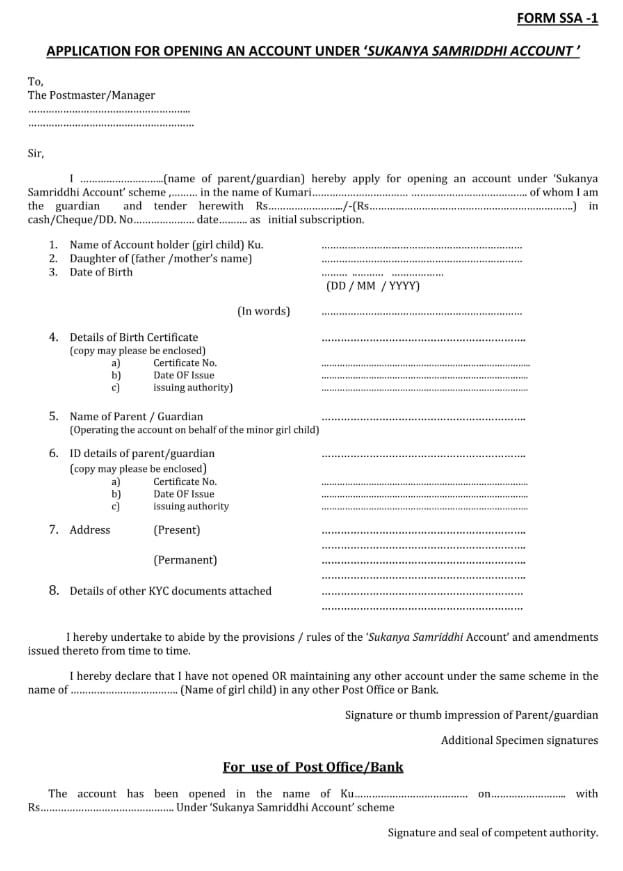
Opening an Sukanya Samriddhi Yojana Account is a relatively simple process thatcan be completed at a post office or any authorised bank branch. The documents typically required include the girl child’s birth certificate, to establish her age and identity; identity and address proof of the parent or legal guardian, which can include Aadhaar, PAN, passport, voter ID, or a similar government-issued document; recent passport-sized photographs of both the girl child and the guardian; and, where applicable, guardianship documents if the account is being opened by someone other than a natural parent.
Furnishing Aadhaar and PAN is required as per the prescribed rules for small savings schemes, so parents should ensure these documents are in place, or apply for them in advance, before initiating the account opening process. In cases where Aadhaar has not yet been issued for the child, banks and post offices generally accept the birth certificate initially and request Aadhaar details to be updated within a specified period afterward, in line with prevailing KYC norms.
Deposit Rules Under Sukanya Samriddhi Yojana
The deposit structure of Sukanya Samriddhi Yojana is designed to be flexible enough for families across different income levels while still encouraging disciplined, regular saving.
Minimum and maximum deposit: A minimum deposit of 250 rupees is required in a financial year to keep the account active. The maximum amount that can be deposited in a financial year is 1.5 lakh rupees, and this deposit limit has remained unchanged. Deposits can be made in any combination and frequency within the year, whether as a single lump sum or through multiple smaller instalments, as long as the total stays within the prescribed minimum and maximum.
Deposit period: While the SSY account has a total tenure of 21 years from the date of opening, active deposits are only required for the first 15 years. After the 15-year deposit period ends, no further contributions are needed, but the balance already accumulated in the account continues to earn interest at the prevailing notified rate until the account matures or is closed.
Mode of deposit: Deposits can be made in cash, through cheque, demand draft, or via electronic transfer, depending on what the specific bank or post office branch supports.
Consequences of missing the minimum deposit: If the minimum deposit of 250 rupees is not made in any given financial year, the account is treated as a defaulted or discontinued account. Such an account can be revived by paying the missed minimum deposit for each defaulted year, along with a small penalty, typically 50 rupees per year of default, subject to the account being revived before its full maturity.
Sukanya Samriddhi Yojana Calculator: How the Numbers Add Up?
One of the most common questions parents have is a simple one: if I deposit a certain amount every month or year, how much will my daughter actually receive at maturity? While actual outcomes depend on how interest rates move over the full 21-year period, illustrative calculations at the current 8.2 percent rate give a useful sense of the scheme’s potential.
Depositing 1,000 rupees a month, or 12,000 rupees a year, for the full 15-year deposit period grows to roughly 5.5 lakh rupees by maturity at the current 8.2 percent rate, against a total deposit of 1.8 lakh rupees. This example illustrates the substantial impact of compounding over a long horizon, where the interest earned ends up being significantly larger than the amount actually deposited.
For families able to contribute closer to the maximum permitted amount, investing 1.5 lakh rupees a year for 15 years results in approximately 63 to 65 lakh rupees at the point of maturity after 21 years, at a constant 8.2 percent rate — more than 2.8 times the total amount actually invested. Since the entire maturity amount is exempt from tax, this represents a genuinely tax-free corpus that can be used entirely toward a daughter’s education or wedding expenses without any deduction.
It is worth stressing that these figures are illustrative and assume a constant 8.2 percent rate held across all 21 years, which is unlikely to be exactly the case in practice since rates are reviewed and can be revised every quarter. The actual maturity value will depend on the specific path of rates notified over the life of the account. Even so, these calculations offer a reasonable benchmark for what a family can expect, and using an online Sukanya Samriddhi Yojana calculator — widely available through bank and post office websites — allows parents to model different monthly or yearly contribution amounts and see the projected corpus based on the current notified rate.
Tax Benefits of the Sukanya Samriddhi Yojana 2026
Sukanya Samriddhi Yojana is often highlighted as one of the very few investment instruments in India that enjoys full Exempt-Exempt-Exempt, or EEE, tax status, which makes it exceptionally efficient from a tax planning standpoint.
- Deduction on contributions: Deposits made toward an SSY account are eligible for deduction under Section 80C of the Income Tax Act, up to a maximum of 1.5 lakh rupees per financial year, subject to the applicable conditions and overall limit under Section 80C, which is shared across other eligible investments such as the Public Provident Fund, life insurance premiums, and Equity Linked Savings Schemes.
- Tax-free interest: The interest credited to the account each year is entirely exempt from income tax, meaning parents do not need to report or pay tax on the annual interest accrual, unlike many bank fixed deposits where interest is fully taxable.
- Tax-free maturity: The maturity amount received at the end of the 21-year tenure is also completely tax-free, ensuring that the entire corpus built up through years of disciplined saving reaches the family without any tax deduction at the point of withdrawal.
Parents should note that with the rollout of updated tax legislation, references to these deductions and exemptions have shifted to correspond with the newer Income Tax Act framework applicable for the current financial year, rather than the older provisions many taxpayers are used to citing.
It is advisable to confirm the exact section numbers and applicable conditions with a tax professional or through official government notifications at the time of filing, since legislative references can be updated even though the underlying tax treatment of the scheme remains favourable.
Sukanya Samriddhi Yojana – Account Maturity and Closure Rules
An Sukanya Samriddhi Yojana account has a total tenure of 21 years measured from the date the account was originally opened, or until the girl child gets married after turning 18, whichever comes first. Understanding the maturity and closure conditions is important for planning how and when the funds become accessible.
Standard maturity: If the account is allowed to run its natural course, it matures 21 years after the date of opening. At this point, the full balance, including all accumulated interest, becomes payable to the account holder.
Marriage-related closure: The account can be closed prematurely for the purpose of the girl’s marriage, but only after she has turned 18 years old. This provision allows families to access the accumulated funds around the time of the wedding rather than being forced to wait for the full 21-year period if the marriage happens earlier.
Withdrawal for higher education: Even before full maturity, partial withdrawal is permitted once the girl turns 18, specifically to fund higher education expenses. Typically, up to 50 percent of the balance available at the end of the preceding financial year can be withdrawn for this purpose, either as a lump sum or in instalments over a maximum of five years, subject to submission of proof such as a confirmed admission offer or fee structure from the educational institution.
Premature closure in special circumstances: Beyond marriage and education-related withdrawals, the account can also be closed prematurely in specific hardship situations, such as the death of the account holder, or in the event of a life-threatening illness of the account holder that requires the funds for treatment, with appropriate medical or death certification submitted to the bank or post office managing the account. In such cases, interest continues to be paid up to the date of closure, and the balance is paid out to the guardian or legal heir as applicable.
Account Transfer and Operational Flexibility
Sukanya Samriddhi Yojana accounts are designed to be portable, which is useful for families who relocate for work or personal reasons during the long tenure of the scheme. The account can be transferred from one post office to another, from one bank to another, or between a post office and a bank, anywhere in the country, without loss of continuity or any change to the accumulated balance and interest.
Operation of the account: Until the girl child turns 10, the account is operated entirely by the parent or guardian on her behalf. Once she turns 10, she may be allowed to operate the account herself, though the guardian typically continues to have oversight until she reaches the age of 18, at which point she can take over full operational control of the account.
Passbook and statements: Account holders receive a passbook at the time of opening, which is updated with each deposit and interest credit. Many banks now also provide online or mobile banking access to SSY accounts, allowing guardians to track balances and plan future deposits more conveniently than the traditional passbook-only system.
Sukanya Samriddhi Yojana vs Other Savings Options
Families evaluating where to place long-term savings for a daughter often compare SSY against alternatives such as the Public Provident Fund, bank fixed deposits, mutual funds, and child-specific insurance plans. Against the Public Provident Fund, SSY generally offers a meaningfully higher interest rate, though PPF has broader eligibility since it isn’t restricted to a girl child and comes with slightly more flexible partial withdrawal rules during its own tenure. Against bank fixed deposits, Sukanya Samriddhi Yojana offers a materially higher guaranteed rate along with full tax exemption on interest, whereas FD interest is generally taxable, which reduces the effective post-tax return for many depositors.
Compared to market-linked instruments such as mutual funds, Sukanya Samriddhi Yojana does not offer the potential for higher returns during a strong market cycle, but it also carries no market risk, since the government guarantees the notified interest rate on the balance held at any given time. This makes Sukanya Samriddhi Yojana particularly well suited for the portion of a family’s savings that is earmarked specifically for a daughter’s education or marriage and where capital protection matters more than the possibility of higher, but uncertain, market-linked growth. Many financial planners suggest that Sukanya Samriddhi Yojana works well as a core, low-risk component of a broader savings plan for a daughter, potentially supplemented by other instruments for families that want to combine guaranteed returns with some market exposure.
Common Mistakes Parents Should Avoid
Even though Sukanya Samriddhi Yojana is a straightforward scheme, a number of avoidable missteps can reduce the benefit families ultimately get from it. One frequent mistake is delaying account opening well past a daughter’s birth. Since the scheme allows accounts to be opened any time before the girl turns 10, some parents postpone opening it for a few years, not realising that every year of delay shortens the compounding window and reduces the eventual corpus for the same monthly contribution. Opening the account as early as possible, ideally within the first year of the child’s life, maximises the benefit of long-term compounding.
Another common error is depositing irregularly or waiting until the end of the financial year to make the annual contribution in one lump sum, often close to the March deadline. While this technically satisfies the minimum deposit requirement, it does not take advantage of the Sukanya Samriddhi Yojana monthly interest calculation method, which rewards deposits made early in the month. Spreading contributions out across the year, or at least depositing early rather than at the last moment, generally results in marginally better interest accrual over time.
Some parents also assume that failing to deposit the maximum permissible amount each year is a wasted opportunity, when in fact even the minimum deposit of 250 rupees is sufficient to keep the account active and compliant. Families under financial strain in a given year should prioritise keeping the account alive with the minimum deposit rather than letting it lapse into default, since reviving a defaulted account later involves additional paperwork and a penalty for each missed year.
A further mistake involves confusion between the deposit period and the maturity period. Some parents stop tracking the account after the 15-year deposit window ends, assuming the account has also matured, when in reality the balance continues to earn interest for a further six years until the full 21-year tenure is completed, unless the account is closed earlier for marriage after the girl turns 18. Understanding this distinction helps families plan more accurately for when the funds will actually become available.
Finally, some guardians overlook updating KYC details, such as a change of address or a new mobile number, over the many years the account remains open. Since the scheme runs for two decades, it is easy for contact information to become outdated, which can create delays when it comes time to process withdrawals or account transfers. Periodically updating these details with the bank or post office branch helps ensure a smooth experience when the funds are eventually needed.
Points to Keep in Mind Before Opening an Sukanya Samriddhi Yojana Account
Before opening an account, it helps for parents to think through a few practical considerations. First, since the scheme is available at both post offices and a wide range of authorised banks, it is worth comparing the service quality, online access features, and ease of future transfers offered by different institutions in the area, since the account will need to be managed for two decades. Second, families should have a realistic sense of how much they can consistently contribute each year, since the actual benefit of SSY comes from disciplined, sustained deposits rather than a single large contribution followed by years of minimal activity.
Third, because the interest rate is reviewed quarterly and can change, families should avoid treating illustrative maturity calculations as guaranteed outcomes. These figures are useful for rough planning purposes, but the actual maturity amount will reflect whatever rates are notified across the full life of the account. Fourth, parents should keep in mind that the 1.5 lakh rupee annual deposit limit under SSY is separate from limits on other savings instruments they might be using, but the Section 80C deduction it qualifies for is a combined limit shared with other eligible investments, so total tax planning should account for this overlap rather than assuming SSY contributions offer an additional, standalone deduction on top of other 80C investments.
Finally, families with more than one daughter should remember that a separate account is required for each child, subject to the two-account-per-family rule, with limited exceptions for twins or triplets. Planning contributions across multiple accounts requires careful budgeting to ensure that the family can sustain consistent deposits for each daughter without straining household finances, particularly in years when other expenses are also high.
Final Thoughts
The Sukanya Samriddhi Yojana continues to stand out in 2026 as one of the most reliable and tax-efficient ways for Indian families to build a long-term corpus dedicated to a daughter’s education and marriage. With a guaranteed interest rate of 8.2 percent for the current quarter, sovereign backing, and complete tax exemption on contributions, interest, and maturity proceeds, the scheme offers a rare combination of safety, strong guaranteed returns, and tax efficiency that few other savings instruments can match.
That said, the interest rate is reviewed every quarter and is not fixed for the full 21-year tenure, so the actual maturity value of an account will depend on how rates move over the years ahead. Parents considering Sukanya Samriddhi Yojana should factor in this variability, use an online calculator to model realistic contribution scenarios, and stay updated on quarterly rate notifications from the Ministry of Finance. Opening an account early, ideally soon after a daughter’s birth, and depositing consistently within the first five days of each month to maximise interest accrual, remains the most effective way to make the most of what this scheme has to offer over its long, disciplined savings horizon.
Official Sources
| Sukanya Samriddhi Yojana | CLICK HERE |
| CLICK HERE | |
| CLICK HERE | |
| CLICK HERE |
Sukanya Samriddhi Yojana – Frequently Asked Questions
What is the current Sukanya Samriddhi Yojana interest rate?
The current rate for the April to June 2026 quarter, the first quarter of financial year 2026-27, is 8.2 percent per annum, compounded annually. This rate is reviewed by the government every quarter and may be revised going forward.
Can an Sukanya Samriddhi Yojana account be opened after the girl turns 10?
No. New Sukanya Samriddhi Yojana accounts can only be opened for a girl child who is below 10 years of age at the time of application. Once a girl crosses this age, a fresh account cannot be opened in her name, though families with an existing account can continue depositing as per the normal rules.
What happens if the minimum yearly deposit is missed?
The account is marked as discontinued or in default for that year. It can be revived at a later date by depositing the missed minimum amount for each defaulted year along with a small penalty, provided the revival is completed before the account’s maturity date.
Is the interest earned on Sukanya Samriddhi Yojana taxable?
No. SSY enjoys full Exempt-Exempt-Exempt tax treatment, meaning the deposits qualify for deduction, the interest earned every year is tax-free, and the final maturity amount is also completely exempt from tax, making it one of the most tax-efficient savings instruments available in India.
Can the account be closed before 21 years for reasons other than marriage or education?
Yes, premature closure is permitted in specific circumstances such as the death of the account holder or a serious, life-threatening illness requiring funds for treatment, subject to submission of the relevant certification to the bank or post office.
How does Sukanya Samriddhi Yojana compare with PPF for a girl child’s future?
SSY typically offers a meaningfully higher guaranteed interest rate than PPF and carries the same sovereign backing and full tax exemption, but it is restricted specifically to a girl child below 10 years of age, whereas PPF can be opened by or for anyone regardless of gender, at any age, and offers somewhat more flexible partial withdrawal terms during its own tenure.
Is Aadhaar mandatory to open an Sukanya Samriddhi Yojana account?
Furnishing Aadhaar, along with PAN, is required as per prescribed KYC norms for small savings schemes. If Aadhaar has not yet been issued for a newborn, many banks and post offices allow the account to be opened initially with a birth certificate, with Aadhaar details to be updated subsequently within a specified window.