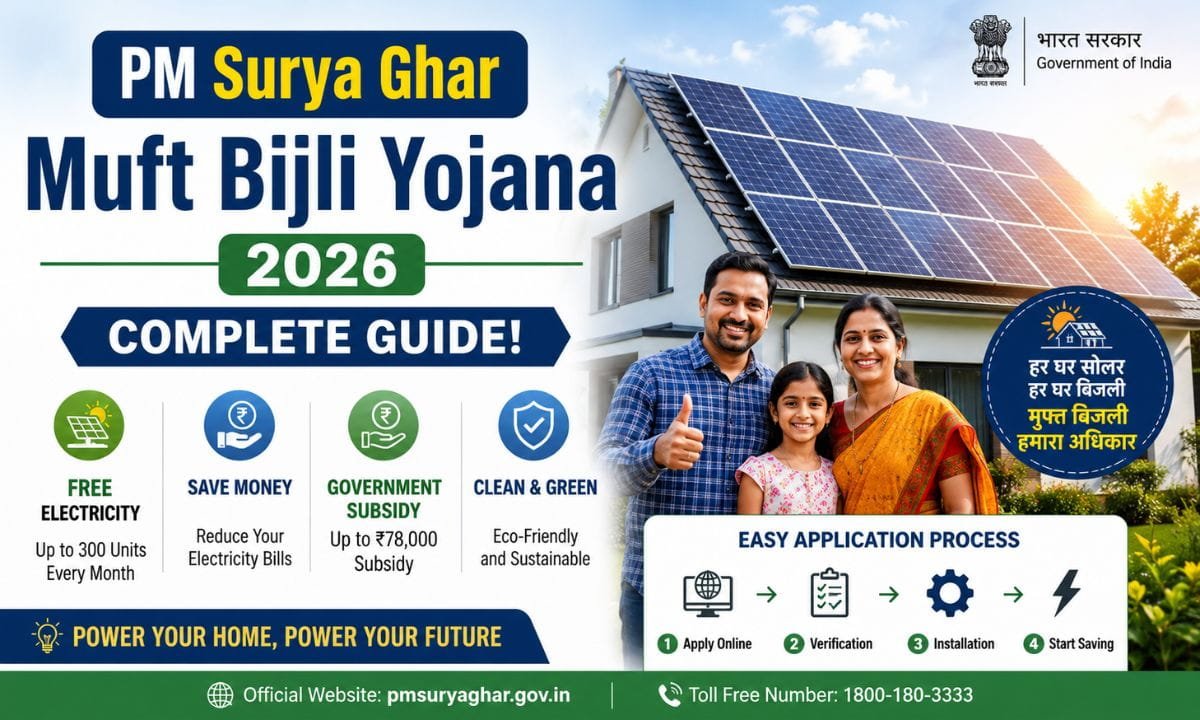
PM Surya Ghar Muft Bijli Yojana 2026: Electricity bills have long been one of the more predictable, recurring burdens on Indian households, rising steadily each year as tariffs increase and consumption grows alongside better living standards. In February 2024, the Government of India launched a scheme aimed directly at breaking this cycle for millions of families: PM Surya Ghar Muft Bijli Yojana, which translates loosely as the “Prime Minister’s Solar Home Free Electricity Scheme.” Announced by Prime Minister Narendra Modi on 13 February 2024, it has since grown into what is widely described as India’s largest residential rooftop solar programme, and by 2026 it has become one of the most talked-about government schemes in the renewable energy space.
The PM Surya Ghar Muft Bijli Yojana basic promise is straightforward: help households install rooftop solar panels, offset a meaningful share of the installation cost through a direct government subsidy, and let families generate enough of their own electricity to reduce, and in many cases eliminate, their monthly power bills. Behind this simple pitch sits a fairly detailed system involving state electricity distribution companies, empanelled vendors, net metering infrastructure, and a national digital portal that coordinates the entire journey from application to subsidy disbursement.
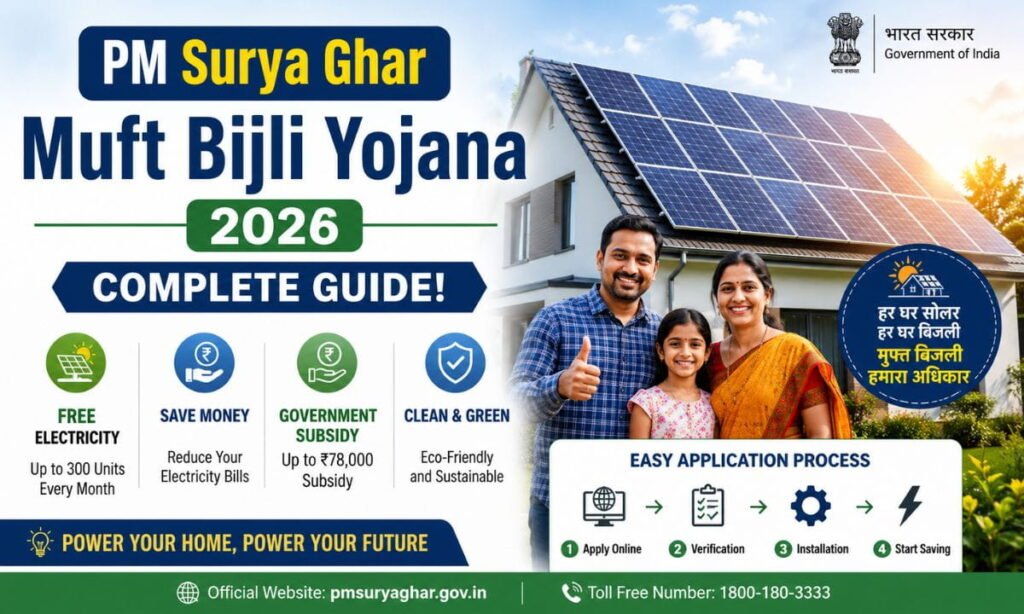
PM Surya Ghar Muft Bijli Yojana – Overview
As the PM Surya Ghar Muft Bijli Yojana moves through its third full year of implementation in 2026, awareness has grown, application processing has become faster and more reliable than in the scheme’s early months, and millions of households across the country have already completed installations. This PM Surya Ghar Muft Bijli Yojana guide covers everything a prospective applicant needs to understand: what the scheme offers, who is eligible, how much subsidy is available, the full step-by-step application process, common pitfalls, and how the scheme fits into India’s broader clean energy goals.
Rooftop solar has, for many years, been technically available to Indian households but financially out of reach for a large share of them. The upfront cost of panels, inverters, wiring, and installation labour has traditionally deterred all but the most committed early adopters, even though the underlying economics, generating free power from sunlight that would otherwise simply fall on an empty roof, have always made intuitive sense. What PM Surya Ghar Muft Bijli Yojana changes is not the underlying technology, which has existed and steadily improved for over a decade, but the financial calculus around it. By combining a meaningful upfront subsidy with access to concessional loans and a structured, DISCOM-backed net metering framework, the scheme brings the payback period for an average household down to a timeframe that makes the investment genuinely attractive rather than merely aspirational.
It is also worth situating the PM Surya Ghar Muft Bijli Yojana within India’s broader climate and energy security commitments. The government has repeatedly framed rooftop solar as a key pillar of its renewable energy strategy, alongside utility-scale solar parks, wind energy expansion, and green hydrogen initiatives. Unlike large, centralised power projects, rooftop solar under this scheme is inherently distributed: each installation sits on an individual home, feeding power directly into the local distribution grid at the point of consumption, which reduces transmission losses and adds resilience to the broader grid in a way that is difficult to replicate through large, centralised generation alone.
What Is PM Surya Ghar Muft Bijli Yojana?
PM Surya Ghar Muft Bijli Yojana, often abbreviated as PMSG-MBY and sometimes referred to informally as PM Suryoday Yojana, is a central government initiative administered by the Ministry of New and Renewable Energy, working in coordination with state-level electricity distribution companies, commonly known as DISCOMs. Launched on 13 February 2024, PM Surya Ghar Muft Bijli Yojana provides eligible homeowners with a direct subsidy of up to 78,000 rupees along with up to 300 units of free electricity per month, through installation of rooftop solar systems that appear on the Approved List of Models and Manufacturers, accessed via the official national portal.
The PM Surya Ghar Muft Bijli Yojana was designed with an ambitious scale in mind. It was launched with a target of reaching one crore, or ten million, households by March 2027, and provides a central subsidy of 30,000 rupees per kilowatt for the first two kilowatts of installed capacity, and 18,000 rupees per kilowatt for the third kilowatt, up to a maximum of 78,000 rupees, paid directly into the homeowner’s bank account after installation and grid commissioning is complete. The scheme carries a substantial financial commitment from the government as well; the total outlay allocated to the programme stands at 75,021 crore rupees.
Structurally, the scheme replaced an earlier initiative known as the Grid Connected Rooftop Solar Programme Phase II, consolidating rooftop solar support into a single, more streamlined national framework. It operates through one national portal at pmsuryaghar.gov.in, coordinated by the Ministry of New and Renewable Energy and implemented on the ground through state DISCOMs.
PM Surya Ghar Muft Bijli Yojana – Progress and Scale as of 2026
The scheme’s uptake has grown steadily since its launch, and government data through 2026 gives a sense of how far it has come. As of 30 May 2026, roughly 40 lakh households had been solarised under the scheme. Separately, other tracking as of a similar period placed the figure at over 32 lakh households, with the government having set a target of 35 lakh household installations specifically for the 2025-26 financial year. While exact figures vary slightly depending on the reporting date and source, the overall trend is unambiguous: adoption has been accelerating meaningfully through 2025 and into 2026.
State-level data also shows how adoption has spread geographically. According to figures reported by the Press Information Bureau in February 2026, Maharashtra, with close to 3.92 lakh installed systems, and Uttar Pradesh, with around 3.26 lakh systems, rank among the leading states by installation numbers.
The PM Surya Ghar Muft Bijli Yojana early months were not without friction. According to more recent assessments of the programme’s evolution, the initial launch encountered several bottlenecks, including an overloaded application portal, DISCOM inspection backlogs stretching for months, and thousands of applicants who waited nearly a year for their subsidy to be processed. However, the situation has improved considerably since then. As of April 2026, the national portal is described as stable, with real-time application tracking now functional, and the Ministry of New and Renewable Energy has begun issuing performance notices to states whose processing has remained consistently slow. For prospective applicants who may have looked into the scheme a year or two ago and held back due to reports of delays, the practical reality in 2026 is meaningfully better than it was at launch.
Falling solar equipment prices have also improved the PM Surya Ghar Muft Bijli Yojana economics for households. The combination of lower per-kilowatt equipment costs and the available subsidy now makes payback periods of roughly four to six years achievable across most North Indian cities, a notable improvement compared to the payback timelines households faced when the scheme first launched.
PM Surya Ghar Muft Bijli Yojana Subsidy Structure: How Much You Can Get?
The subsidy under PM Surya Ghar Muft Bijli Yojana is structured in slabs based on system capacity, rather than as a flat percentage of cost, though it is often described in percentage terms as well. For a system of up to 2 kilowatts, the subsidy works out to 30,000 rupees per kilowatt, which can amount to up to 60 percent of the installation cost at that capacity. For the portion of a system between 2 and 3 kilowatts, the subsidy rate steps down to 18,000 rupees per kilowatt, covering up to 40 percent of the additional cost in that band. Combining these two slabs, the maximum subsidy available under the scheme is 78,000 rupees, applicable to systems of 3 kilowatts capacity or larger.
It is important for applicants to understand that this cap does not scale upward with larger systems. The central subsidy is capped at 78,000 rupees for systems up to 3 kilowatts, regardless of the actual system size installed; a 5 kilowatt or 10 kilowatt system does not receive a proportionally larger subsidy. Practical guidance from industry sources consistently advises households to size their solar system based on their actual electricity consumption pattern, rather than attempting to maximise the subsidy amount alone, since installing unnecessary additional capacity beyond the 3 kilowatt threshold does not bring any extra government subsidy.
Some categories of applicants may be eligible for enhanced PM Surya Ghar Muft Bijli Yojana subsidy amounts. According to more recent reporting, special category states, which typically include the North Eastern states and hill states, can receive subsidies of up to 1,17,000 rupees, reflecting the higher cost of installation and the government’s broader push to extend renewable energy access to these regions.
Beyond the central subsidy, several state governments run their own supplementary schemes that add further financial support on top of the central amount. States including Uttar Pradesh, Bihar, and Rajasthan have been noted as running additional state-level top-up subsidies, which means the effective, all-in subsidy available to a household can be higher than the central figure alone, depending on the state in which the applicant resides. Given that state top-up schemes and their terms can change, applicants are advised to check their specific state’s current top-up provisions on the relevant state renewable energy department portal alongside the central pmsuryaghar.gov.in portal.
It is also worth clarifying how the subsidy is actually paid out. The subsidy is not applied as an upfront discount at the time of purchase or installation. Rather, it is disbursed after the system has been installed, inspected, and commissioned by the local DISCOM, at which point the amount is credited directly to the beneficiary’s bank account, generally within thirty days once the bank details and a cancelled cheque are submitted following receipt of the commissioning certificate. This means households need to be prepared to cover the full upfront cost of installation, whether through savings or a loan, and then receive the subsidy as a reimbursement after the process is complete.
Free Electricity: The “Muft Bijli” Component
The PM Surya Ghar Muft Bijli Yojana name promises free electricity, and this benefit flows from how a correctly sized rooftop solar system interacts with a household’s actual power consumption. The scheme’s central promise is to help families install rooftop solar systems that generate their own power and, in doing so, receive up to 300 units of free electricity every month once the system is fully live. For an average Indian household, whose monthly consumption often falls in a broadly similar range, this level of self-generated power can be enough to bring the monthly electricity bill down to zero, or very close to it, depending on how closely the installed capacity matches actual usage patterns.
This PM Surya Ghar Muft Bijli Yojana benefit is closely tied to the mechanism of net metering. Under net metering, any solar power generated during the day that exceeds what the household is consuming at that moment is exported to the DISCOM’s grid rather than being wasted. The surplus energy contributed to the grid is effectively sold to the electricity distribution company, and this exported power is credited against the household’s consumption from the grid at other times, such as during the evening or at night when solar generation is not available. This two-way flow, generation during sunlight hours and grid draw at other times, is what allows a correctly sized system to meaningfully offset, or in many cases fully cover, a household’s total monthly electricity bill.
PM Surya Ghar Muft Bijli Yojana Eligibility Criteria
Eligibility for PM Surya Ghar Muft Bijli Yojana is centred on residential electricity consumers, and the criteria are relatively accessible compared to many other government schemes.
- The applicant must be an Indian citizen and must hold a residential electricity connection; the PM Surya Ghar Muft Bijli Yojana is not open to commercial or industrial consumers. To qualify, the applicant must be an Indian residential consumer, the property must have a suitable rooftop available for solar installation, the household must hold a valid electricity connection, the system must be installed through a registered solar vendor empanelled under the scheme, and the completed system must be connected through net metering; commercial and industrial consumers are explicitly not eligible for this particular subsidy.
- On the technical side, sanctioned load also matters. The customer generally needs a residential connection with a sanctioned load of 10 kilowatts or below to qualify under the scheme’s standard framework.
- There is also an important one-time restriction tied to each electricity account. The subsidy can be claimed only once per electricity consumer number, and this entitlement does not reset if the property changes ownership, meaning a new owner of a property that has already claimed the subsidy under its existing consumer number generally cannot claim it again for the same connection.
- All equipment used in the installation must meet specific quality standards. Systems must use solar panels and inverters that appear on the Ministry of New and Renewable Energy’s Approved List of Models and Manufacturers, commonly referred to as the ALMM list.
- This requirement exists to ensure that subsidised installations use equipment of verified quality and origin, and failing to use ALMM-listed components is one of the most common reasons applications encounter problems or have their subsidy claims rejected or delayed.
Documents Required for PM Surya Ghar Muft Bijli Yojana
Applicants should prepare a set of standard documents before beginning the PM Surya Ghar Muft Bijli Yojana application process. These typically include a valid electricity bill or connection details establishing the applicant’s existing consumer number and DISCOM, an Aadhaar card for identity verification, since the subsidy is disbursed via Aadhaar-linked direct benefit transfer, bank account details along with a cancelled cheque to enable subsidy disbursement, proof of property ownership or residence establishing the applicant’s connection to the installation address, and a passport-size photograph where required during registration.
Following the technical feasibility approval stage, additional documents related to the specific installation are typically required, including the solar system design, a single line diagram of the electrical connection, inverter specifications, and certification from the installer confirming the system meets applicable technical standards. These are usually compiled and submitted by the empanelled vendor on behalf of the household as part of the DISCOM approval process, rather than being something the homeowner needs to prepare independently from scratch.
PM Surya Ghar Muft Bijli Yojana 2026 – Step-by-Step Application Process
The application process for PM Surya Ghar Muft Bijli Yojana runs almost entirely online through the national portal, though it involves several distinct stages spanning registration, DISCOM technical approval, physical installation, and final subsidy disbursement.
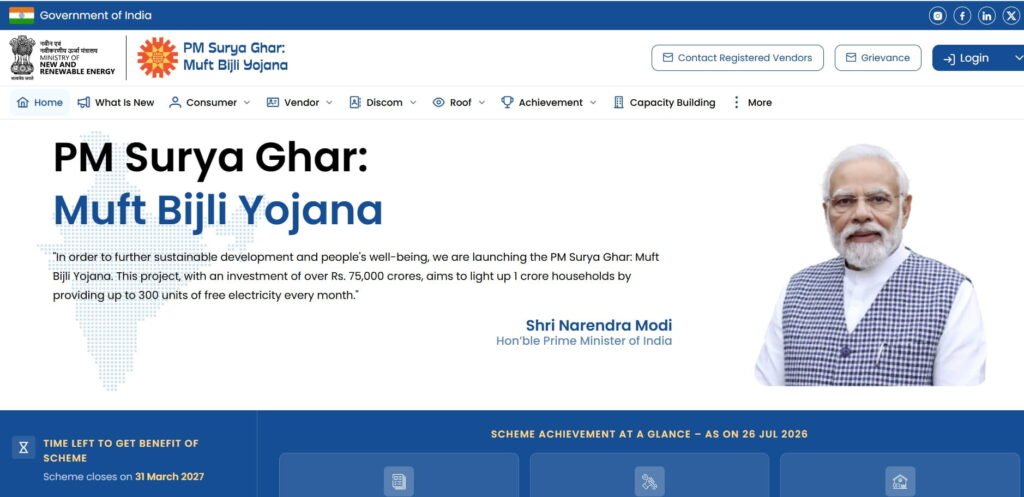
- The first step is visiting the official portal at pmsuryaghar.gov.in and selecting the consumer registration option. On the portal, the applicant selects their state and their specific electricity distribution company, since DISCOM jurisdiction determines which local office will process the technical feasibility review.
- The second step involves entering the applicant’s electricity consumer number, mobile number, and email address, following the on-screen PM Surya Ghar Muft Bijli Yojana registration instructions. Once these details are submitted, the applicant completes verification through a One-Time Password, or OTP, sent to the registered mobile number.
- The third step is logging back into the portal using the registered mobile number and consumer number, and navigating to the rooftop solar application section on the applicant’s dashboard.
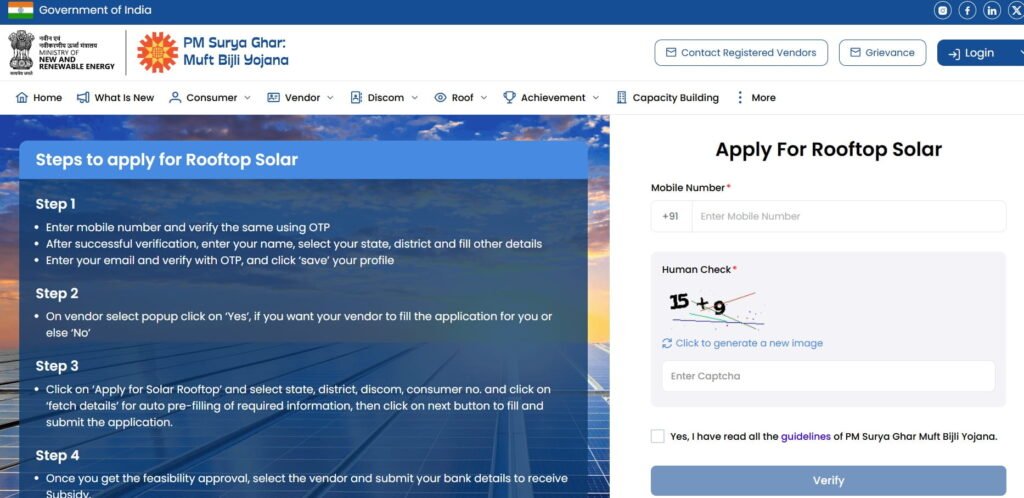
- The fourth step involves filling out the actual application for the rooftop solar installation, entering details such as the property address, existing electricity connection information, and the proposed capacity of the solar system the household wishes to install. Applicants should verify these details carefully before submission, since inaccuracies at this stage can cause delays later in the process.
- The fifth step is submission of the application, after which the relevant DISCOM reviews the request and conducts a technical feasibility assessment. This step checks whether the rooftop is structurally and technically suitable for solar installation and whether net metering is feasible for that particular grid location. DISCOM feasibility approval generally takes anywhere from seven to thirty days, depending on the state and how quickly submitted documents can be verified, and may take longer in cases requiring an additional site inspection or correction of submitted details.
- Once feasibility approval is granted, the sixth step is selecting a vendor from the list of DISCOM-registered, MNRE-empanelled installers available through the portal. Choosing a vendor properly registered under the scheme is essential, since installations carried out by unregistered vendors, or using equipment not on the ALMM list, are not eligible for the subsidy.
- The seventh step is the actual physical installation of the rooftop solar system by the chosen vendor, in line with the approved technical specifications.
- The eighth step, following completion of installation, is uploading the installation and plant details to the portal and formally applying for the net meter. A net meter is essential because it separately measures both the electricity drawn from the grid and the surplus electricity exported back to the grid, forming the basis for calculating the household’s net electricity consumption and, by extension, its final bill.
- The ninth step involves a physical inspection by DISCOM officials to verify that the installation and the net meter have been set up correctly and meet all applicable technical and safety standards.
- The tenth and final step, once the inspection is cleared, is receipt of a commissioning certificate confirming the system is officially operational. At this stage, the applicant submits bank account details along with a cancelled cheque through the portal, after which the subsidy amount is credited directly into the applicant’s bank account, typically within around thirty days.
Throughout this process, applicants can track the real-time status of their PM Surya Ghar Muft Bijli Yojana application on the portal, and, as noted earlier, this tracking functionality has become considerably more reliable through 2026 compared to the PM Surya Ghar Muft Bijli Yojana early implementation period.
Loan Options for Financing the Upfront Cost
Since the subsidy is disbursed only after installation and commissioning are complete, households need a way to fund the upfront cost of the system in the meantime. To support this, the scheme is designed to work alongside concessional loan facilities offered by participating banks. Beneficiaries under the scheme are eligible for bank loans at concessional rates, and a national online portal has been created to promote the scheme at the grassroots level, with urban local bodies and panchayats encouraged to promote rooftop solar adoption in their areas.
Several major public sector banks participate in offering these solar-linked loan products. According to recent reporting, low-interest solar loans are available through banks such as the State Bank of India, at rates around 7.25 percent, alongside similar offerings from other public sector lenders including Punjab National Bank and Canara Bank. These loans are typically structured specifically for rooftop solar financing and can help bridge the gap between the upfront installation cost and the eventual subsidy reimbursement, allowing households to spread the net cost of the system over a repayment period rather than paying the full amount at once.
Common Mistakes to Avoid
Given the multi-stage nature of the application process, a number of avoidable errors tend to cause delays or, in some cases, disqualification from the subsidy.
- One frequent issue involves equipment choice. Installers sometimes use cheaper panels or inverters that are not on the ALMM list in order to reduce their own costs, which can jeopardise the household’s subsidy eligibility entirely. Applicants are generally advised to confirm ALMM listing status independently rather than relying solely on the vendor’s assurance, and to specifically request tier-one panel brands and check the itemised invoice for equipment details.
- Incomplete or unclear documentation is another common source of delay. Missing documents, or scanned copies that are difficult to read, can hold up subsidy processing by weeks or months, so applicants are encouraged to prepare a complete, organised set of clear digital scans of all required documents before beginning the online application.
- Applications can also stall at the DISCOM approval stage simply due to processing backlogs or administrative oversight. Given this, it is worth proactively tracking application status on the portal and following up with the DISCOM roughly every week if a stage appears to be taking unusually long, rather than assuming the process will move forward automatically without any prompting.
- Net metering agreements are sometimes signed without being read carefully, which can lead to confusion later about billing calculations, rights, and obligations under the arrangement. Reviewing this agreement in detail before signing is a small step that can prevent misunderstandings once the system is operational.
- Finally, warranty documentation is occasionally overlooked at the point of installation. It is advisable to obtain, in writing, both the panel manufacturer’s warranty, which commonly runs around 25 years, and a separate installer’s workmanship warranty, commonly around 5 years, since verbal assurances offer little protection if an installer becomes unresponsive after completing the work.
Environmental and Long-Term Financial Benefits
Beyond the immediate reduction in monthly electricity bills, the scheme carries broader benefits that extend across the roughly 25-year operational lifespan typical of a well-maintained rooftop solar system. Households that install solar under the scheme gain a degree of protection against future electricity tariff hikes, since a meaningful share of their consumption is met through self-generated power rather than grid electricity purchased at prevailing rates. Over a multi-decade horizon, this can translate into substantial cumulative savings compared to a household that continues to rely entirely on grid power.
From a national perspective, the scheme also contributes to India’s broader clean energy and emissions targets, supporting the shift toward renewable sources of electricity generation at the household level, which collectively adds up to a meaningful share of distributed generation capacity when aggregated across millions of homes. The scheme’s one crore household target, if achieved, would represent one of the largest distributed rooftop solar deployments undertaken anywhere in the world.
For individual households, the combination of a substantial upfront subsidy, access to concessional financing, falling equipment costs, and the prospect of a near-zero electricity bill for years to come makes the financial case for participating in the scheme considerably stronger in 2026 than it may have appeared at the scheme’s launch, when equipment costs were higher and processing infrastructure was still being built out.
Getting Help and Support
For applicants who run into difficulties at any stage of the process, or who have general questions about the scheme, a toll-free helpline is available at 15555 to resolve queries relating to the rooftop solar scheme. Beyond the official helpline, many state DISCOMs also maintain their own local support channels, and empanelled vendors are generally expected to assist households through the technical stages of the application, including feasibility submission and net metering documentation, as part of their standard installation service.
Given how many independent websites, informational portals, and third-party service providers have emerged around the scheme, applicants should take care to distinguish between the official government portal, pmsuryaghar.gov.in, and unofficial third-party sites, some of which may offer paid assistance or awareness services. While such third-party support is not necessarily illegitimate, the core application, subsidy tracking, and disbursement process itself is designed to be completed free of any government fee directly through the official portal, and applicants should verify any request for payment carefully before proceeding.
PM Surya Ghar Muft Bijli Yojana – Conclusion
PM Surya Ghar Muft Bijli Yojana has evolved considerably since its launch in February 2024, moving from an ambitious but operationally strained early rollout into a considerably more mature, streamlined programme by 2026, with millions of households already benefiting from installed systems and a national portal that now offers real-time application tracking. With a central subsidy of up to 78,000 rupees, the possibility of higher amounts in special category states, additional state-level top-ups in several regions, concessional bank financing, and the prospect of up to 300 units of free electricity a month once a system is fully commissioned, the scheme represents one of the more substantial financial incentives currently available to Indian households considering a shift to solar power.
Prospective applicants are encouraged to begin by registering on the official portal at pmsuryaghar.gov.in, selecting their correct DISCOM, and carefully working through the feasibility, vendor selection, installation, and net metering stages in sequence, while insisting on ALMM-listed equipment and complete documentation at every step. Given that subsidy slabs, state top-up availability, and procedural details can be updated periodically by the government, applicants should confirm the latest figures and requirements directly on the official portal, or through their local DISCOM, before finalising their installation plans.
Households weighing whether now is the right time to apply should also factor in a few practical realities that have become clearer as the scheme has matured. Processing timelines, while still variable across states, have generally improved compared to the scheme’s first year, meaning applicants today are less likely to face the extended waits that characterised the early rollout. Equipment costs have continued to trend downward as manufacturing scale has increased, which, combined with the fixed subsidy amounts, has effectively improved the value proposition over time even without any change to the subsidy slabs themselves. And with concessional loan products now more widely available from major public sector banks, the upfront cash requirement that once made solar installation feel out of reach for many middle-income households has become considerably more manageable.
At the same time, prospective applicants should go in with realistic expectations about the process. This is not an instant, one-click subsidy; it involves genuine coordination between the homeowner, an empanelled vendor, and the local DISCOM across multiple stages, and attentiveness at each step, particularly around equipment quality and documentation, meaningfully affects how smoothly the process goes. Households that approach the scheme with a clear sense of their actual electricity consumption, a properly sized system request rather than an oversized one aimed at maximising subsidy, and a willingness to follow up on their application status periodically, tend to have the smoothest path from initial registration to a fully commissioned, subsidy-credited rooftop solar system.
Official Sources
| PM Surya Ghar Muft Bijli Yojana Apply Online | CLICK HERE |
PM Surya Ghar Muft Bijli Yojana – FAQ’s
What is the Pradhan Mantri Surya Ghar Muft Bijli Yojana?
The PM Surya Ghar Muft Bijli Yojana is a Government of India scheme that promotes rooftop solar installations for households. Eligible beneficiaries receive Central Financial Assistance (subsidy) to install rooftop solar systems, helping to reduce electricity bills and generate clean energy.
Who can apply for this scheme?
You can apply if you:
Are an Indian citizen.
Own a house with a suitable roof.
Have a valid electricity connection.
Have not previously received a rooftop solar subsidy for the same installation.
How much subsidy is provided under this scheme?
The Central Government provides a subsidy based on the capacity of the rooftop solar system:
1 kW: Up to ₹30,000
2 kW: Up to ₹60,000
3 kW or higher: Up to ₹78,000 (maximum central subsidy)
How can I apply for the PM Surya Ghar Muft Bijli Yojana?
Visit the official PM Surya Ghar portal, register using your electricity consumer details, apply for feasibility approval, select a registered vendor, complete the installation, and then submit a subsidy claim after inspection and commissioning.
Can I install a system larger than 3 kW?
Yes. You can install a system larger than 3 kW if your electricity consumption requires it. However, the central subsidy is capped at ₹78,000, which is equivalent to the subsidy for a 3 kW system.
Can I sell the excess electricity generated by my solar panels?
Yes. Under the net metering regulations applicable in your state or with your distribution company (DISCOM), the excess electricity generated by your rooftop solar system can generally be fed into the grid, subject to local regulations and approvals.