Ayushman Bharat Card 2026: Healthcare costs in India have long been a major source of financial stress for lower and middle-income families. A single hospital admission, especially one involving surgery, ICU care, or a prolonged illness, can wipe out years of savings for an average household. To address this challenge, the Government of India launched the Ayushman Bharat Pradhan Mantri Jan Arogya Yojana (AB PM-JAY) in September 2018, positioning it as the world’s largest government-funded health assurance scheme.
In 2026, the scheme continues to expand its reach, simplify its digital processes, and widen its eligibility net. Millions of new beneficiaries are being added every month, senior citizens above 70 years now enjoy a dedicated top-up cover, and the entire application and card-download process has become almost entirely paperless. This article is a complete, in-depth guide to the Ayushman Bharat Card in 2026 — covering what it is, who is eligible, how to apply online, the documents required, the benefits it offers, its limitations, and much more.
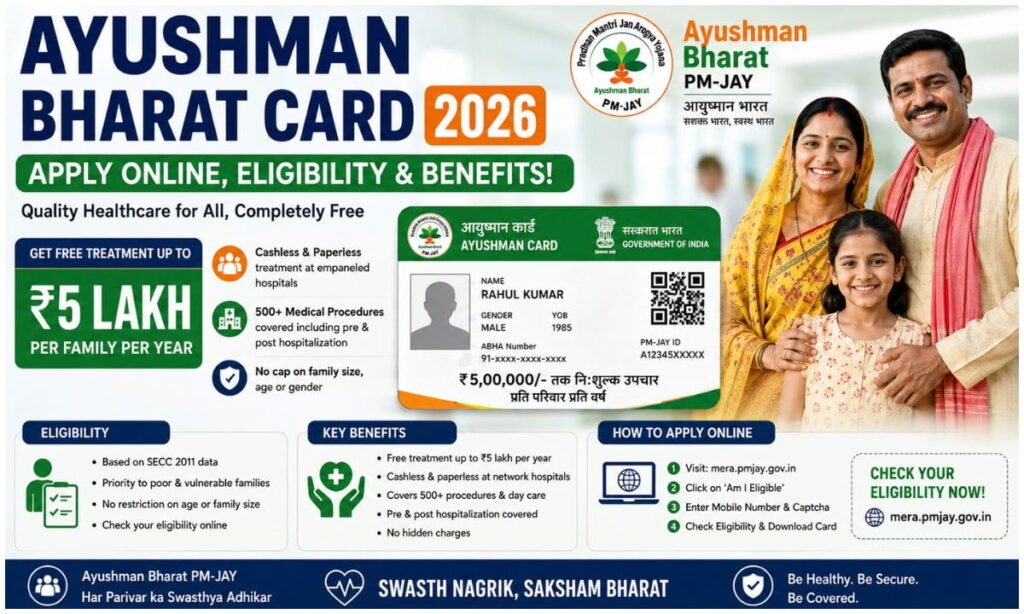
What Is the Ayushman Bharat Card ?
The Ayushman Bharat Card, also known as the PM-JAY Card or Ayushman Card, is an identity document issued to beneficiaries of the Ayushman Bharat Pradhan Mantri Jan Arogya Yojana. It acts as proof that the cardholder is entitled to cashless and paperless hospitalisation benefits at empanelled government and private hospitals across India.
The Ayushman Bharat Card is run by the National Health Authority (NHA), which functions under the Ministry of Health and Family Welfare. Under this Ayushman Bharat Card, every eligible family receives health cover of up to ₹5 lakh per year, which can be used for a wide range of secondary and tertiary medical treatments. The scheme does not require the family to pay any premium; both the central and respective state governments jointly fund the cost of the Ayushman Bharat Card.
Unlike a private health insurance policy, PM-JAY does not involve underwriting, medical tests, or waiting periods for most conditions. Pre-existing diseases are covered from day one, which is a significant advantage compared to typical private insurance products, where such conditions are often excluded for two to four years. The Ayushman Bharat Card is closely linked with the Ayushman Bharat Health Account (ABHA), a 14-digit unique health ID that digitises a person’s medical records, prescriptions, and diagnostic reports, allowing doctors at any empanelled hospital to access a patient’s medical history instantly.
Why the Ayushman Bharat Card Scheme Matters in 2026?
Since its launch, more than 43.5 crore Ayushman Bharat Card have been generated across the country, and the network of empanelled hospitals has crossed 36,000 institutions, spanning both public and private facilities. As of 2026, the scheme is operational in all states and union territories, with West Bengal being the most recent addition to fully integrate with the central scheme alongside its own state-run Swasthya Sathi programme.
Several developments make 2026 a particularly important year for the scheme:
- Expanded senior citizen coverage: Since September 2024, every Indian citizen aged 70 years and above is eligible for an additional ₹5 lakh cover annually, regardless of income, existing insurance, or whether their family already holds a PM-JAY card.
- Faster digital enrolment: New face-authentication technology under the “Aapke Dwar Ayushman” campaign allows a person to complete e-KYC simply by taking a selfie that is matched against their Aadhaar photograph, cutting down enrolment time from weeks to minutes.
- Ration card-based fast-track approval: In states such as Bihar and Uttar Pradesh, having your name listed on the family ration card is now often sufficient to get the card issued within 24 hours.
- Broader hospital network and package list: The scheme now covers 1,953 medical and surgical packages under the NHA’s Health Benefit Package (HBP 2.2) list, spanning nearly 24 medical specialities.
Who Is Eligible for the Ayushman Bharat Card?
Eligibility under PM-JAY is one of the most misunderstood aspects of the scheme because, unlike most government welfare programmes, it is not primarily determined by current income. Instead, most beneficiaries are identified through the Socio-Economic Caste Census (SECC) 2011 database, which recorded deprivation and occupational indicators of households across India. Over time, many states have also expanded this list using their own ration card and welfare databases, and the senior citizen category has been made universal regardless of any census data.
Broadly, PM-JAY eligibility can be understood under four categories: rural households, urban households, senior citizens aged 70 and above, and state-specific expansions.
Rural Eligibility Criteria
In rural areas, a household is automatically considered eligible if it meets at least one of six deprivation criteria used in the SECC 2011 survey. These are:
- D1: The household lives in a single room with kutcha (makeshift or non-durable) walls and a kutcha roof.
- D2: The household has no adult member between the ages of 16 and 59 years.
- D3: The household is female-headed, with no adult male member between the ages of 16 and 59 years.
- D4: The household has a disabled member and no able-bodied adult member to support the family.
- D5: The household belongs to a Scheduled Caste (SC) or Scheduled Tribe (ST) community.
- D7: The household is landless and derives its primary income from manual, casual labour.
In addition to these deprivation criteria, certain categories of rural households are automatically included regardless of the above conditions. These include:
- Destitute families or those living on alms
- Families of manual scavengers
- Families of bonded or released labourers
- Primitive and particularly vulnerable tribal groups (PVTGs)
Urban Eligibility Criteria
Unlike rural areas, urban eligibility is based on a list of eleven pre-defined occupational categories rather than housing or demographic deprivation. A household qualifies if its primary earning member works in one of the following occupations:
- Rag pickers
- Beggars
- Domestic workers
- Street vendors, cobblers, hawkers, and other service providers working on the street
- Construction workers, plumbers, masons, labourers, painters, welders, security guards, and other head-load workers
- Sweepers, sanitation workers, and gardeners
- Home-based artisans and handicraft workers, tailors
- Transport workers such as drivers, conductors, helpers, cart pullers, and rickshaw pullers
- Shop workers, assistants, peons in small establishments, delivery assistants, waiters
- Electricians, mechanics, assemblers, and repair workers
- Washer-men and chowkidars
If your household’s primary income earner works in any of these occupational categories, you are generally eligible for a PM-JAY card, subject to verification against the relevant database.
Senior Citizens Aged 70 and Above
One of the most important updates to the scheme is the introduction of the Vaya Vandana expansion. Since 11 September 2024, every Indian citizen aged 70 years or older is entitled to health coverage under PM-JAY, irrespective of their income, social category, or whether they are already covered under another government or private health insurance scheme.
Key points about senior citizen eligibility:
- This benefit is non-means-tested, meaning wealth or income does not disqualify a senior citizen.
- Seniors who are part of a family already covered under the standard PM-JAY scheme receive an additional, separate top-up cover of ₹5 lakh per year, exclusively for themselves, over and above the family’s existing ₹5 lakh limit.
- Even individuals already covered under schemes like the Central Government Health Scheme (CGHS), Ex-Servicemen Contributory Health Scheme (ECHS), or private health insurance can choose to opt for this additional Ayushman Bharat cover.
- A dedicated card, sometimes referred to informally as the “senior citizen Ayushman card,” is issued separately for this category.
State-Specific Expansions
States have the flexibility to broaden the SECC 2011-based eligibility list using other databases, most commonly the National Food Security Act (NFSA) ration card database and state-specific welfare beneficiary lists. This means that individuals or families who were missed during the original 2011 census can still become eligible if they fall under a state-approved beneficiary category or hold a valid ration card that the state has linked to the scheme.
For example, in Uttar Pradesh and Bihar, ration card holders are being fast-tracked for card issuance without needing to prove SECC deprivation status separately. West Bengal operates a slightly different, dual-track model. While the state runs its own Swasthya Sathi health scheme for state residents, eligible central beneficiaries can still apply for the standard Ayushman Bharat Card to access nationwide portability of benefits — meaning they can use their card at empanelled hospitals in other states as well.
How to Check If You Are Eligible for Ayushman Bharat Card?
Since PM-JAY does not use an “apply first, then get approved” model in the traditional sense, checking your Ayushman Bharat Card eligibility status is usually the first step before generating a card. You can check eligibility through any of the following channels:
- The official PM-JAY beneficiary portal (beneficiary.nha.gov.in)
- The Ayushman Bharat mobile app
- The UMANG app
- Common Service Centres (CSCs)
- Empanelled government hospitals, through an on-site “Arogya Mitra” kiosk operator
- The PM-JAY toll-free helpline
To check Ayushman Bharat Card eligibility online, you typically need to enter your mobile number, receive an OTP, and then search using your name, ration card number, or Aadhaar-linked household details for your state.
Documents Required for Ayushman Bharat Card Application
While the online enrolment process for the standard Ayushman Bharat Card has been simplified so that Aadhaar-based e-KYC alone may be sufficient in many cases, it is advisable to keep the following documents ready, as some states or categories may require additional proof:
- Aadhaar Card – Mandatory for e-KYC and identity verification.
- Ration Card – Used as proof of eligibility in many states, especially where SECC data is being supplemented with NFSA databases.
- Registered Mobile Number – Required for OTP verification during the application and download process.
- Passport-size Photograph – Sometimes required for physical card printing or CSC-based applications.
- Income Certificate (in specific state-expanded schemes) – Not required for standard SECC-based eligibility, but may be requested under some state government top-up programmes.
- Additional ID Proofs – Documents such as an e-Shram card, labour card, disability certificate, caste certificate (for SC/ST categories), or PMJAY eligibility letter sent by the government can support the application, especially for urban occupational categories.
- Proof of Age – For senior citizens applying under the 70+ category, any valid age proof document (Aadhaar, voter ID, PAN card, or birth certificate) is generally accepted.
- Proof of Residence – Some state-specific schemes may require a domicile certificate in addition to the standard documents.
It is worth noting that for most beneficiaries whose names already appear in the SECC 2011 database or an approved state list, the entire process can be completed using just Aadhaar and a registered mobile number.
How to Apply for the Ayushman Bharat Card Online in 2026?
The application and Ayushman Bharat Card-generation process has become almost entirely digital. Below is a detailed, step-by-step explanation of how to apply through the primary online channels.
Step 1: Visit the Official Beneficiary Portal
Open a web browser on your mobile phone or computer and navigate to the official PM-JAY beneficiary portal at beneficiary.nha.gov.in. This is the National Health Authority’s dedicated platform for checking eligibility, applying, and downloading the Ayushman Card.
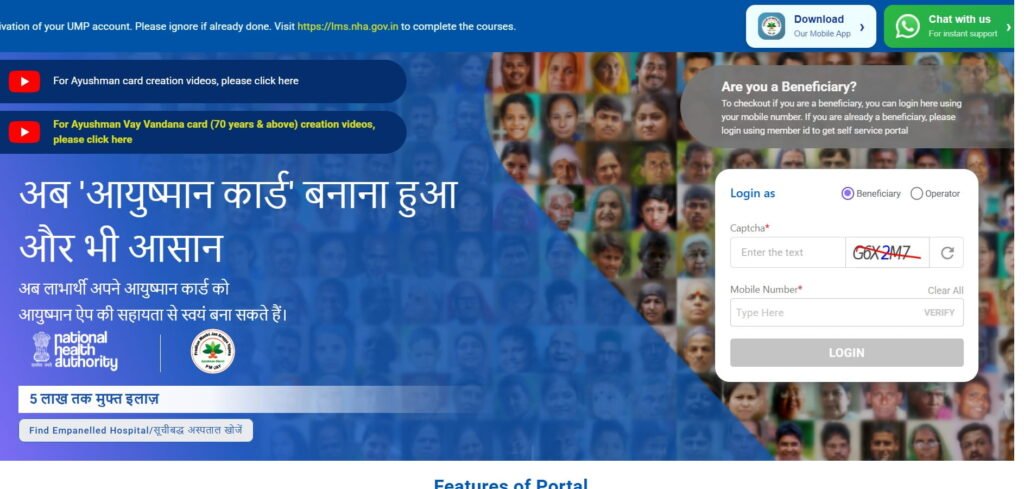
Step 2: Login Using Your Mobile Number
On the homepage, select the “Beneficiary” login option. Enter your registered mobile number and the captcha code shown on the screen, then request an OTP. Enter the OTP received on your phone to log in securely.
Step 3: Search for Your Eligibility
Once logged in, select your state and choose a search method — this can be done using your Aadhaar number, ration card number, mobile number, name, or family ID, depending on what information is available and what your state supports. The portal will then display whether your household is listed as an eligible PM-JAY beneficiary.
Step 4: Complete e-KYC Verification
If your name appears in the eligible list, you will be prompted to complete e-KYC. This can be done in a few ways:
- Aadhaar OTP-based verification – An OTP is sent to your Aadhaar-linked mobile number for authentication.
- Fingerprint or iris-based biometric verification – Available at CSCs and hospital kiosks using biometric devices.
- Face authentication – Under the newer “Aapke Dwar Ayushman” initiative, applicants can complete verification simply by taking a live photograph through their phone’s camera, which is matched against the Aadhaar database photograph. This method has significantly reduced processing time.
Step 5: Fill in Additional Details
You may need to confirm or update basic details such as your name, date of birth, gender, address, and family details as recorded in the government database. Any mismatches between your Aadhaar details and the SECC/ration card data may need to be corrected at this stage.
Step 6: Card Approval and Generation
Once your identity is verified and your details are confirmed, your application moves to the approval stage. In most cases today, approval is instantaneous or completed within a few hours. For cases requiring manual verification (such as first-time inclusions through state ration card databases), approval can take up to 24 hours in fast-track states, though it may occasionally take longer depending on the volume of applications and the verification method used.
Step 7: Download Your Ayushman Bharat Card
Once approved, you can download your Ayushman Bharat Card directly in PDF format through any of these three channels:
- The PM-JAY beneficiary portal (beneficiary.nha.gov.in)
- The Ayushman Bharat mobile application
- The UMANG (Unified Mobile Application for New-age Governance) app
To download the card, simply log in using your Aadhaar number or registered mobile number, verify with an OTP, and select the “Download Card” option. The card generated will contain your photograph, a unique PM-JAY ID, and a QR code that hospitals use to instantly verify your eligibility.
Applying Through a Common Service Centre (CSC)
For individuals who are not comfortable with the online process or lack consistent internet access, applying through a nearby Common Service Centre remains a reliable offline alternative. At a CSC, a Village Level Entrepreneur (VLE) will:
- Verify your eligibility using your Aadhaar and ration card details.
- Complete biometric or OTP-based e-KYC on your behalf.
- Capture your photograph if required.
- Submit the application and generate the card once approved.
A small facilitation fee may be charged by some CSCs for printing the physical card, although the digital PDF download itself is free of cost.
Applying at an Empanelled Government Hospital
Most government hospitals and many empanelled private hospitals have an “Arogya Mitra” help desk. If you are unsure of your eligibility or need urgent assistance (for example, at the time of hospital admission), you can approach this desk with your Aadhaar card and ration card. The Arogya Mitra will check your eligibility on the spot and, if eligible, help generate your card so that you can proceed with cashless treatment.
The Ayushman Bharat Health Account (ABHA)
Alongside the PM-JAY card, the government strongly encourages every citizen — not just PM-JAY beneficiaries — to create an Ayushman Bharat Health Account (ABHA). This is a voluntary 14-digit health ID that acts as a centralised digital health record locker.
Benefits of linking your Ayushman Card with an ABHA ID include:
- Doctors at empanelled hospitals can instantly access your past prescriptions, diagnostic reports, discharge summaries, and treatment history.
- It significantly speeds up diagnosis and reduces the risk of medical errors, especially during emergencies when a patient cannot communicate their medical history.
- It reduces duplication of tests, since previous reports are already available digitally.
- It supports better continuity of care when a patient moves between different hospitals or cities.
You can create an ABHA ID for free through the ABHA mobile app, the official ABHA website, or during registration at any participating hospital, using either your Aadhaar number or your mobile number for verification.
Benefits of the Ayushman Bharat Card
The Ayushman Bharat Card is one of the most comprehensive publicly funded health cover instruments available to Indian citizens. Its key benefits include:
Health Cover of Up to ₹5 Lakh Per Family Per Year
Every eligible family, regardless of its size, receives a floater cover of up to ₹5 lakh annually. This means the sum insured is shared across all members of the family rather than being allocated individually, and it resets at the start of each policy year.
Additional ₹5 Lakh Cover for Senior Citizens (70+)
As discussed earlier, citizens aged 70 and above receive a separate top-up cover of ₹5 lakh per year exclusively for themselves, in addition to any existing family cover.
Cashless and Paperless Treatment
Beneficiaries do not need to pay anything at the hospital counter for covered treatments, nor do they need to submit reimbursement claims later. The empanelled hospital settles the bill directly with the National Health Authority or the relevant state health agency.
Coverage for Pre-Existing Diseases from Day One
Unlike most private health insurance policies, which impose a waiting period of two to four years before covering pre-existing conditions, PM-JAY covers these conditions immediately from the very first day of enrolment.
Coverage Across the Country (Portability)
The scheme allows for national portability, meaning a beneficiary from one state can access treatment at any empanelled hospital in another state under the same card. This is particularly useful for migrant workers and their families.
No Age or Family Size Restrictions
All members of an eligible household — from newborns to the elderly — are covered under the family’s policy, with no cap on the number of family members or their ages (other than the separate senior citizen provision).
Pre- and Post-Hospitalisation Expenses Covered
The scheme covers related diagnostic tests and medicines up to three days before hospital admission and continues to cover follow-up care and medicines for fifteen days after discharge.
Wide Range of Medical and Surgical Packages
As of 2026, the scheme covers 1,953 pre-defined health benefit packages spanning close to 24 medical specialities, including general medicine, general surgery, cardiology and cardiothoracic surgery, neurosurgery, oncology, orthopaedics, urology, gynaecology, paediatrics, ophthalmology, ENT, plastic surgery, burns management, and mental health, among others.
Large and Growing Hospital Network
With more than 36,000 empanelled hospitals across public and private sectors, beneficiaries have considerable choice and accessibility, even in relatively remote areas.
No Premium Payment by Beneficiaries
The entire cost of the scheme is borne jointly by the central and state governments; the beneficiary does not pay any premium, membership fee, or renewal charge.
What Is Not Covered Under the Ayushman Bharat Card?
While the scheme is comprehensive, it does have certain exclusions that beneficiaries should be aware of so as to avoid confusion at the time of treatment:
- Outpatient Department (OPD) consultations are generally not covered; the scheme is primarily designed for hospitalisation-based (in-patient) treatment.
- Cosmetic surgeries that are not medically necessary are excluded.
- Fertility treatments, including IVF and related procedures, are not covered.
- Organ transplants are excluded in most cases, barring specific exceptions notified by the NHA from time to time.
- Standalone diagnostic tests taken outside of a hospital admission are not covered.
- Drug rehabilitation and de-addiction services are excluded from the scheme’s benefit packages.
Beneficiaries should always confirm with the hospital’s Arogya Mitra desk whether a specific treatment or procedure falls within the scheme’s approved package list before proceeding, to avoid any unexpected out-of-pocket expenses.
Ayushman Bharat Arogya Mandir (Health and Wellness Centres)
Beyond hospitalisation coverage, the broader Ayushman Bharat programme also includes a network of Ayushman Arogya Mandirs (previously known as Health and Wellness Centres, or AB-HWCs). These centres focus on primary healthcare, preventive services, and early detection of common non-communicable diseases such as diabetes, hypertension, and certain cancers. They also provide services related to maternal and child health, mental health support, basic dental care, and geriatric care, functioning as the first point of contact for most citizens before a referral to a hospital becomes necessary.
How to Check Ayushman Card Status and Remaining Balance?
Since the ₹5 lakh cover is a floater amount shared across the family (and used against specific treatment packages rather than a simple wallet-style balance), beneficiaries often want to track how much of their annual entitlement has already been utilised. This can be done by:
- Logging into the PM-JAY beneficiary portal using your registered mobile number.
- Navigating to the claims or transaction history section.
- Reviewing past hospital admissions, the treatment package used, and the amount claimed against each admission.
Alternatively, beneficiaries can call the toll-free PM-JAY helpline or visit the Arogya Mitra desk at any empanelled hospital to get an update on their utilisation status.
Common Reasons Applications Get Rejected or Delayed
Understanding common pitfalls can help applicants avoid unnecessary delays:
- Name or detail mismatch between Aadhaar records and the SECC/ration card database, which requires correction before approval.
- Household not listed in the SECC 2011 database and not yet covered under any state expansion scheme.
- Incorrect or outdated mobile number linked to Aadhaar, which prevents OTP-based verification.
- Incomplete biometric verification, particularly in areas with poor network connectivity for fingerprint-based authentication.
- Duplicate applications submitted under slightly different name spellings or details, causing system flags.
If your name does not appear as eligible, it is worth checking whether your state has a supplementary welfare scheme or ration card-based inclusion list, since being excluded from the original 2011 census does not necessarily mean permanent ineligibility.
Helpline and Customer Support
For any queries, complaints, or assistance regarding eligibility, applications, or hospital treatment, beneficiaries can reach out to the National Health Authority’s dedicated PM-JAY support channels:
- Toll-Free Helpline: 14555 (also accessible as 1800-11-4477)
- Official Website: pmjay.gov.in
- Beneficiary Portal: beneficiary.nha.gov.in
It is advisable to always use official government channels for any scheme-related communication, since enrolment under PM-JAY is completely free, and anyone demanding payment to guarantee eligibility, enrolment, or approval should be treated as a red flag for fraud.
The Ayushman Bharat Card has grown into one of the most significant public health initiatives in the world, offering meaningful financial protection to hundreds of millions of Indian families against the cost of serious illness. With the 2026 updates — including universal coverage for citizens aged 70 and above, faster face-authentication-based enrolment, and an expanding network of over 36,000 empanelled hospitals — the scheme has become more accessible than ever before.
For families who are eligible, whether through the original SECC 2011 database, a state-specific ration card expansion, an approved urban occupational category, or simply by virtue of age, applying for the Ayushman Bharat Card is a straightforward, free process that can be completed largely from a smartphone. Given the significant financial protection it offers — cashless treatment worth up to ₹5 lakh a year, coverage for pre-existing conditions from day one, and a wide network of participating hospitals — every eligible individual and family should consider checking their eligibility and applying for the card at the earliest opportunity, well before a medical emergency makes it urgent.
Official Sources
| OFFICIAL WEBSITE | CLICK HERE |
| AAROGYA MITRA | CLICK HERE |
Frequently Asked Questions
Is there any fee to apply for the Ayushman Bharat Card?
No. Enrolment, verification, and card generation are entirely free of cost under PM-JAY. Some Common Service Centres may charge a nominal facilitation or printing fee for a physical copy, but the digital PDF download itself carries no cost.
Can I apply for the card if I am not listed in the SECC 2011 database?
If your family was not part of the original 2011 census but you belong to a category that your state has since added — for example, through a ration card-based expansion — you may still be eligible. Additionally, if you are 70 years of age or older, you qualify automatically regardless of the SECC listing.
Can senior citizens with existing private health insurance still apply?
Yes. The 70-plus category benefit is independent of any other insurance coverage a senior citizen may already have, including CGHS, ECHS, or private policies.
How long does it take to get the card after applying?
With Aadhaar-based e-KYC and face authentication, many applications are processed within minutes to a few hours. Ration card-based fast-track approvals in certain states can take up to 24 hours, while other cases requiring manual verification may take slightly longer.
Can I use my Ayushman Card in a state other than the one I applied in?
Yes, the scheme supports national portability, allowing you to seek treatment at any empanelled hospital across India, not just within your home state.
Does the Ayushman Card cover OPD visits or routine check-ups?
No, the scheme is primarily focused on hospitalisation (in-patient) treatment and does not cover outpatient consultations or routine check-ups, although preventive and primary care services are separately available through Ayushman Arogya Mandirs.
What happens if my family uses up the entire ₹5 lakh cover in a year?
Once the annual family floater limit is exhausted, further treatment under the scheme is not covered for that policy year, and the limit resets at the start of the next year. Beneficiaries would need to explore other means, such as state government schemes or personal funds, for any additional treatment needed within the same year.