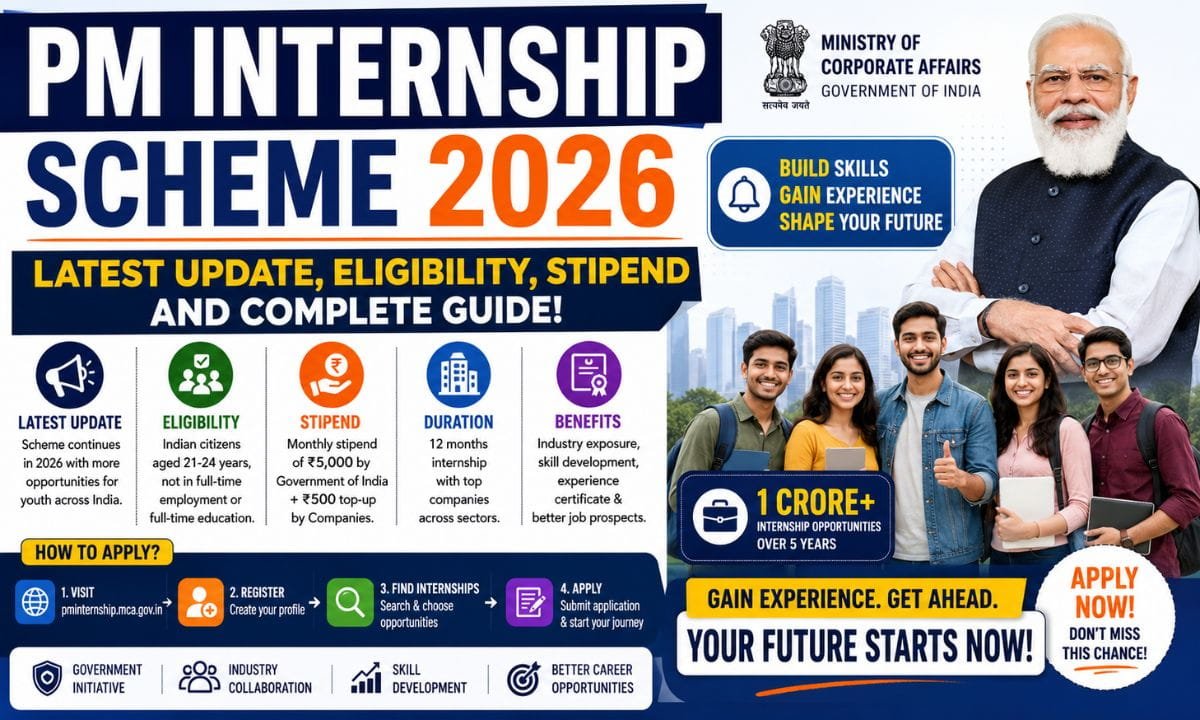
PM Internship Scheme 2026: The Prime Minister Internship Scheme, commonly known as PMIS, has become one of the most talked-about youth employment initiatives in India. Launched by the Ministry of Corporate Affairs in October 2024, the scheme was designed with a single, ambitious purpose: to close the widening gap between what young Indians learn in classrooms and what employers actually expect from them on the job. Over the past year and a half, the scheme has gone through several rounds of piloting, feedback, and revision, and 2026 has turned out to be its most transformative year yet. From a sharply increased stipend to a completely redesigned eligibility structure and a much wider pool of participating organisations, the PM Internship Scheme 2026 looks quite different from the version that was first announced.
This article (PM Internship Scheme) brings together the most recent developments concerning PMIS, explains what has changed and why, and walks through everything a prospective applicant needs to know, including eligibility, stipend structure, application process, participating companies, and the challenges the scheme continues to face.
Background: Why the PM Internship Scheme Was Created?
India has one of the youngest populations in the world, often described as a demographic dividend waiting to be converted into an economic asset. Yet for years, employers across sectors have complained that graduates, despite holding degrees and diplomas, often lack the practical, workplace-ready skills that businesses need. Multiple industry surveys and government assessments pointed to the same conclusion: formal education in India, while strong on theory, rarely provides enough exposure to real business environments, corporate processes, or hands-on technical work.
To address this mismatch, the Union Finance Minister announced the PM Internship Scheme during the Union Budget presentation, with the stated aim of providing internship opportunities to one crore, or ten million, young Indians over a five-year period. The PM Internship Scheme was conceived as a partnership between the government and India’s largest companies, where the government would provide financial support to interns while companies would provide the actual workplace training, mentorship, and exposure. The Ministry of Corporate Affairs was given charge of running the programme, and internships were structured to last twelve months in the original design, with companies drawing from their Corporate Social Responsibility obligations to help fund and support the initiative.
The first pilot round opened with tremendous enthusiasm. A dedicated PMIS portal was created, offering candidates the ability to register using Aadhaar-based verification, generate an auto-filled biodata, and browse thousands of internship listings across more than twenty sectors, ranging from oil and gas to travel, hospitality, banking, and manufacturing. In its very first week, the portal listed more than eighty thousand opportunities from participating companies, drawing applications from students and job seekers across the country.
The Problem With the Original Design
Despite the strong initial response, data released by the Ministry of Corporate Affairs through parliamentary disclosures told a more complicated story. While companies had collectively offered more than 1.65 lakh internship opportunities across the first two pilot rounds, actual joining numbers fell dramatically short. In the first pilot round, over 82,000 internship offers were made, but only around 8,760 candidates actually joined. The second round saw a similar pattern, with more than 83,000 offers extended but only about 7,300 candidates taking up the opportunity.
This gap between offers made and internships actually joined became a central concern for policymakers. On investigation, several structural issues emerged as the likely culprits. Many candidates were unwilling or unable to relocate to a different city for an internship, particularly when the placement was far from their hometown and involved additional living expenses. The original twelve-month duration also proved to be a deterrent, since many young people, especially those still exploring career options or preparing for competitive exams, were reluctant to commit a full year to a single internship.
The original monthly stipend of five thousand rupees, while helpful, was seen by many prospective interns as insufficient to cover the cost of relocating and living independently in a new city, especially in comparison to what some private-sector entry-level jobs were offering. Finally, since participation was largely limited to around five hundred of India’s largest companies, opportunities tended to cluster in major metropolitan hubs, leaving young people in smaller towns and cities with limited practical access even when they were technically eligible.
Recognising these gaps, the government began redesigning the scheme through 2025 and into early 2026, culminating in what has now become the scheme’s most significant overhaul to date.
The Big Reset: Changes Effective From March 2026
In March 2026, the government announced a substantial revision of the PM Internship Scheme, with the new provisions taking effect from March 21, 2026. This update addressed almost every major complaint that had emerged from the first two pilot rounds.
The most visible change was to the stipend. The monthly financial assistance to interns was raised from five thousand rupees to nine thousand rupees, marking an increase of nearly eighty percent. Under the revised funding structure, eight thousand one hundred rupees of this amount is credited through Direct Benefit Transfer from the government, while the remaining nine hundred rupees is contributed by the host company. In addition to the monthly stipend, interns continue to receive a one-time incidental grant, which several sources place at around six thousand rupees, intended to help cover initial joining expenses such as travel and setting up in a new location.
The eligible age band was also widened. Previously, only candidates between twenty-one and twenty-four years of age could apply. Under the revised rules, the age criterion now spans eighteen to twenty-five years, opening the door to a much larger pool of candidates, including those who have just completed schooling or a diploma programme and are not yet in a formal job.
Perhaps the most welcomed change was the reduction in internship duration. Instead of a rigid twelve-month commitment, internships under the revised scheme now typically run for six to nine months, depending on the host organisation and the nature of the role. This shorter, more flexible duration is expected to make the programme far more attractive to students who cannot commit a full year, including those juggling academic responsibilities or preparing for further studies and competitive examinations.
Eligibility in terms of educational qualification was also broadened. Candidates who have completed Class 10, Class 12, an Industrial Training Institute course, a diploma, a graduate degree, or a postgraduate degree can apply for PM Internship Scheme, and this now explicitly includes professional courses such as the Master of Business Administration, depending on the specific requirements of individual internship listings. A further important change allows final-year undergraduate and postgraduate students to apply while still completing their degree, provided they submit a No Objection Certificate from their college or university confirming that the internship will not interfere with their academic obligations.
The PM Internship Scheme has also expanded its sectoral coverage significantly. Where the earlier phases were concentrated in a narrower set of traditional industries, the 2026 version now spans more than twenty sectors, including newer, high-growth areas such as semiconductors, renewable energy, information technology, and advanced manufacturing, reflecting the government’s broader push to align skilling programmes with the industries expected to drive future economic growth.
Pilot Round 3: Widening the Net Beyond Big Corporates
Building on the March 2026 changes, the government introduced a further and arguably more structurally significant reform in April 2026, when Pilot Round 3 of the scheme was rolled out. This round directly tackled the geographic concentration problem that had limited the reach of the first two rounds.
Until this point, participation in the scheme had been restricted largely to India’s five hundred largest companies, selected primarily on the basis of their Corporate Social Responsibility spending, annual turnover, or net worth. Under Pilot Round 3, this pool has been dramatically widened to include Micro, Small and Medium Enterprises, Global Capability Centres, and a range of statutory bodies and professional institutes. The number of companies and organisations eligible to participate has grown from roughly five hundred to approximately two thousand.
The inclusion of Micro, Small and Medium Enterprises is particularly significant from a policy standpoint. MSMEs form the backbone of India’s industrial economy and are spread across virtually every district in the country, unlike large corporations that tend to be concentrated in major metros. By bringing MSMEs into the fold, the government aims to create internship opportunities much closer to where candidates actually live, reducing the need for costly relocation and making the scheme genuinely accessible to youth in Tier 2 and Tier 3 towns. This is also expected to benefit smaller industries directly, giving them access to trained young talent while strengthening local industrial ecosystems.
Global Capability Centres, which are offshore units set up by multinational corporations in India to manage high-value functions such as software engineering, artificial intelligence, research and development, cybersecurity, and financial analytics, have also been brought into the programme. Interning at a GCC gives young Indians exposure to globally relevant skills and working practices, potentially improving their competitiveness not just in the domestic job market but internationally as well.
Beyond MSMEs and GCCs, several statutory and professional bodies have also been added to the list of eligible organisations. These include the Airports Authority of India, which offers practical training opportunities in aviation and airport operations; the Shipping Corporation of India, which provides exposure to the maritime and logistics sector; and professional institutes such as the Institute of Chartered Accountants of India, the Institute of Company Secretaries of India, and the Institute of Cost Accountants of India, which between them offer internship pathways in finance, auditing, corporate governance, compliance, and cost accounting.
Another notable feature of Pilot Round 3 is the expanded role given to state governments. Under the revised framework, each state government is now permitted to nominate up to twenty companies of its choice to participate in the scheme. This provision is intended to let states bring in regionally important industries and local employers that might not otherwise qualify under the centrally administered selection criteria, effectively allowing internship opportunities to be tailored to local economic priorities. It is also being framed by policymakers as a step towards cooperative federalism in the design and delivery of national employment schemes.
To sustain quality standards even as the base of participating organisations widens, the Ministry of Corporate Affairs has retained financial eligibility benchmarks for companies. Broadly, a company’s eligibility continues to be linked to its average Corporate Social Responsibility expenditure over the preceding three financial years, along with either an annual turnover above one thousand crore rupees or a net worth exceeding five hundred crore rupees, ensuring that participating organisations have the financial capacity to properly support and mentor interns.
Under Pilot Round 3, which took effect from April 2026 and is expected to run through December 2026, the government has set a target of facilitating around 1.10 lakh internship opportunities.
Government Strategy to Improve Participation
Beyond structural changes to eligibility, stipend, and duration, the government has also launched a set of complementary initiatives aimed specifically at improving awareness and, more importantly, actual participation rates, since low joining numbers rather than low interest in the scheme were identified as the core problem in earlier rounds.
One notable step has been a partnership with the National Cadet Corps to help with grassroots mobilisation, tapping into the NCC’s extensive network of young cadets across schools and colleges nationwide. The government has also been working with MY Bharat, the Mera Yuva Bharat platform, which serves as a national youth engagement and outreach mechanism, to spread awareness of the scheme among eligible young people who might not otherwise come across it.
Discussions are also reportedly underway with MSME industry clusters to identify and create internship opportunities that are genuinely close to where candidates live, rather than concentrated in major cities. Alongside these outreach efforts, the combination of a higher stipend and a shorter, more manageable internship duration is itself expected to directly improve retention and joining rates, since these were the two most commonly cited reasons candidates gave for declining internship offers in the earlier rounds.
Eligibility Criteria: Who Can Apply for PM Internship Scheme
For candidates evaluating whether they qualify for the PM Internship Scheme in its current form, the eligibility framework can be summarised as follows. Applicants must be Indian citizens, and must fall within the age bracket of eighteen to twenty-five years at the time of application. In terms of educational qualification, candidates who have completed Class 10, Class 12, an ITI course, a diploma, a graduate degree, or a postgraduate degree are generally eligible, and this has now been extended to cover professional and postgraduate management courses depending on specific internship requirements. Final-year students pursuing an undergraduate or postgraduate degree are also permitted to apply, provided they obtain and submit a No Objection Certificate from their educational institution confirming that the internship will not disrupt their academic schedule.
Certain categories of candidates remain excluded from the scheme. Those who are already engaged in regular full-time employment are generally not eligible, since the scheme is designed for candidates seeking their first substantial exposure to the professional workplace rather than those already established in a job. Similarly, candidates enrolled as full-time students in a manner that would conflict with internship commitments are typically excluded, barring the final-year exception described above.
Students enrolled in online or distance learning programmes, however, remain eligible to apply provided they otherwise satisfy the age and educational criteria, which opens the scheme up to a wider set of learners who may not be part of a conventional full-time campus programme. An Aadhaar card linked to an active mobile number is a mandatory requirement for PM Internship Scheme registration, since it is used both for identity verification through e-KYC and for the direct transfer of the monthly stipend into the intern’s bank account.
Stipend and Financial Benefits
Under the current structure, selected interns receive a monthly stipend of nine thousand rupees, a substantial increase from the five thousand rupees offered when the scheme was first launched. Of this amount, eight thousand one hundred rupees is contributed by the central government through Direct Benefit Transfer, while the remaining nine hundred rupees comes from the participating company. In addition, interns are provided a one-time incidental or joining grant intended to help offset initial costs, commonly cited at around six thousand rupees, though the exact figure and disbursement method can vary depending on the specific internship listing and host organisation.
Some sources have also described variations in stipend structure depending on whether an internship is arranged directly through the central portal or through a state-nominated company, so applicants are always advised to check the specific terms attached to the internship listing they are applying for.
Beyond the direct financial assistance, interns benefit from a digital certificate of completion, mentorship from experienced professionals within the host organisation, and, in many cases, genuine exposure to live projects and business operations rather than purely observational or clerical work. For interns placed with government departments, public sector undertakings, or state-run institutions, the experience often includes exposure to public governance, policy implementation, and digital infrastructure projects, which can be particularly valuable for those considering careers in the public sector or preparing for competitive government examinations.
How to Apply for PM Internship Scheme 2026?
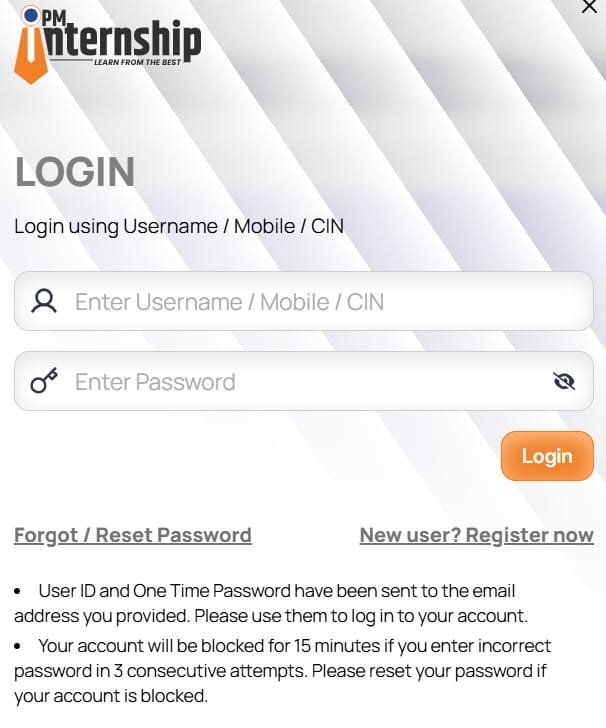
The application process for the PM Internship Scheme continues to run through the dedicated PMIS portal, which remains open for registration throughout the year even though individual internship listings carry their own specific deadlines. The general process begins with registration on the portal using an Aadhaar-linked mobile number, followed by completion of e-KYC verification. Once registered, candidates fill in their educational background, skills, and preferences, and the portal’s biodata generation tool automatically compiles this information into a standard format that can be used across multiple applications.
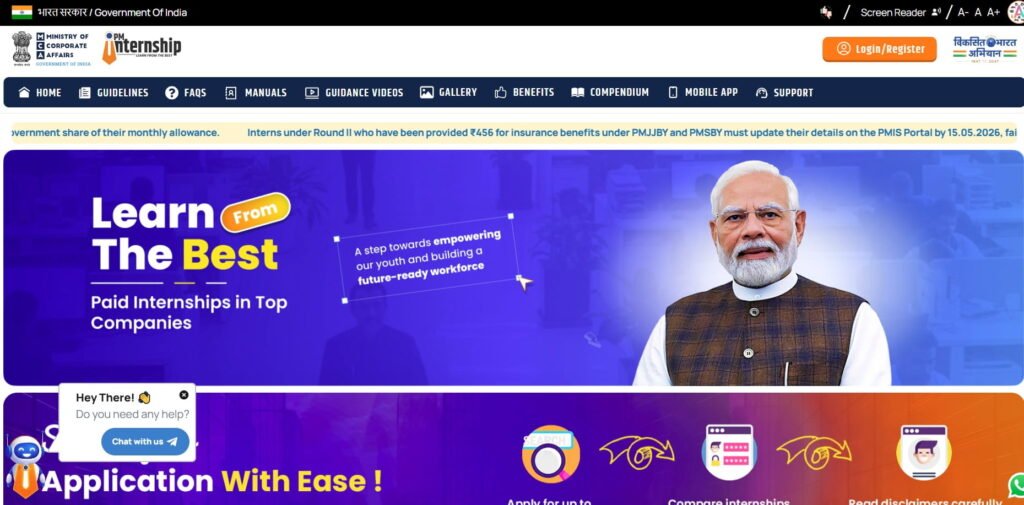
After registration, candidates can browse and filter internship listings by sector, location, company, and duration, and apply to as many relevant openings as they wish, since applying to multiple listings is generally advised to improve the chances of selection. Selected candidates are then notified through the portal and are required to complete any remaining formalities, including submission of the No Objection Certificate for final-year students, before formally joining their assigned internship.
Throughout the internship, communication, task submission, and mentorship sessions are managed through official government-provided platforms, and candidates are advised to regularly check their dashboard for updates on new listings, deadlines, and selection status. Given the frequency with which listings and deadlines change, candidates are also encouraged to enable notifications on the portal so that they do not miss company-specific application windows.
Participating Companies and Sectors
The PM Internship Scheme now counts several hundred companies as active participants, including well recognised names across banking, financial services, manufacturing, and consumer goods, alongside the newly included MSMEs, Global Capability Centres, and statutory bodies described earlier. PM Internship Scheme Internship listings span a wide variety of roles depending on the sector and the specific business needs of the host organisation, and the available opportunities are refreshed regularly on the portal as new companies join or as existing participants open fresh listings.
Sector coverage has grown well beyond the original core of oil and gas, manufacturing, and banking to include newer and increasingly important industries such as semiconductors, renewable energy, and information technology, reflecting a deliberate effort to align the scheme with sectors expected to be central to India’s future economic growth and job creation.
Why PM Internship Scheme Matters for India’s Economy?
The significance of the PM Internship Scheme extends well beyond the immediate benefit to individual interns. From an employment perspective, the scheme is intended to improve overall job readiness among young Indians before they formally enter the labour market, reducing the mismatch between academic qualifications and the practical skills employers actually seek. From a skill development standpoint, it offers structured, real-world workplace exposure that goes beyond what classroom learning or even vocational training programmes typically provide.
The inclusion of MSMEs is expected to have a particularly meaningful impact at the local level, since it allows smaller industries to access trained, motivated young talent while simultaneously strengthening industrial ecosystems in smaller towns and cities. This aligns with the broader goal of converting India’s demographic dividend, its large and youthful population, into a genuinely productive economic asset capable of sustaining long-term growth. For companies, the scheme also offers a practical benefit in terms of easier hiring, since organisations get the opportunity to identify and evaluate promising interns over several months, potentially reducing the cost and risk associated with traditional recruitment processes for entry-level roles.
Challenges That Remain
Despite the significant improvements introduced through the March 2026 revision and Pilot Round 3, the scheme continues to face a number of challenges that policymakers and observers have flagged as areas requiring ongoing attention. Maintaining consistent internship quality across an expanding base of thousands of participating organisations, many of them considerably smaller and less resourced than the large corporations that dominated the scheme’s early phases, will require robust and continuous monitoring.
Many MSMEs, in particular, may lack the structured mentoring systems and formal training frameworks that larger companies are more easily able to provide, raising questions about how consistently interns will receive meaningful, well-supervised experience regardless of which organisation they are placed with.
Female participation is another area of concern, since mobility and safety considerations may continue to limit uptake among young women in certain regions, even as the scheme becomes more geographically accessible overall. Finally, and perhaps most fundamentally, the scheme’s ultimate success will be judged not just by how many internships are offered or joined, but by whether these experiences genuinely translate into improved long-term employment outcomes for participants, a question that will only be answerable with more time and more comprehensive tracking of interns after they complete the programme.
The Way Forward
Looking ahead, policy commentary around the scheme has consistently pointed to a few priority areas. Establishing a robust digital monitoring mechanism that tracks not just internship completion rates but also post-internship employment outcomes is widely seen as essential to understanding whether the scheme is delivering on its core promise. Building in structured, regular feedback loops from both interns and host employers could help refine the programme design on an ongoing basis, rather than relying solely on periodic large-scale revisions such as those seen in March and April of 2026.
Deeper collaboration with universities, Industrial Training Institutes, Skill India centres, and state governments is also expected to help expand outreach further, particularly into smaller towns where awareness of the scheme may still be limited. Finally, linking successful internship completion more directly with future hiring incentives for participating companies could help ensure that the scheme functions not just as a temporary training exercise but as a genuine pipeline into long-term employment.
A Closer Look at the Selection Process
While the PM Internship Scheme application process itself is fairly straightforward, the selection stage is where the scheme differs meaningfully from a typical private-sector hiring process. Once a candidate applies to a listing, the shortlisting is generally handled jointly, with the portal’s algorithm matching candidate profiles, qualifications, and stated preferences against the requirements specified by the host organisation, after which the company itself reviews shortlisted profiles and makes the final selection decision. This two-stage approach is intended to keep the process transparent and merit-based while still giving participating companies enough flexibility to choose candidates who genuinely fit their team’s needs.
Candidates who receive an offer are given a defined window to accept and complete onboarding formalities, and this is precisely the stage where earlier pilot rounds saw the steepest drop-off, since many candidates who initially applied and were selected ultimately chose not to join once faced with practical considerations such as relocation, duration, or the adequacy of the stipend. The 2026 reforms, particularly the higher stipend and shorter duration, are aimed squarely at improving this conversion rate from offer to actual joining, which the government has identified as the single biggest weakness in the scheme’s performance so far.
Work Mode, Duration and Day-to-Day Expectations
Interns under the current phase of the PM Internship Scheme are generally expected to contribute somewhere between fifteen and twenty hours a week, though this can vary depending on the specific role, department, or company. The overall internship period typically spans eight to twelve weeks at the shorter end of listings, extending up to the broader six-to-nine-month range described under the March 2026 revision for many corporate placements. Some departments and organisations offer flexibility around early completion or extension of the internship, generally based on the intern’s performance and the status of the project they are working on.
Work mode, whether in-person, hybrid, or in limited cases remote, is typically communicated to selected candidates at the time of onboarding rather than being fixed uniformly across all listings, since this depends heavily on the nature of the host organisation and the specific role.
For internships hosted within government departments, public sector undertakings, and other public institutions, the experience is often structured around short-term, skill-based assignments tied to real governance or policy projects, giving interns a rare opportunity to contribute to national development work while still completing their studies or early career preparation.
Conclusion
The PM Internship Scheme has come a long way since its launch in October 2024. What began as an ambitious but somewhat rigid programme, offering a modest stipend and a demanding twelve-month commitment largely through India’s largest corporations, has evolved by 2026 into a considerably more flexible, better-funded, and far more geographically accessible initiative. The increase in monthly stipend to nine thousand rupees, the widened age eligibility of eighteen to twenty-five years, the shortened six-to-nine-month duration, and above all the expansion of eligible host organisations to include MSMEs, Global Capability Centres, and various statutory and professional bodies together represent a genuine attempt by the government to learn from the shortcomings of the scheme’s earlier rounds.
Whether these changes succeed in closing the gap between internship offers made and internships actually joined, a gap that plagued the first two pilot rounds, will become clearer as data from Pilot Round 3 accumulates through the rest of 2026. For now, young Indians across the country, from metropolitan graduates to candidates in smaller towns newly served by MSME participation, have more reason than before to consider the PM Internship Scheme as a genuine stepping stone into the professional world. As always, given how frequently the scheme’s rules, deadlines, and listings are updated, prospective applicants are strongly encouraged to verify the latest details directly on the official PMIS portal before applying.
Official Sources
| Official Web Page | CLICK HERE |
| MyScheme – Prime Minister’s Internship Scheme | CLICK HERE |
| MY Bharat – Prime Minister Internship Scheme | CLICK HERE |
| Contact Details | pminternship@mca.gov.in pmisindustrysupport@mca.gov.in 1800 11 6090 |
PM Internship Scheme – Frequently Asked Questions
What is the current monthly stipend under the PM Internship Scheme?
As of the March 2026 revision, selected interns receive nine thousand rupees a month, up from the original five thousand rupees, with the bulk of this amount coming from the central government through Direct Benefit Transfer and a smaller portion contributed by the host company.
Can students studying through distance or online learning programmes apply?
Yes, provided they meet the standard age and educational eligibility criteria, distance and online learners are eligible to apply on the same basis as full-time campus students.
Where should candidates check for the latest updates?
Since eligibility rules, stipend structures, deadlines, and available listings are updated fairly frequently, candidates are strongly advised to rely on the official PMIS portal for the most current and authoritative information rather than depending solely on secondary sources.
Can state governments influence which companies participate?
Yes. Under the current framework, each state government can nominate up to twenty companies of its choosing to participate in the scheme, allowing for regionally relevant industries to be included alongside centrally selected organisations.
Which companies and organisations can host interns under the 2026 version of the scheme?
Participation has expanded significantly under Pilot Round 3 to include not just India’s largest corporations but also Micro, Small and Medium Enterprises, Global Capability Centres, and statutory and professional bodies such as the Airports Authority of India, the Shipping Corporation of India, and professional institutes covering chartered accountancy, company secretaryship, and cost accountancy.
Is Aadhaar mandatory to apply?
Yes. An Aadhaar card linked to an active mobile number is required for identity verification and to receive the stipend through Direct Benefit Transfer.
Who is eligible to apply in 2026?
Indian citizens between the ages of eighteen and twenty-five who have completed at least Class 10 are generally eligible, along with those who hold a Class 12 certificate, an ITI qualification, a diploma, a graduate degree, or a postgraduate degree. Final-year students can also apply provided they submit a No Objection Certificate from their institution.
Is the internship still a full twelve-month commitment?
No. Under the current structure, most internships run for six to nine months, a significant reduction from the original twelve-month design, though some listings, particularly shorter departmental postings, may run for as little as eight to twelve weeks.