National Scholarship Portal 2026: For millions of students across India, the difference between continuing their education and dropping out often comes down to a few thousand rupees at the right moment. The National Scholarship Portal, widely known by its abbreviation NSP, was built precisely to close that gap. It functions as the Government of India’s single, unified digital platform where students from Class 1 all the way through to doctoral studies can apply for dozens of central and state scholarship schemes without having to navigate a maze of separate department websites, paper forms, and disconnected verification processes.
The portal has now opened for the 2026-27 academic year, and this cycle brings with it a fresh set of dates, updated verification requirements, and the usual wide spread of scholarship schemes covering pre-matric students, post-matric students, minority communities, Scheduled Castes, Scheduled Tribes, Other Backward Classes, persons with disabilities, and several merit-based and subject-specific categories. This article walks through everything a student or parent needs to know about applying on National Scholarship Portal in 2026, including how the portal works, who is eligible, what documents are required, the current income limits, the step-by-step application process, and the common mistakes that cause applications to stall.
What Exactly Is the National Scholarship Portal?
The National Scholarship Portal is a Mission Mode Project under the Digital India initiative, and it was created under the National e-Governance Plan with a clear objective: to build a Simplified, Mission-oriented, Accountable, Responsive and Transparent system, often summarised by the acronym SMART, for the disbursal of scholarships to eligible students. Before National Scholarship Portal existed, students had to apply separately to whichever ministry, department, or state government administered a particular scholarship, often through offline paperwork that was slow, inconsistent, and prone to duplication or leakage of funds. National Scholarship Portal consolidated all of this into one website, scholarships.gov.in, where a student creates a single profile and can then apply to any scheme they are eligible for, whether it is funded by the central government or by their state.
The National Scholarship Portal today hosts more than fifty distinct scholarship schemes originating from a wide range of ministries and departments, including the Department of School Education and Literacy, the Ministry of Social Justice and Empowerment, the Ministry of Tribal Affairs, the Ministry of Minority Affairs, the Ministry of Railways, the Ministry of Home Affairs, the Ministry of Statistics and Programme Implementation, and the Department of Agriculture Research and Education, alongside numerous state-specific scholarship schemes for students who are domiciled residents of a particular state.
All payments made through the portal are transferred directly into the student’s bank account using Direct Benefit Transfer, which is intended to eliminate intermediaries and reduce the possibility of funds being lost or delayed along the way.
Key Dates for the 2026-27 Academic Year
The National Scholarship Portal opened for fresh applications and renewals for the 2026-27 academic session on June 1, 2026. For the majority of central scholarship schemes hosted on the platform, the last date to submit an online application is October 31, 2026. This deadline, however, is not universal across every scheme. Certain schemes, such as those administered by the Ministry of Statistics and Programme Implementation and the Department of Agriculture Research and Education, also carry deadlines aligned with the October 31 cut-off for the current cycle, while other schemes may set their own specific windows that can be extended depending on administrative decisions taken during the year. Because deadlines are known to shift, sometimes with short notice, students are strongly advised to treat October 31, 2026 as a general target rather than an absolute guarantee for every scheme, and to verify the exact date for their specific scholarship directly on the portal before assuming they have more time.
Beyond the student submission deadline, the National Scholarship Portal workflow also includes downstream verification stages at the institution, district, and state levels, each of which carries its own timeline. Historically, institutional verification windows have closed a few weeks after the student submission deadline, so students are encouraged not to wait until the final days of October to submit their applications, since the National Scholarship Portal typically experiences heavy traffic in the closing weeks, which can slow down form submission and document uploads.
One Time Registration: The Gateway to National Scholarship Portal
Every interaction with the National Scholarship Portal begins with a process called One Time Registration, commonly abbreviated as OTR. As the name suggests, this registration is meant to be completed only once by a student, after which the same OTR profile and reference number can be used to apply for any scholarship scheme across multiple years, including renewals, without having to re-enter basic personal details each time. The OTR system exists primarily to prevent duplicate student accounts and to ensure that identity verification is consistently anchored to a single authenticated profile.
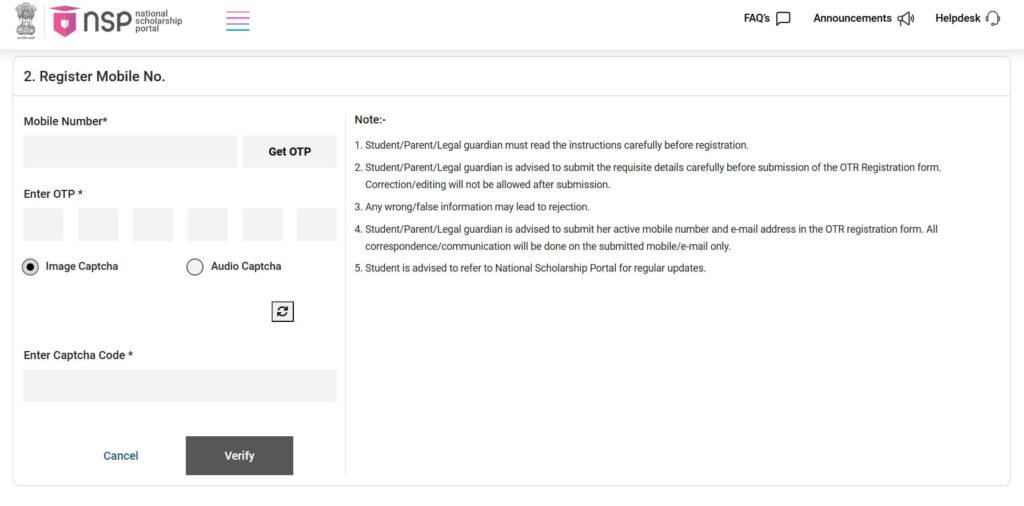
To generate an OTR, a student visits the official National Scholarship Portal and selects the option to register, after which they are asked to enter their Aadhaar number along with a mobile number that is actively linked to that Aadhaar record. An OTP is sent to this mobile number for verification. Once the mobile number and Aadhaar details are successfully verified, the portal generates a unique and permanent OTR ID for the student.
For the 2026-27 cycle, the verification process has been tightened further, with Aadhaar-based Face Authentication or biometric authentication now mandatory for students during registration, and this stricter verification requirement also extends to the Head of Institution at the student’s school, college, or university, who plays a role in confirming and verifying applications submitted by their enrolled students.
After the OTR ID is generated, the student sets a password, which together with the OTR ID becomes their permanent login credential for the portal going forward. It is worth noting that losing access to the mobile number linked to Aadhaar can complicate this process considerably, so students are advised to ensure their Aadhaar details, particularly the linked mobile number, are current and accurate before beginning registration.
Categories of Scholarships Available on National Scholarship Portal
The scholarships hosted on National Scholarship Portal are broadly grouped by the stage of education a student has reached, though many schemes also carry additional eligibility layers based on caste category, religious minority status, disability status, gender, or subject of study.
Pre-Matric scholarships are aimed at students studying up to Class 10, and are particularly significant for children from economically weaker households, since financial pressure at this stage is a major contributor to early school dropout. These schemes typically cover students from Class 1 through Class 10, with some variations targeting Class 9 and 10 specifically.
Post-Matric scholarships form one of the largest and most heavily subscribed categories on the portal, covering students from Class 11 and 12 onward through diploma, undergraduate, postgraduate, and in some cases doctoral studies. Within this category sit some of the most well-known central schemes, including the Post-Matric Scholarship for Scheduled Caste students, the Post-Matric Scholarship for Scheduled Tribe students, and parallel schemes for Other Backward Classes, Economically Backward Classes, De-notified Tribes, and notified minority communities. These schemes generally cover tuition fees, compulsory non-refundable institutional fees, and a monthly maintenance allowance credited directly to the student’s bank account.
Merit-based and merit-cum-means schemes reward strong academic performance, sometimes combined with an income ceiling, and include programmes such as the Central Sector Scheme of Scholarship for College and University Students, which supports undergraduate students with an annual financial award, and the Merit-cum-Means Scholarship administered by the Ministry of Minority Affairs.
Subject-specific and talent-based schemes exist as well, rewarding students who pursue particular fields of study or who demonstrate exceptional aptitude. The National Means-cum-Merit Scholarship, aimed at meritorious students from economically weaker sections studying in Class 9 through 12 in government and government-aided schools, is one prominent example, selecting students through a dedicated examination at the Class 8 level. Another is the INSPIRE Scholarship for Higher Education, which supports students pursuing natural and basic sciences and is aimed at those who rank among the top performers in their board examinations or in national entrance examinations such as JEE Advanced or NEET.
Disability, gender, and welfare-linked scholarships round out the portal’s offerings, supporting differently-abled students, girls pursuing specific streams of education, and students from communities identified as needing additional welfare support, often with relatively higher income ceilings compared to the standard pre-matric and post-matric limits.
In addition to these central schemes, every state and union territory maintains its own set of scholarships hosted on the same portal, typically restricted to students who are domicile residents of that particular state. These state schemes often mirror the structure of central schemes, covering pre-matric, post-matric, and merit categories, but with eligibility, income limits, and award amounts set independently by the respective state government.
Eligibility Criteria: General Requirements
While each individual scheme carries its own specific eligibility rules, certain requirements apply broadly across almost all schemes hosted on the National Scholarship Portal. The applicant must be an Indian citizen. The student must be currently enrolled in a school, college, or university that is formally recognised by the relevant education authority or regulatory body. The student is generally required to have passed their most recent qualifying examination, and in the case of renewal applications, must typically show satisfactory academic progress and attendance in the previous year.
Family income is one of the most consequential eligibility factors, since the vast majority of National Scholarship Portal schemes are targeted at economically disadvantaged students, and income ceilings vary considerably depending on the scheme in question. For most Pre-Matric scholarship schemes, the annual family income limit is generally set at up to one lakh rupees. For most Post-Matric schemes, this ceiling typically rises to somewhere between two lakh and two and a half lakh rupees annually, with the Post-Matric Scholarship schemes for Scheduled Caste and Scheduled Tribe students specifically set at an income ceiling of two and a half lakh rupees per year from all sources combined, a figure that must usually be certified by a Tehsildar or an equivalent revenue officer.
Certain other welfare-oriented schemes carry considerably higher income ceilings, in some cases reaching four and a half lakh rupees, and in a smaller number of cases extending as high as eight lakh rupees, depending on the specific scheme’s guidelines. Because these limits differ so significantly from one scheme to another, students are always advised to check the precise income ceiling attached to the specific scholarship they intend to apply for, rather than assuming a single uniform limit applies across the portal.
Category-based eligibility also plays an important role, since a large share of National Scholarship Portal schemes are specifically reserved for students belonging to Scheduled Castes, Scheduled Tribes, Other Backward Classes, Economically Weaker Sections, notified minority communities, or students with disabilities. A valid and current caste, community, minority, or disability certificate, as applicable, is generally a mandatory requirement for these category-specific schemes.
An Aadhaar-linked and active bank account is compulsory for every applicant, since this is the account into which Direct Benefit Transfer payments are made, and any mismatch between a student’s Aadhaar details and their bank account records is one of the most common reasons scholarship payments fail to reach students on time.
Finally, National Scholarship Portal operates on a no-dual-benefit principle, meaning a student is generally not permitted to hold more than one government scholarship of a similar type for the same academic year, although in some cases students can combine a central National Scholarship Portal scheme with a state scheme, provided the combined benefit does not exceed the full cost of their course fees, a condition that varies by state and should be confirmed against the specific terms of the state scheme in question.
Documents Typically Required
Although exact document requirements vary by scheme, applicants are generally expected to prepare a standard set of paperwork before beginning their application, since starting the process without these documents ready is one of the most frequent reasons applications stall midway. This typically includes the student’s Aadhaar card, recent passport-sized photographs, marksheets or certificates from the previous qualifying examination, a bonafide or enrolment certificate from the current institution confirming active admission, an income certificate issued by a competent authority, and, where relevant to the specific scheme, a caste, tribe, minority, or disability certificate.
Bank account details, including the account number and IFSC code, are also required, and applicants should double-check that these details exactly match the bank account linked to their Aadhaar number to avoid payment failures later in the process. For scholarships involving smaller award amounts, some schemes do not require every supporting document to be uploaded directly to the portal, though students should always follow the specific document checklist listed against the particular scheme they are applying for.
Step-by-Step: How to Apply on National Scholarship Portal ?
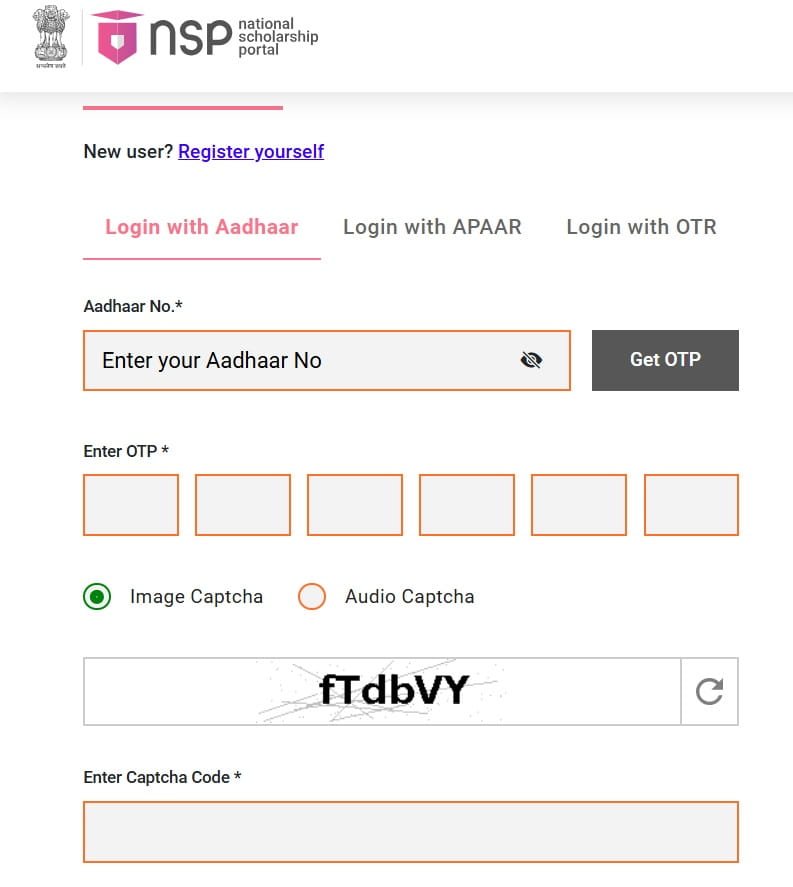
The application process on the National Scholarship Portal follows a fairly consistent sequence regardless of which scheme a student is applying for. The first step is completing One Time Registration as described earlier, using an Aadhaar number and an actively linked mobile number, followed by the newly mandatory face or biometric authentication for the 2026-27 cycle. Once the OTR ID and password are generated, the student logs into the National Scholarship Portal using these credentials.
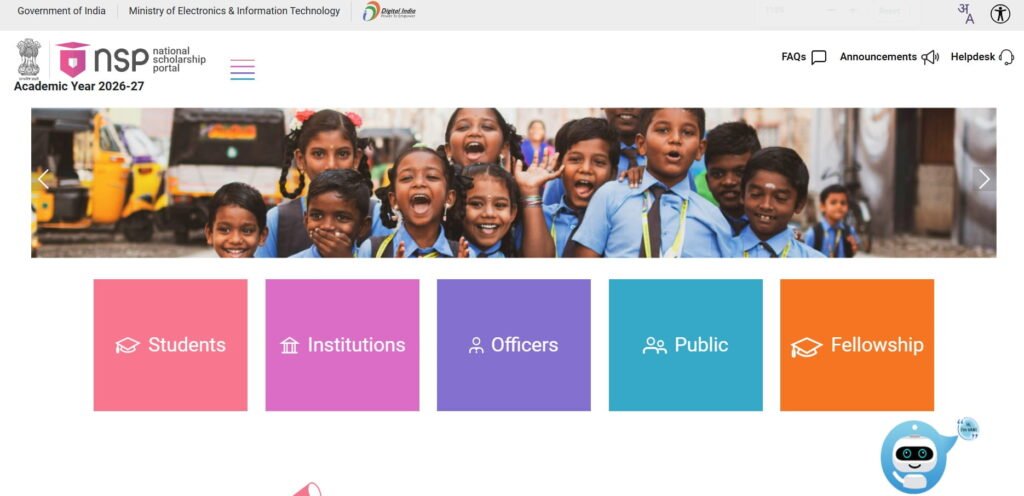
After logging in, the student navigates to the application section on their dashboard, commonly labelled as the option for a fresh application or scheme selection, and browses the list of available scholarship schemes. Since eligibility criteria differ significantly across schemes, students should carefully review the requirements, income limits, and category restrictions of each scheme before selecting one, rather than applying indiscriminately, since applying for a scheme the student does not actually qualify for typically results in rejection at the verification stage.
Once a scheme is selected, the student proceeds to fill in the detailed application form, which generally requires personal details, academic history, current course and institution information, family income details, category or community information where applicable, and bank account details for Direct Benefit Transfer. The student then uploads the required supporting documents in the specified format and size, taking care to ensure that scanned documents are legible, since blurry or incomplete uploads are another common cause of application rejection or delay.
After reviewing all entered information carefully, since corrections after final submission can be difficult or impossible depending on the stage of processing, the student submits the completed application. From this point, the application moves into a multi-stage verification process. It is first reviewed and forwarded by the Head of Institution at the student’s school or college, confirming that the student is genuinely enrolled and that the academic details provided are accurate. The application then typically moves through district-level and state-level verification stages, depending on the specific scheme and its administrative structure, before finally being cleared for disbursal. Once fully verified and approved, the scholarship amount is credited directly into the student’s Aadhaar-linked bank account through Direct Benefit Transfer.
Throughout this process, students are strongly encouraged to track their application status regularly through their National Scholarship Portal dashboard, since applications can occasionally be sent back for correction at the institutional or district verification stage, and delays in responding to such requests can push disbursal well past the expected timeline.
Renewal Applications on National Scholarship Portal
For students who received an National Scholarship Portal scholarship in a previous academic year and remain enrolled in the same course, most schemes require an annual renewal application rather than a completely fresh submission. Renewal applications generally use the same OTR profile created during the student’s original registration, and typically require confirmation of continued enrolment, updated academic performance details such as the previous year’s marks or grade point average, and reconfirmation of family income and bank details.
Renewal is not automatic, and students who fail to submit a renewal application within the specified window risk losing continuity of their scholarship benefit, even if they remain otherwise eligible. As with fresh applications, renewal deadlines are set individually for each scheme and should be checked directly on the portal.
Common Problems and How to Avoid Them
A significant share of the difficulties students encounter on National Scholarship Portal are avoidable with careful preparation. One of the most frequent issues is a mismatch between the bank account details entered on the National Scholarship Portal and the account actually linked to the student’s Aadhaar number, which causes Direct Benefit Transfer payments to fail even after an application has been fully approved. Students should verify Aadhaar-bank seeding status in advance, ideally by checking directly with their bank, rather than assuming the linkage is already correctly configured.
Another common obstacle is an application remaining stuck at the institutional verification stage, often because the Head of Institution or the relevant nodal officer at the college has not yet reviewed and forwarded the application. Students facing this issue are generally advised to follow up directly and promptly with their institution’s scholarship cell rather than waiting passively, since institutional delays are one of the largest contributors to overall processing time. Incomplete or incorrect document uploads, such as an income certificate that has expired or a caste certificate that does not match the format required by a particular scheme, also frequently cause applications to be rejected or sent back for correction, so students should confirm that all certificates are current and issued by the appropriate competent authority before uploading them.
Finally, missing the OTR-based face or biometric authentication step, newly emphasised for the 2026-27 cycle, can prevent an application from being submitted at all, so students should ensure this step is completed early in the process rather than leaving it until close to the deadline, when portal traffic is typically at its highest and technical issues are more likely to cause delays.
A Closer Look at Some Major Central Schemes
To give applicants a more concrete sense of what is actually on offer, it is worth examining a handful of the more prominent schemes hosted on the National Scholarship Portal in slightly greater detail, keeping in mind that exact figures are set by each scheme’s annual notification and should always be confirmed on the National Scholarship Portal itself.
The Post-Matric Scholarship for Scheduled Caste students is one of the largest schemes by volume of beneficiaries, supporting students from Class 11 onward through diploma, undergraduate, postgraduate, and doctoral studies. It typically covers full tuition fees along with a monthly maintenance allowance, which historically has ranged from roughly two hundred and thirty rupees to around twelve hundred rupees depending on the course and whether the student is a hosteller or a day scholar, alongside additional allowances for books and study materials in certain cases. The parallel Post-Matric Scholarship for Scheduled Tribe students follows a broadly similar structure, administered by the Ministry of Tribal Affairs, with the same income ceiling of two and a half lakh rupees per year.
The PM YASASVI scheme, which supports Other Backward Classes, Economically Backward Classes, and De-notified, Nomadic, and Semi-Nomadic Tribes, functions in a comparable way, providing both pre-matric and post-matric support along with a dedicated entrance examination for certain components of the scheme that determines merit-based selection among applicants.
The Ministry of Minority Affairs administers its own family of schemes, including Pre-Matric, Post-Matric, and Merit-cum-Means Scholarships for students belonging to notified minority communities. The Post-Matric Minority Scholarship, for instance, generally applies an income ceiling of around two lakh rupees per year and requires the student to have secured at least fifty percent marks in their previous qualifying examination to remain eligible.
The National Means-cum-Merit Scholarship targets a more specific group: meritorious students from economically weaker sections who are enrolled in Class 9 through 12 in government, government-aided, or local body schools. Selection for this scheme is based on a dedicated examination conducted at the Class 8 level, generally combining a mental ability test and a scholastic aptitude test, and successful candidates receive an annual award, historically around twelve thousand rupees paid at a rate of one thousand rupees per month, provided they maintain satisfactory academic performance and attendance in subsequent years.
For students pursuing higher studies in the natural and basic sciences, the INSPIRE Scholarship for Higher Education offers a considerably larger annual award, historically around eighty thousand rupees a year, aimed at students who rank among the top performers in their school board examinations or who qualify through top ranks in national entrance examinations such as JEE Advanced or NEET, with an additional mentorship component built into the scheme.
Finally, the Central Sector Scheme of Scholarship for College and University Students provides financial assistance to undergraduate students who performed well in their Class 12 board examinations but come from economically modest backgrounds, offering an annual scholarship amount that has historically been in the range of ten to twenty thousand rupees depending on the year of study, disbursed directly to the student’s bank account.
Each of these schemes, along with dozens of others hosted on the portal, carries its own specific notification for the 2026-27 academic year, including updated award amounts, income ceilings, and application windows, all of which should be verified directly against the live scheme details on the portal before a student finalises their application.
Why National Scholarship Portal Matters?
The significance of the National Scholarship Portal extends well beyond the convenience of a single application platform. By consolidating scholarship administration into one transparent digital system, National Scholarship Portal has substantially reduced the scope for the kind of fund leakage and duplication that plagued scattered, offline scholarship disbursal in the past. Direct Benefit Transfer ensures that approved funds reach a student’s own bank account without passing through intermediaries, addressing a longstanding concern around delayed or diverted scholarship payments.
For families for whom the cost of school fees, examination fees, hostel charges, or basic study materials represents a genuine barrier to a child’s education, the range of schemes hosted on National Scholarship Portal, spanning pre-matric support for young children through post-matric assistance for undergraduate, postgraduate, and doctoral students, provides a continuous safety net across the full span of a student’s academic journey. The scale of the platform, hosting more than fifty central schemes alongside dozens of state-specific schemes, also means that students from a very wide range of backgrounds, whether defined by caste, income, religious community, disability status, gender, or academic merit, are likely to find at least one scheme for which they qualify, provided they take the time to search the portal carefully rather than assuming no suitable scheme exists.
A Note of Caution
Because scholarship amounts, income ceilings, eligibility conditions, and deadlines are reviewed and revised periodically, sometimes on a yearly basis and sometimes even mid-cycle, students should treat any secondary source, including this article, as a general guide rather than a final authority. The scholarship-focused websites and information portals that report on National Scholarship Portal updates are useful for understanding the broad shape of the system, but the only fully authoritative source for exact dates, income limits, and scheme-specific requirements remains the official portal itself, at scholarships.gov.in. Students are also reminded that the National Scholarship Portal does not charge any application fee, and they should be cautious of any third-party website or individual that asks for payment in connection with applying for or securing an National Scholarship Portal scholarship.
Conclusion
The National Scholarship Portal has, over the years since its creation under the National e-Governance Plan, grown into the backbone of India’s scholarship disbursal system, and the 2026-27 cycle continues that trajectory with a broad set of central and state schemes now open for application from June 1, 2026, through to a general deadline of October 31, 2026 for most schemes. The tightening of identity verification through mandatory face or biometric authentication reflects the government’s ongoing effort to keep the system secure and free of duplicate or fraudulent claims, even as the underlying goal remains unchanged: ensuring that financial hardship does not stand between a student and their education.
For students and families navigating the process for the first time, the path forward is straightforward in outline even if it requires some patience in practice. Complete One Time Registration early, gather the required documents in advance, carefully identify the specific scheme or schemes that match your educational stage, category, and family income, submit the application well before the deadline rather than in the final rush, and follow up actively with your institution if the application appears to be delayed at the verification stage. Handled this way, the National Scholarship Portal remains one of the most valuable tools available to Indian students seeking to fund their education, and staying updated directly through the official portal is the surest way to make the most of it.
Official Sources
| Official Site | CLICK HERE |
| NSP PORTAL OTR | CLICK HERE |
| Apply For Scholarships | CLICK HERE |
National Scholarship Portal – Frequently Asked Questions
What is the last date to apply for National Scholarship Portal scholarships in 2026?
For the majority of central scholarship schemes, the deadline for the 2026-27 academic year is October 31, 2026, though certain individual schemes may carry their own separate deadlines, and students should always confirm the exact date for their specific scheme on the portal.
Is there any application fee to apply on the National Scholarship Portal?
No. Applying for any scholarship scheme through National Scholarship Portal is completely free of charge, and students should be wary of any third party requesting payment in connection with the application process.
Do I need to complete One Time Registration every year?
No. OTR is meant to be completed only once, and the same OTR ID and reference number can then be used for fresh applications as well as renewal applications in subsequent years.
Can I apply for more than one scholarship at the same time?
Generally, a student is permitted to hold only one government scholarship of a similar type in a given academic year, although in some cases a central National Scholarship Portal scheme can be combined with a state-level scheme, provided the combined benefit does not exceed the full cost of the student’s course, subject to the specific terms of the relevant state scheme.
What happens if my Aadhaar is not linked to my bank account?
Direct Benefit Transfer payments cannot be processed if a student’s Aadhaar is not properly seeded with their bank account, which is one of the most common reasons for delayed or failed scholarship disbursal, so students should confirm this linkage with their bank before or immediately after applying.
Is renewal automatic for students who received a scholarship last year?
No. Most schemes require an annual renewal application confirming continued enrolment and satisfactory academic performance, and failing to submit this renewal within the specified window can result in a break in the scholarship, even for otherwise eligible students.
What should I do if my application is stuck at the institution verification stage?
Students are advised to follow up directly and promptly with their institution’s scholarship cell or the designated nodal officer, since delays at this stage are frequently caused by pending review at the college or school level rather than an issue with the application itself.