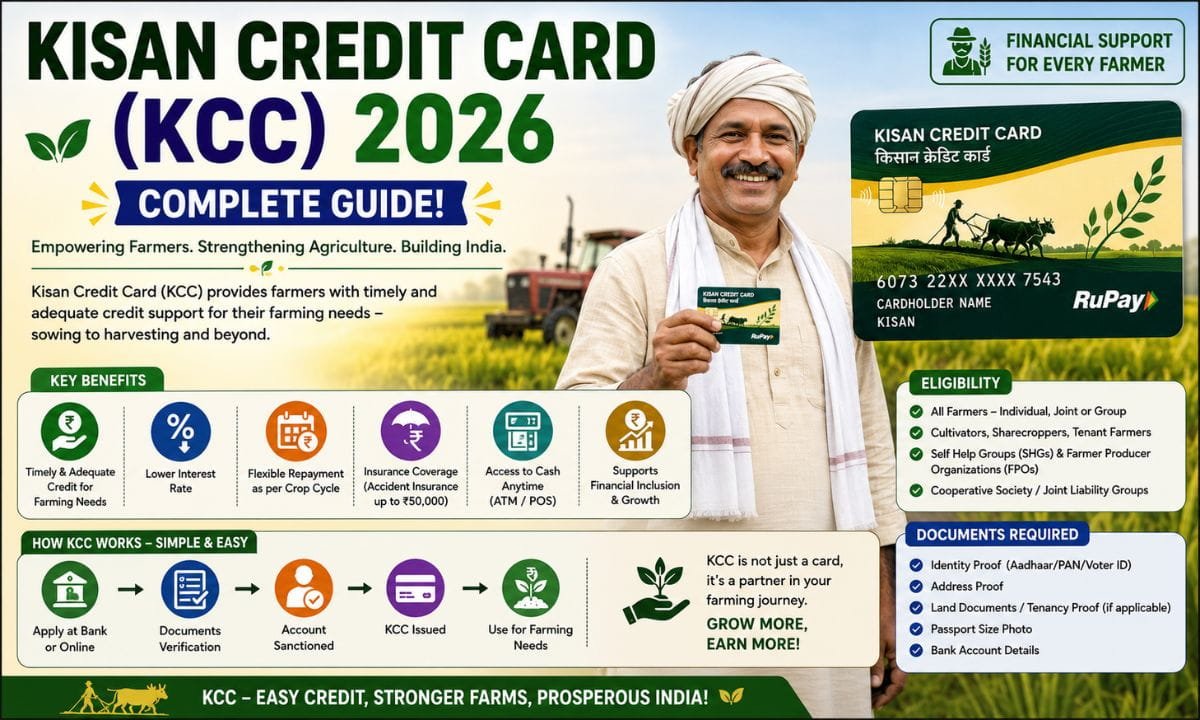
Kisan Credit Card 2026: For millions of Indian farmers, the biggest obstacle to a good harvest is rarely the weather or the soil — it is cash flow. Seeds, fertilisers, pesticides, irrigation, labour, and equipment all need to be paid for months before a single rupee comes back from the sale of the crop. Before the late 1990s, this gap was routinely filled by moneylenders charging exploitative interest rates, trapping generations of farming families in debt.
The Kisan Credit Card (KCC) scheme was designed to break that cycle. Launched in 1998 by the Government of India in association with the Reserve Bank of India (RBI) and the National Bank for Agriculture and Rural Development (NABARD), KCC gives farmers access to timely, affordable, and flexible credit through the formal banking system. Nearly three decades later, it remains one of the largest and most successful financial inclusion programmes in the world, with crores of active cardholders and lakhs of crores of rupees in outstanding credit. This guide walks through everything a farmer, agricultural worker, or interested reader needs to know about the Kisan Credit Card in 2026 — what it is, who can get one, how much credit it offers, what it costs, how to apply for Kisan Credit Card, and how it fits alongside other government schemes like PM-KISAN and PMFBY.
What Is the Kisan Credit Card?
The Kisan Credit Card is not a physical credit card in the way most people imagine plastic cards for shopping. It is a revolving credit facility, similar in spirit to a credit card, that allows a farmer to draw money as and when needed — for buying seeds, fertiliser, or diesel, for paying labourers, or for meeting post-harvest expenses — and to repay it according to the crop cycle rather than a fixed monthly instalment.
The defining feature of Kisan Credit Card is its flexibility. Instead of applying for a fresh loan every season, a farmer is sanctioned a limit once, based on the land they cultivate and the crops they grow, and can then withdraw and repay funds repeatedly within that limit over the year, much like an overdraft facility. This structure recognises that farming income is seasonal and lumpy, arriving mainly at harvest time, while expenses are spread across the growing season.
Originally meant purely for crop production loans, the scope of KCC has expanded considerably over the years. In 2004, it was broadened to cover investment credit and allied farm activities. In 2019, it was extended further to include the working-capital needs of animal husbandry, dairy, and fisheries. Today, a farmer, a dairy owner, a fish farmer, or a beekeeper can all potentially hold a Kisan Credit Card suited to their specific activity.
Who Issues the Kisan Credit Card?
Kisan Credit Card is not tied to a single bank. It is issued through a wide network of lending institutions across the country, including:
- Public Sector Banks such as State Bank of India, Punjab National Bank, and Bank of Baroda.
- Private Sector Scheduled Commercial Banks such as HDFC Bank and ICICI Bank.
- Regional Rural Banks (RRBs).
- Rural Cooperative Banks.
- Small Finance Banks.
- Primary Agricultural Credit Societies (PACS) that are linked with Scheduled Commercial Banks.
This broad network means that a card is generally issued by a bank branch or cooperative society close to where the farmer actually lives and cultivates land, rather than requiring travel to a distant urban branch.
KCC Interest Rate in 2026: How the 4% Effective Rate Works?
One of the most attractive features of the Kisan Credit Card is its interest rate, which is among the cheapest institutional credit available to any borrower category in India. Understanding how this rate is arrived at is important, because the advertised “4%” figure is the result of layered subsidies rather than the bank’s base lending rate.
Here is how the arithmetic works:
- Base rate: Banks generally lend under KCC at a base interest rate of around 7% per annum for short-term crop and allied-activity loans.
- Interest subvention: Under the Modified Interest Subvention Scheme (MISS), the central government reimburses banks a portion of this interest — historically about 1.5 to 2 percentage points — so that the farmer is charged a lower rate upfront.
- Prompt Repayment Incentive (PRI): On top of the interest subvention, the government provides an additional incentive of around 3 percentage points to farmers who repay their loan on time, within the stipulated period.
Combine these two benefits and a farmer who borrows and repays promptly effectively pays interest at around 4% per annum, well below what unsecured personal loans or moneylenders would charge. Farmers who delay repayment lose the prompt-repayment incentive and, in cases of default, revert to the full base rate, which can rise close to 9% per annum. This structure is deliberately designed to reward discipline: the cheaper the loan, the more important it becomes to repay on schedule.
A critical administrative condition attached to this benefit is Aadhaar linkage. Banks require a farmer’s Aadhaar number to be seeded with their bank account in order to route the interest subvention and prompt-repayment incentive correctly. Farmers whose Aadhaar is not linked may end up paying the full, unsubsidised rate even if they repay on time, simply because the subsidy cannot be credited without it.
Kisan Credit Card Loan Limit: The Big Change for 2026
For years, the interest subvention benefit under KCC applied only to short-term loans up to Rs 3 lakh. In the Union Budget for 2025-26, the Finance Minister announced a significant enhancement: raising the ceiling for the Modified Interest Subvention Scheme from Rs 3 lakh to Rs 5 lakh. This was framed as a major boost for farmers, allowing a much larger share of their working-capital needs to be covered at the concessional rate rather than at commercial rates once they crossed the old Rs 3 lakh threshold.
It is worth noting for accuracy that while the Rs 5 lakh ceiling was announced in the Budget speech, some subsequent official circulars implementing the Interest Subvention Scheme for the 2025-26 financial year have continued to reference the Rs 3 lakh limit during the rollout period. Farmers should treat Rs 5 lakh as the announced and intended enhanced ceiling, but should always confirm the specific limit applicable to their loan with their bank branch, since implementation timelines for subsidy ceilings can vary as circulars are updated through the year.
Beyond the interest-subvention ceiling, the actual credit limit sanctioned to an individual farmer is calculated separately by the bank, based on:
- The size of landholding and the crops cultivated
- The scale of finance fixed for each crop in that district (an amount per acre or hectare set by the district-level technical committee)
- Post-harvest and household consumption needs
- Maintenance expenses for farm assets and, where relevant, allied activities like livestock
For marginal and small farmers, banks also offer a simplified “Flexi KCC,” which provides a flexible limit — commonly in the range of Rs 10,000 to Rs 50,000 — based on landholding and cropping pattern, without requiring the more detailed loan calculation used for larger limits. This is meant to make small-ticket credit accessible with minimal paperwork.
The overall sanctioned limit, called the Maximum Permissible Limit (MPL), is typically fixed for five years, factoring in the short-term crop loan requirement plus any term-loan component for capital investment (such as buying equipment or developing irrigation), and is reviewed periodically, usually annually, to account for changes in cropping pattern, price escalation, or scale of finance revisions.
Collateral: Do You Need to Pledge Security?
A major barrier to formal credit historically was the requirement for collateral, which many smallholder farmers simply did not have in a form banks would accept. Kisan Credit Card addresses this directly.
For loans up to Rs 1.6 lakh (and, per revised RBI guidelines, up to Rs 2 lakh in many cases), Kisan Credit Card loans are collateral-free. The farmer does not need to pledge land, gold, or any other asset as security. For loans above this threshold, banks may require security in the form of a mortgage of land or other collateral, depending on internal policy and the size of the loan.
This collateral-free feature is one of the primary reasons Kisan Credit Card has been able to reach tenant farmers, oral lessees, and sharecroppers who do not hold formal land titles.
Who Is Eligible for a Kisan Credit Card?
Eligibility under Kisan Credit Card has been progressively widened since 1998, and by 2026 it covers a broad spectrum of people engaged in agriculture and allied activities:
- Farmers with land: Individual or joint owner-cultivators of agricultural land are the core eligible category.
- Tenant farmers, oral lessees, and sharecroppers: Even without formal land ownership, these farmers can obtain a KCC through self-declaration of cultivation, though the specifics depend on state-level recognition of tenancy. States such as Andhra Pradesh, Odisha, Karnataka, and Tamil Nadu have formal Lease Cultivation Certificate (LCC) systems that make this process smoother; in states without such systems, tenant farmers may face more difficulty establishing eligibility.
- Landless agricultural labourers: Joint Liability Groups (JLGs) and Self Help Groups (SHGs) of landless labourers and tenant farmers can also access KCC collectively.
- Dairy farmers, fishermen, and allied-activity workers: Since the scheme’s 2019 expansion, individuals engaged in animal husbandry, dairying, inland or marine fisheries, and fish farming are eligible, subject to activity-specific documentation such as veterinary certificates, Pashu Aadhaar tags, or valid fishing licenses and boat registration.
- PM-KISAN beneficiaries: Farmers already registered under the PM-KISAN income support scheme are given priority for KCC issuance, and banks have been directed to proactively extend KCC to all PM-KISAN beneficiaries who do not yet have one.
Documents Required to Apply for Kisan Credit Card
While specific requirements can vary slightly by bank, the standard documentation for a KCC application includes:
- A duly filled application form (available at the bank branch or through the PM-KISAN portal)
- Two passport-size photographs
- Identity proof, such as Aadhaar card, voter ID, driving licence, or passport
- Address proof, such as Aadhaar card or driving licence
- Proof of landholding, duly certified by the local revenue authority
- Details of the cropping pattern, including the crops grown and the acreage under each
- Security or collateral documents, where the sanctioned loan amount exceeds the collateral-free threshold
- Any additional documents the sanctioning bank may require based on the applicant’s specific activity (for instance, veterinary certificates for dairy-linked KCC, or fishing licences for fisheries-linked KCC)
Farmers who are already PM-KISAN beneficiaries can generally speed up the process by visiting their PM-KISAN-registered bank branch with their PM-KISAN registration number, since much of their basic identity and land information is already on file.
How to Apply for Kisan Credit Card in 2026?
There are several routes available to apply for a Kisan Credit Card, reflecting the government’s push toward both physical accessibility and digital convenience:
1. Directly at a bank branch: The most traditional route remains visiting the nearest branch of a bank that issues KCC, submitting the application form along with the required documents, and undergoing the bank’s verification and sanctioning process.
2. Through the bank’s website or mobile app: Most major public and private sector banks now allow farmers to initiate a KCC application online, uploading scanned documents and tracking application status digitally, before final verification and disbursement.
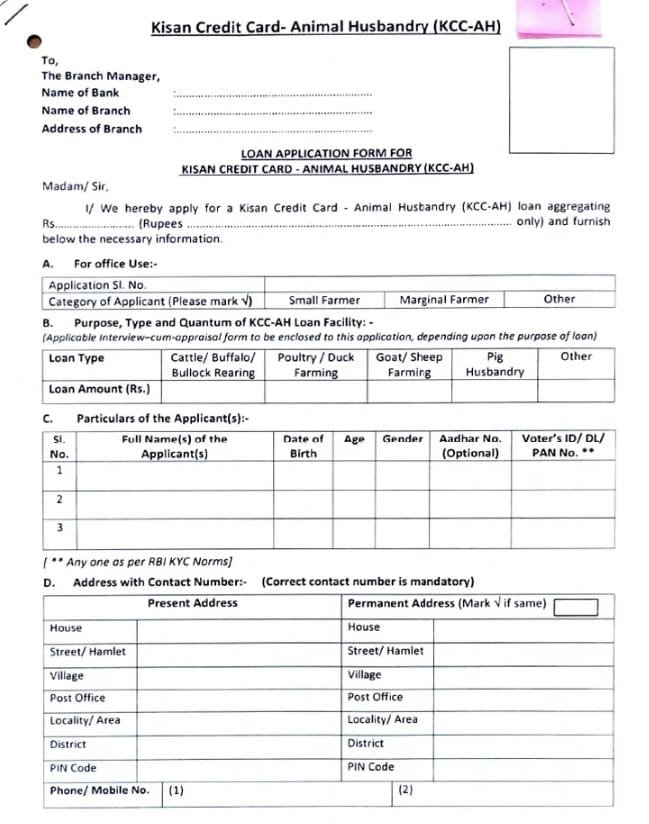
3. Through Common Service Centres (CSCs): For farmers in areas with limited direct bank access, Common Service Centres, which are widely distributed across rural India, can assist in filling and submitting KCC applications.
4. Through the PM-KISAN portal: Since KCC and PM-KISAN are closely linked administratively, the PM-KISAN portal provides a downloadable KCC application form, and PM-KISAN beneficiaries are increasingly being fast-tracked for KCC issuance through this channel.
Once submitted, the bank verifies the applicant’s land records, cropping details, and identity, computes the eligible limit based on the scale of finance for the applicant’s district and crops, and sanctions the KCC. Many banks have also introduced digital versions of the Kisan Credit Card, accessible through platforms like DigiLocker, in addition to a RuPay-enabled physical card that can be used for withdrawals at ATMs and for certain point-of-sale transactions.
What Can KCC Funds Be Used For?
The scope of permissible use under a Kisan Credit Card is broader than many farmers realise. It covers:
- Short-term credit needs for cultivating crops, including seasonal horticultural and vegetable crops
- Working capital for medium- and long-duration crops such as flowers, fruits, spices, plantation crops, aromatic plants, and medicinal plants
- Post-harvest expenses, including financing against electronic Negotiable Warehouse Receipts (e-NWR), which allows farmers to store produce in accredited warehouses and borrow against the receipt rather than being forced to sell immediately at low post-harvest prices
- Working capital for allied activities such as dairy, animal husbandry, fisheries, and beekeeping
- Consumption needs of the farm household, within limits
- Maintenance expenses for farm equipment and assets
One important restriction to keep in mind: KCC funds are meant strictly for agricultural and allied purposes. Diverting the loan to non-agricultural personal or business use is considered misuse and can lead to loan recall, reversion to the full unsubsidised interest rate, and in serious cases, further action by the lending bank.
Insurance Cover Linked to Kisan Credit Card
Kisan Credit Card holders are typically provided with personal accident insurance cover as part of the scheme, protecting the farmer (and in some structures, co-borrowers) against accidental death or disability. Additionally, crop loans disbursed through KCC are generally linked to the Pradhan Mantri Fasal Bima Yojana (PMFBY), India’s flagship crop insurance scheme.
Farmers who take a KCC loan for a notified crop in a notified area are usually auto-enrolled for crop insurance coverage under PMFBY, with the premium deducted from the loan amount, unless the farmer specifically opts out within the stipulated window. Farmers should verify their PMFBY enrolment status at the time of sowing to ensure they are not left without coverage due to an administrative gap.
KCC and PM-KISAN: How the Two Schemes Work Together?
It is common for farmers to conflate PM-KISAN and the Kisan Credit Card, but the two serve very different purposes and are best understood as complementary rather than substitutes.
- PM-KISAN is a direct income-support scheme, providing eligible farmer families a fixed cash transfer (commonly Rs 6,000 per year, paid in instalments) directly into their bank accounts, with no repayment obligation. It exists to supplement farm household income and is not tied to any specific expenditure.
- KCC, in contrast, is a credit facility. It provides working capital that must eventually be repaid, at a subsidised interest rate if repaid promptly, and is meant to finance the actual cost of cultivation and allied activities.
- Because they solve different problems — one boosting income, the other providing affordable credit — most small and marginal farmers benefit from holding both. Recognising this complementarity, the government has actively pushed PM-KISAN beneficiaries toward KCC enrolment, and a large majority of PM-KISAN beneficiaries are now believed to also hold an active Kisan Credit Card.
Can KCC Be Combined With Other Loans?
Farmers sometimes ask whether a Kisan Credit Card loan for agriculture can be combined with other credit lines, such as a Mudra loan for a small non-agricultural business. In principle, this is possible, since KCC is restricted to agricultural and allied purposes while Mudra loans are meant for non-farm micro-enterprises, so the two do not overlap in purpose.
In practice, however, banks assess a borrower’s total credit exposure across all loans before sanctioning any new facility, which means a farmer already carrying a substantial KCC limit may receive a comparatively smaller Mudra sanction, or vice versa, depending on the bank’s internal risk assessment.
Renewing, Enhancing, and Reviewing Your KCC Limit
A Kisan Credit Card is not a one-time transaction; it needs periodic attention.
- Annual review: Banks typically review KCC accounts every year to ensure the account is being operated properly and that repayment is on track.
- Five-year renewal cycle: The overall Maximum Permissible Limit is generally fixed with a five-year horizon in mind, incorporating projected increases in scale of finance over time, though it is subject to review and adjustment.
- Requesting an enhancement: If a farmer’s cropping area increases, or they shift to higher-value crops, they can apply for an enhancement to their KCC limit at the time of renewal. The bank will typically revisit the scale of finance applicable to the new cropping pattern before deciding on a revised limit.
- Losing subvention benefits: If a farmer notices that they are being charged full interest rather than the subsidised rate, the most common reasons are a default or delayed repayment in the previous cycle (which claws back the prompt-repayment incentive), incomplete Aadhaar linkage, or, in rarer cases, a temporary pause or delay in the disbursal of the government’s subvention allocation. Farmers facing this issue should raise it directly with their branch manager to identify the specific cause.
The Discipline of Timely Repayment
It bears repeating, because it is central to how KCC actually functions in practice: the low, subsidised interest rate is conditional, not automatic. A farmer who borrows under KCC and repays within the stipulated period, generally within twelve months of drawal for short-term crop loans, or as per the sanctioned schedule for other purposes, retains eligibility for both the interest subvention and the prompt-repayment incentive, bringing their effective cost of borrowing down to around 4% per annum. A farmer who repays even a single day late can lose these benefits for that drawal, and a farmer who defaults altogether reverts to the bank’s full commercial rate, which can be more than double the subsidised rate.
This structure is a deliberate policy choice: it uses the promise of cheap credit as an incentive for financial discipline, rather than offering a blanket low rate regardless of repayment behaviour. For farmers, the practical takeaway is straightforward — treat the KCC repayment date with the same seriousness as any other important agricultural deadline, because missing it is expensive in a very direct, quantifiable way.
Scale of the KCC Scheme
The scale of the Kisan Credit Card programme today is substantial. Outstanding credit disbursed through operative KCC accounts has grown many times over since the scheme’s early years, crossing roughly Rs 10 lakh crore in cumulative operative credit and benefiting well over 7.7 crore farmers across the country, spanning crop cultivation, dairy, and fisheries. This makes KCC one of the largest agricultural credit programmes anywhere in the world, and a central pillar of India’s broader financial inclusion strategy for rural households.
The RuPay KCC Card and Digital Access
A lesser-known but increasingly important feature of the modern Kisan Credit Card is its RuPay debit-card component. Many banks now issue KCC holders a physical RuPay-enabled card linked to their credit account, allowing withdrawals directly from ATMs rather than requiring a branch visit every time funds are needed. This is particularly useful during peak sowing or input-purchase periods, when a farmer may need cash quickly and cannot afford to wait in a bank queue.
Alongside the physical card, several banks have begun offering a digital version of the KCC that can be stored and accessed through DigiLocker, India’s government-backed digital document wallet. This digital card carries the same sanctioned limit and terms as the physical card and can serve as a convenient backup or reference, particularly for younger, more digitally comfortable farmers or their family members who may handle banking transactions on their behalf.
Banks have also increasingly adopted co-lending arrangements, where public sector banks partner with non-banking financial companies (NBFCs) to jointly finance KCC accounts. Where implemented, this model has generally helped reduce the time taken to sanction and disburse loans, since NBFC partners often bring faster on-ground verification capacity in areas where bank branch density is lower.
Choosing Between Banks: What to Compare
Since KCC is offered by hundreds of banks and cooperative institutions across the country, farmers are not limited to a single provider and can, in principle, compare options before applying. While the core interest-subvention benefit is standardised by the central government and does not vary by lender, a few practical factors can still differ meaningfully from one bank to another:
- Processing time: Some banks, particularly those with a strong rural branch network or an active cooperative structure in a given district, tend to process KCC applications faster than others.
- Ease of digital application and tracking: Larger public and private banks generally offer more developed mobile app and website interfaces for tracking application status, viewing statements, and managing repayments online.
- Local presence and relationship banking: For many farmers, particularly in remote areas, the deciding factor is simply which bank or cooperative society has an accessible branch or field officer nearby, since ongoing renewal, enhancement, and query resolution depend heavily on being able to reach the branch conveniently.
- Additional bundled benefits: Some banks bundle KCC accounts with additional facilities, such as preferential rates on farm equipment loans or simplified processes for warehouse-receipt financing, which can be worth asking about at the time of application.
Farmers already holding a savings account with a particular bank, especially one where their PM-KISAN payments are credited, will often find it simplest and fastest to apply for KCC through that same bank, since much of their identity, address, and account information will already be on file.
State-Level Variations Worth Knowing
While Kisan Credit Card is a centrally designed scheme, some aspects of its implementation are shaped by state-level systems, most notably around tenant farmers. States such as Andhra Pradesh, Odisha, Karnataka, and Tamil Nadu have introduced formal Lease Cultivation Certificate (LCC) systems, which give tenant farmers, oral lessees, and sharecroppers a documented basis for establishing their cultivation rights when applying for KCC.
In states without an equivalent system, tenant farmers may find it harder to establish eligibility and may need to rely more heavily on local revenue authority certification or group-based lending structures such as Joint Liability Groups. Farmers who cultivate leased land are encouraged to check with their state agriculture department or local revenue office about whether an LCC-equivalent system exists in their area, since it can materially simplify the KCC application process.
Final Thoughts
Nearly three decades after its introduction, the Kisan Credit Card has evolved from a simple crop-loan instrument into a comprehensive credit and insurance product covering the full range of agricultural and allied activities that Indian farm households depend on. The enhancements announced for 2025-26, particularly the move to raise the interest-subvention ceiling to Rs 5 lakh, reflect a continued policy commitment to deepening formal credit access in rural India and reducing farmers’ dependence on informal, high-cost lenders.
For farmers considering a Kisan Credit Card application in 2026, the essential steps are straightforward: confirm eligibility based on landholding or activity, gather the required documentation, apply through a convenient channel such as a local bank branch, a Common Service Centre, or the PM-KISAN portal, and, once sanctioned, treat repayment discipline as non-negotiable in order to retain access to the lowest possible effective interest rate. Farmers who are also PM-KISAN beneficiaries should treat Kisan Credit Card as a natural next step, since the two schemes together offer a meaningful combination of income support and affordable working capital that can materially ease the financial pressure of the agricultural cycle.
As with any government financial scheme, specific limits, interest rates, and procedural requirements can be revised through budget announcements and RBI circulars over the course of the year. Farmers are advised to confirm the latest applicable terms with their bank branch or through official government channels such as the PM-KISAN portal or RBI notifications before finalising any KCC application or renewal.
Official Sources
| Kisan Rin Portal (Government of India) | CLICK HERE |
| Department of Financial Services (Ministry of Finance) | CLICK HERE |
| Department of Agriculture & Farmers Welfare | CLICK HERE |
Kisan Credit Card – Common Questions Farmers Ask
Can a farmer without land ownership get a Kisan Credit Card ?
Yes. Tenant farmers, oral lessees, and sharecroppers can obtain a Kisan Credit Card through self-declaration of cultivation, and landless farmers organised into Joint Liability Groups are also eligible, though the ease of doing so depends on whether the farmer’s state has a formal system for recognising tenancy.
Can I get both a Kisan Credit Card and a Mudra loan?
In principle yes, since they cover different purposes, but banks will look at your overall credit exposure, which may affect the size of each individual sanction.
Is PM-KISAN the same as Kisan Credit Card ?
No. PM-KISAN is a no-repayment income-support cash transfer, while Kisan Credit Card is a repayable credit facility. They are designed to be used together, not as substitutes for one another.
What happens if I use KCC funds for something other than agriculture?
This is treated as a misuse of the facility and can lead to loan recall, reversion to the full commercial interest rate, and potentially further action by the bank.
Do I need collateral for a Kisan Credit Card loan?
Not for loans up to the collateral-free threshold, which stands at Rs 1.6 lakh to Rs 2 lakh depending on the bank and current guidelines. Above that, banks may require security.
Is a Kisan Credit Card loan available to fishermen?
Yes. Since the scheme’s expansion, inland and marine fishermen and fish farmers are eligible, generally requiring a valid fishing licence or boat registration certificate as part of the application.