
Atal Pension Yojana 2026: Retirement planning is no longer a concern reserved for salaried professionals with provident funds and gratuity benefits. For the millions of Indians working in the unorganised sector — daily wage earners, domestic helpers, street vendors, drivers, farmers, and small shop owners — old age often arrives without any structured financial safety net. The Atal Pension Yojana, commonly known as APY, was designed precisely to fill this gap. Launched by the Government of India in 2015, this scheme has grown into one of the largest voluntary pension programmes in the country, and in 2026 it continues to be a vital tool for building a secure retirement on a small budget.
This Atal Pension Yojana guide walks through everything a prospective or existing subscriber needs to know about APY in 2026 — its eligibility rules, the benefits it offers, how the contribution and pension amounts are calculated, the application process, taxation aspects, and answers to the questions people ask most often about the scheme.

What Is the Atal Pension Yojana 2026?
The Atal Pension Yojana is a government-backed, defined-benefit pension scheme administered by the Pension Fund Regulatory and Development Authority, widely known as PFRDA. It was introduced as part of the broader National Pension System framework but was specifically tailored for workers who do not have access to formal retirement benefits such as the Employees’ Provident Fund or a government pension.
Under Atal Pension Yojana, a subscriber contributes a small, fixed amount every month (or quarterly, or half-yearly, depending on preference) between the age of joining and the age of 60. Once the subscriber turns 60, the scheme begins paying a guaranteed monthly pension for the rest of their life. Unlike market-linked retirement products such as mutual funds or the regular National Pension System, Atal Pension Yojana does not expose the subscriber’s contributions to market volatility. The Atal Pension Yojana amount is fixed and guaranteed by the Central Government at the time of enrolment, which is what makes the scheme especially attractive to risk-averse, lower-income savers who cannot afford to see their retirement corpus shrink due to market swings.
As of early 2026, the Atal Pension Yojana has crossed nine crore total enrolments, and the financial year 2025-26 turned out to be the strongest year yet for new sign-ups, with more than 1.35 crore fresh subscribers joining in that single year alone. This growth reflects both rising awareness of retirement planning among informal-sector workers and continued government push through banks and post offices to widen the scheme’s reach.
Is Atal Pension Yojana Still Active in 2026?
Yes. The Atal Pension Yojana remains fully active in 2026. The Union Cabinet has approved the continuation of the Atal Pension Yojana with funding support up to the financial year 2030-31, putting to rest any doubts about its future. This extension means that both existing subscribers and new applicants can continue to rely on the scheme’s guarantees without concern about it being discontinued in the near term.
Alongside the continuation, the government and PFRDA have also introduced procedural updates. From October 2025 onward, new subscriber registrations are being accepted only through a revised application form that includes a FATCA and CRS declaration, in line with updated regulatory guidelines. Banks and post offices offering APY services have been instructed to use only this updated form for fresh enrolments.
Who Is Eligible for Atal Pension Yojana in 2026?
Eligibility for Atal Pension Yojana is intentionally kept simple so that it remains accessible to workers with limited financial literacy or documentation. The core eligibility conditions for 2026 are as follows.
Age criteria: An applicant must be between 18 and 40 years old at the time of joining. This wide window is a deliberate design choice. Someone who joins at 18 gets the maximum possible number of years to contribute — up to 42 years — which keeps their monthly contribution very low. Someone who waits until 40 has only 20 years left before the pension starts, so their contribution for the same pension amount is significantly higher.
Citizenship: Only Indian citizens can enrol in the scheme. Non-resident Indians were previously allowed to join, but current guidelines restrict fresh enrolment of NRIs, so applicants should confirm their residency status before applying.
Bank or post office account: The applicant must hold an active savings bank account or a post office savings account. This account is essential because all Atal Pension Yojana contributions are collected through auto-debit, so the account must be functional and adequately funded on the contribution due dates.
Aadhaar and mobile number linkage: The savings account used for Atal Pension Yojana must be linked to the subscriber’s Aadhaar number and an active mobile number. This linkage supports identity verification, transaction alerts, and other communication regarding the account.
Income tax status: This is one of the most important eligibility restrictions to understand. Since 1 October 2022, individuals who pay income tax are not permitted to join the Atal Pension Yojana. This rule was introduced specifically to keep the scheme focused on its intended beneficiaries — low-income and unorganised-sector workers — rather than allowing higher-income taxpayers to benefit from a scheme designed for those without formal retirement security.
If a person joins Atal Pension Yojana and it is later discovered that they were an income taxpayer at the time of joining or afterward, the account is liable to be closed, and only the accumulated savings (without the government guarantee or co-contribution, where applicable) will be returned to the subscriber.
Minimum contribution period: Subscribers are required to contribute for a minimum of 20 years before they become eligible for the guaranteed pension. This is why the scheme sets the upper age limit for joining at 40 — even someone joining at that age will complete 20 years of contribution by the time they turn 60.
It is worth noting that while the scheme is designed primarily for unorganised sector workers, it is technically open to any eligible Indian citizen who is not an income tax payer, regardless of their occupation, provided they meet the age and account requirements.
Documents Required to Open an APY Account
Enrolling in Atal Pension Yojana does not require an elaborate paper trail. The documents typically needed include:
- A savings bank account or post office savings account, already active and in the applicant’s name.
- A registered mobile number, used for OTP-based verification and for receiving contribution alerts and account updates.
- Proof of age, which can be an Aadhaar card, birth certificate, or school leaving certificate, to confirm that the applicant falls within the 18 to 40 age bracket.
- KYC documents, such as a PAN card or other valid identification, if requested by the bank or post office managing the account.
- A nominee’s details, since Atal Pension Yojana requires the subscriber to name a nominee who will receive the accumulated pension wealth in case both the subscriber and their spouse pass away.
Benefits of the Atal Pension Yojana
The appeal of Atal Pension Yojana lies in a combination of simplicity, affordability, and government backing. Here are the key benefits that make it a compelling option for retirement planning in 2026.
Guaranteed monthly pension
The centrepiece of the scheme is a guaranteed monthly pension ranging from 1,000 rupees to 5,000 rupees, payable for life starting at age 60. Subscribers choose their desired pension slab — 1,000, 2,000, 3,000, 4,000, or 5,000 rupees — at the time of enrolment, and the required contribution is calculated accordingly. Because the pension amount is fixed and guaranteed by the government rather than dependent on market performance, subscribers know exactly what they will receive decades before they retire.
Affordable, flexible contributions
Monthly contributions under Atal Pension Yojana are deliberately kept low, starting from as little as 42 rupees a month for an 18-year-old opting for the smallest pension slab. Subscribers can choose to pay monthly, quarterly, or half-yearly, whichever suits their income pattern best. This flexibility is particularly useful for workers whose earnings are seasonal or irregular, such as farmers or daily wage labourers.
Family protection through spousal continuation
If the subscriber dies before reaching 60, or after starting to receive the pension, their spouse is entitled to receive the exact same pension amount for the rest of their life. This spousal continuation benefit effectively extends the financial security of the scheme to the subscriber’s immediate family, not just the individual who enrolled.
Return of corpus to nominee
After both the subscriber and the spouse have passed away, the accumulated pension wealth — the total corpus built up through contributions and returns — is paid out in a lump sum to the nominee designated by the subscriber. This ensures that the family does not lose out on the savings even after both primary beneficiaries are gone.
Government guarantee
Because Atal Pension Yojana is backed by the Central Government, the promised pension amount is protected even if the returns generated by the underlying pension fund fall short of projections. In such a scenario, the government makes up the shortfall to ensure the subscriber still receives the guaranteed pension. This guarantee is what distinguishes Atal Pension Yojana from purely market-linked retirement products and gives it particular appeal among cautious savers.
Tax benefits under Section 80CCD
Contributions made toward Atal Pension Yojana are eligible for a deduction under Section 80CCD of the Income Tax Act, subject to the applicable limits and conditions in force. It is important to note, however, that since income tax payers are barred from joining APY after October 2022, this tax deduction benefit is primarily relevant to those who joined the scheme before that cutoff and later became taxpayers, or in specific circumstances permitted under current tax rules. Prospective subscribers should verify the latest provisions before assuming any tax benefit, since tax rules are subject to periodic revision.
Low default penalty
If a subscriber misses a contribution, a modest penalty is charged, ranging from roughly 1 rupee to 10 rupees per month depending on the contribution slab, until the dues are cleared. This penalty structure is designed to be a gentle nudge rather than a punitive burden, keeping the scheme accessible even to those with inconsistent cash flow.
Portability and ease of management
An APY account is linked to the subscriber’s Aadhaar and bank account, which makes it portable across jobs, locations, and even bank branches. Subscribers do not need to worry about losing their pension account if they change employment or move to a different city, since the account is tied to their individual identity rather than to a specific employer.
Atal Pension Yojana Contribution Chart 2026
The exact monthly contribution a subscriber needs to pay depends on two factors: the age at which they join the scheme, and the monthly pension amount they choose. The general principle is straightforward — the younger you are when you join, and the smaller the pension you choose, the lower your monthly contribution will be, because your money has more time to grow and compound before you start drawing the pension.
Below is an indicative contribution chart showing the approximate monthly contribution required for each pension slab, based on the subscriber’s age at entry.
- At age 18: a monthly contribution of about 42 rupees secures a 1,000 rupee pension, while 210 rupees secures the maximum 5,000 rupee pension.
- At age 20: contributions range from roughly 50 rupees for the 1,000 rupee pension slab up to around 248 rupees for the 5,000 rupee slab.
- At age 25: contributions range from about 76 rupees for the 1,000 rupee pension up to approximately 376 rupees for the 5,000 rupee pension. For a 3,000 rupee pension specifically, a 25-year-old would contribute around 226 rupees a month.
- At age 30: contributions range from roughly 116 rupees for the 1,000 rupee slab to about 577 rupees for the 5,000 rupee slab.
- At age 35: contributions rise further, with the 1,000 rupee slab requiring a higher monthly amount and the 5,000 rupee slab climbing toward the 900-rupee range, reflecting the shorter contribution window remaining.
- At age 40: this is where contributions peak, since the subscriber has only 20 years left before turning 60. At this age, the 1,000 rupee pension slab requires a contribution of around 291 rupees a month, while the maximum 5,000 rupee pension slab requires the highest contribution under the scheme, at approximately 1,454 rupees a month.
These figures are indicative and drawn from the officially published PFRDA contribution tables, which are also displayed at every bank branch and post office offering APY. Because the exact contribution amount is fixed based on actuarial calculations tied to the subscriber’s exact age in completed years at entry, it is always advisable to confirm the precise figure with your bank or through the official APY contribution chart before enrolling, rather than relying solely on approximate figures.
How the Atal Pension Yojana Calculator Works?
To make it easier for prospective subscribers to understand what they will need to pay and what they will eventually receive, most banks, post offices, and financial websites offer an Atal Pension Yojana calculator. Using this tool typically involves three simple inputs.
- First, the applicant enters their current age. Second, they select their desired monthly pension amount from the five available slabs — 1,000, 2,000, 3,000, 4,000, or 5,000 rupees. Third, they may choose their preferred contribution frequency, whether monthly, quarterly, or half-yearly.
- Once these details are entered, the calculator instantly displays the exact monthly contribution required, the total number of years the subscriber will need to contribute before turning 60, and often an estimate of the total amount that will be paid into the scheme over the subscriber’s working life. Some calculators also show an estimate of the lump sum that would be payable to a nominee in the unfortunate event of the subscriber’s death, which typically corresponds to the accumulated pension wealth at that point in time.
- For instance, a 25-year-old who wants a monthly pension of 3,000 rupees after turning 60 would typically be shown a required monthly contribution of around 226 rupees. Over 35 years of contribution, this adds up to a modest but meaningful investment that secures a lifelong guaranteed income later.
- Similarly, someone who enters the scheme at 18 and opts for the top pension slab of 5,000 rupees a month would see a monthly contribution requirement of around 210 rupees, spread across 42 years — a relatively small sum given the length of the accumulation period.
- Using an Atal Pension Yojana calculator before enrolling is strongly recommended, since it allows a prospective subscriber to compare how contribution amounts change across different ages and pension slabs, helping them choose an option that fits comfortably within their monthly budget while still securing a meaningful pension.
How to Apply for Atal Pension Yojana in 2026?
Enrolling in Atal Pension Yojana can be done through either an online or an offline route, depending on what is more convenient for the applicant.
For the online route, an applicant can visit their bank’s net banking portal or mobile banking application, most of which now have a direct Atal Pension Yojana enrolment option. Alternatively, applications can be submitted through the official enps portal maintained for National Pension System and APY registrations. The applicant will need to provide their Aadhaar number, registered mobile number, bank account details, and choose their preferred pension amount and contribution frequency. Verification is typically completed through an OTP sent to the registered mobile number.
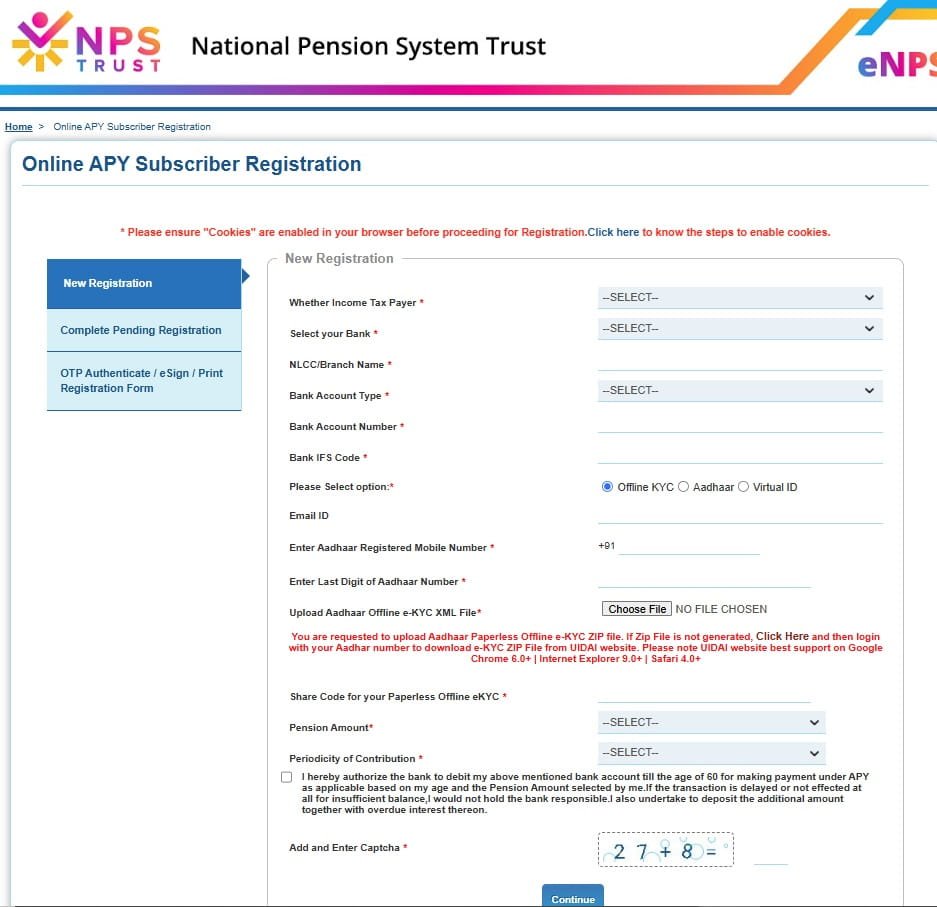
For the offline route, an applicant can visit the nearest bank branch or post office that offers APY services. They will need to fill out the physical Atal Pension Yojana application form, which since October 2025 must be the revised version that includes the FATCA and CRS declaration.
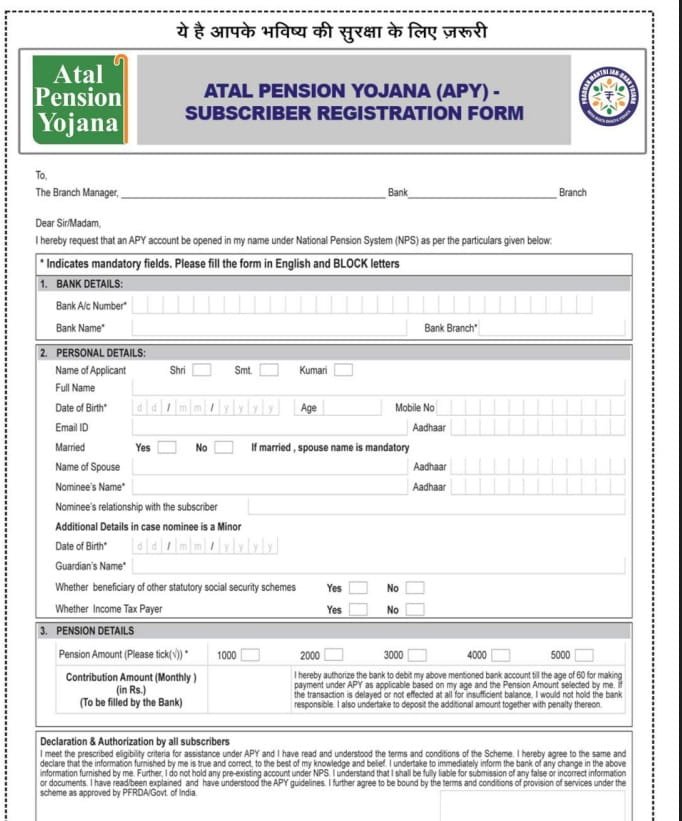
Along with the form, the applicant submits their Aadhaar number, mobile number, and provides instructions for the auto-debit of contributions from their linked savings account. Once the application is processed, the subscriber receives a Permanent Retirement Account Number, commonly known as a PRAN, which serves as the unique identifier for their Atal Pension Yojana account.
After enrolment, the chosen contribution amount is automatically deducted from the linked savings account on the due date each month, quarter, or half-year, depending on the frequency selected. Subscribers are encouraged to maintain sufficient balance in their linked account around the contribution date to avoid the small default penalty.
Atal Pension Yojana – Exit and Withdrawal Rules
Because Atal Pension Yojana is a long-term retirement product, early or partial withdrawal is generally not permitted. The scheme is structured this way to ensure that subscribers stay committed to building their retirement corpus rather than treating it as a short-term savings account.
- At age 60, the subscriber can begin withdrawing their guaranteed monthly pension for life, based on the slab they chose at the time of joining.
- In case of the subscriber’s death before age 60, the spouse has the option to either continue contributing to the account for the remaining period and eventually receive the same pension, or to exit the scheme and receive the accumulated pension wealth as a lump sum.
- Voluntary exit before the age of 60 is allowed only in specific circumstances, such as the subscriber’s terminal illness or death, in accordance with the PFRDA’s Exit and Withdrawal Regulations. In such cases, the accumulated corpus, including the subscriber’s own contributions and the returns earned, is paid out, though the government-guaranteed pension amount itself is only applicable to those who complete the full contribution term.
- Partial withdrawals during the contribution period are not permitted under normal circumstances, reinforcing the scheme’s design as a dedicated retirement vehicle rather than a general savings account.
Atal Pension Yojana vs National Pension System
Prospective subscribers sometimes wonder how Atal Pension Yojana compares to the broader National Pension System, since both are regulated by PFRDA and share some structural similarities. The key difference lies in the nature of returns. APY offers a guaranteed, fixed pension amount that does not fluctuate based on market performance, making it a defined-benefit scheme. The National Pension System, on the other hand, offers market-linked returns, meaning the eventual pension amount depends on how the underlying investments perform over time, with no guaranteed minimum payout.
This makes Atal Pension Yojana better suited to individuals who prioritise certainty and are contributing relatively small amounts, while the National Pension System may appeal more to those seeking potentially higher returns and who are comfortable with market-related risk, often at higher contribution levels.
Who Should Consider Enrolling in Atal Pension Yojana?
While the scheme is open to any eligible citizen, it is particularly well suited to certain categories of savers. Young workers just starting their careers in the informal economy stand to benefit the most, since joining at 18 or in the early twenties locks in the lowest possible contribution for a given pension amount, and the long accumulation period allows even small monthly payments to build a meaningful retirement income. Gig workers, delivery personnel, and platform-based workers who lack any employer-provided retirement benefit also find Atal Pension Yojana useful, since the scheme does not depend on a formal employment relationship and can be maintained independently through auto-debit from a personal savings account.
Homemakers who do not have an independent income stream but hold a savings account in their own name can also enrol, giving them a degree of financial independence in old age that is not tied to a spouse’s earnings or pension. Small business owners and self-employed professionals who do not fall into the income tax bracket, such as small traders, artisans, and agricultural workers, are another natural fit, since they typically lack access to structured retirement products like the Employees’ Provident Fund.
On the other hand, individuals who already have access to strong employer-sponsored retirement benefits, or who fall into higher income tax brackets, are either ineligible or may find that other market-linked retirement instruments better suit their financial goals, given that APY’s pension ceiling of 5,000 rupees a month is designed to provide a baseline safety net rather than a comprehensive retirement income for higher earners.
Common Mistakes Subscribers Should Avoid
Even though Atal Pension Yojana is a simple scheme by design, a number of avoidable mistakes can reduce its effectiveness for subscribers. One common error is choosing a pension amount without first using a calculator to check the affordability of the corresponding contribution over the full term. Selecting a higher pension slab may feel appealing at the time of enrolment, but if the monthly contribution becomes difficult to sustain years later, the subscriber risks accumulating penalties or, in more serious cases of prolonged default, losing the benefit of continuous compounding.
Another frequent mistake is failing to maintain sufficient balance in the linked savings account on the scheduled contribution date. Since contributions are collected through auto-debit, an account with insufficient funds results in a missed contribution and an accruing penalty, even if the subscriber did not intend to skip payment. Setting a calendar reminder a few days before the debit date, or maintaining a small buffer balance, can help avoid this issue.
Subscribers sometimes also neglect to update their nominee details after major life events such as marriage or the birth of a child, which can create complications when the accumulated pension wealth is eventually paid out. It is advisable to review and update nominee information periodically to ensure it reflects the subscriber’s current wishes.
Finally, some individuals continue contributing to an APY account after becoming income tax payers without realising that this is a violation of the current eligibility rules introduced in October 2022. Since such accounts are liable to be flagged during verification and may lose access to the government guarantee, it is important for subscribers whose financial circumstances change over time to stay informed about how those changes affect their continued eligibility.
Final Thoughts
The Atal Pension Yojana remains one of the most practical retirement solutions available to India’s unorganised workforce in 2026. Its combination of low, flexible contributions, a government-guaranteed pension, family protection through spousal continuation, and straightforward enrolment through banks and post offices makes it an accessible starting point for anyone without access to formal retirement benefits. With the scheme’s continuation confirmed through the financial year 2030-31 and enrolment numbers at an all-time high, APY is positioned to remain a cornerstone of India’s social security architecture for years to come.
That said, prospective subscribers should always verify the latest contribution chart, eligibility conditions, and tax provisions directly with their bank, post office, or the official PFRDA and Jan Suraksha portals before enrolling, since minor procedural updates are periodically introduced. Starting early, even with a small monthly contribution, remains the single most effective way to maximise the benefit this scheme has to offer.
Official Sources
| PFRDA | CLICK HERE |
| Apply for Atal Pension Yojana in 2026 | CLICK HERE |
| Atal Pension Yojana application form | CLICK HERE |
Atal Pension Yojana – Frequently Asked Questions
What is the full form of APY and PRAN?
APY stands for Atal Pension Yojana. PRAN stands for Permanent Retirement Account Number, which is the unique identifier assigned to every subscriber’s pension account.
Can a homemaker or self-employed person join APY?
Yes. The scheme is open to any eligible Indian citizen between 18 and 40 years of age with a savings account, regardless of their occupation, as long as they are not an income tax payer. This includes homemakers, self-employed individuals, farmers, and workers across the unorganised sector.
Can an income tax payer still get benefits from an old APY account?
If a person joined APY before the October 2022 restriction came into effect and has since become an income tax payer, existing guidance suggests such accounts may face restrictions or closure upon verification, since the scheme’s continuing benefits, including the government guarantee, are intended for non-taxpayers. Anyone in this situation should check directly with their bank or the PFRDA helpline for the most current treatment of their account.
What happens if I stop paying my contributions?
If contributions are missed, a small penalty accrues each month until the dues are cleared. If the account remains inactive for an extended period without contributions, it may eventually be frozen or deactivated, though the subscriber’s accumulated savings are not forfeited and can typically be withdrawn.
Can I change my chosen pension amount later?
Subscribers are generally allowed to increase or decrease their chosen pension slab, but this facility is usually limited to once a year, and it is advisable to choose the initial pension amount carefully to avoid the complications and revised contribution calculations that come with switching later.
Is APY better than a fixed deposit for retirement planning?
APY and fixed deposits serve different purposes. A fixed deposit offers a lump sum with interest but does not automatically convert into a lifelong monthly pension unless specifically structured to do so. APY, by contrast, is purpose-built to deliver a guaranteed monthly income for life after age 60, along with spousal continuation and nominee benefits, making it more directly suited to retirement income planning, especially for those without access to employer-provided pension benefits.