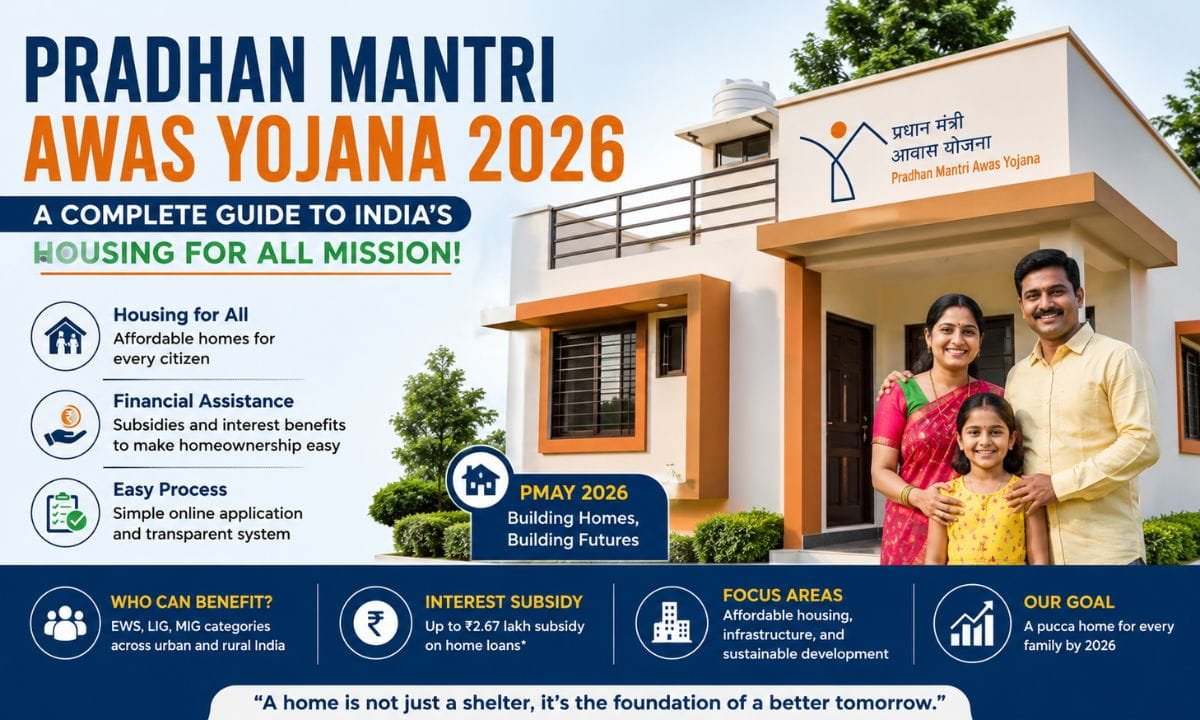
Pradhan Mantri Awas Yojana 2026: Owning a home is one of the most basic aspirations of every Indian family, yet for millions of economically weaker and low-income households, this dream has long remained out of reach because of high property prices, limited access to credit, and the absence of institutional support. To address this gap, the Government of India launched the Pradhan Mantri Awas Yojana 2026 (PMAY), a flagship housing scheme designed to ensure that every eligible family in the country, whether in a city or a village, has access to a pucca house with basic amenities such as water, sanitation, and electricity.
The Pradhan Mantri Awas Yojana 2026 was launched on 25 June 2015 with the ambitious vision of “Housing for All.” Over the past decade, PMAY has grown into one of the largest government-funded housing programmes anywhere in the world, and it continues to evolve through new phases, revised guidelines, and expanded budgets. This article offers a complete and detailed overview of Pradhan Mantri Awas Yojana 2026, covering its history, objectives, structure, eligibility criteria, subsidy amounts, application process, required documents, and the latest updates for 2026.
Pradhan Mantri Awas Yojana 2026 – Origins and Objectives of the Scheme
When Pradhan Mantri Awas Yojana 2026 was first announced, the government’s stated ambition was straightforward: to provide a pucca house to every houseless family and every family living in kutcha or dilapidated housing by the year 2022, which marked 75 years of India’s independence. A decade later, the scheme has not merely survived the revision of its own deadline; it has been expanded, restructured, and relaunched under a second phase that targets an additional one crore urban homes by 2029.
The Pradhan Mantri Awas Yojana operates under two broad verticals based on geography:
- Pradhan Mantri Awas Yojana – Urban (PMAY-U), which caters to families living in towns and cities.
- Pradhan Mantri Awas Yojana – Gramin (PMAY-G), which caters to families living in rural areas.
Both verticals share the same underlying philosophy, that housing is a basic human need and a foundation for dignity, health, and economic mobility, but they are structured differently to suit the distinct realities of urban and rural India.
The Journey So Far: PMAY-Urban 1.0
The original PMAY Urban phase, which ran from 2015 to 2024, sanctioned over 119 lakh houses across 4,331 towns and cities in India. This first phase focused on four broad components: in-situ slum redevelopment, credit-linked subsidy for home loans, affordable housing in partnership with private developers, and beneficiary-led individual house construction.
Under the erstwhile Credit Linked Subsidy Scheme (CLSS) component of PMAY-Urban 1.0, an interest subsidy of 6.5%, 4%, and 3% was made available on loan amounts up to ₹6 lakh, ₹9 lakh, and ₹12 lakh respectively for eligible beneficiaries belonging to the Economically Weaker Section, Lower Income Group, and Middle Income Group categories. This subsidy mechanism helped lakhs of first-time homebuyers reduce the overall cost of their home loans, and it laid the foundation for the more expansive interest subsidy scheme that continues under the current phase of the mission.
Union Cabinet Approval of PMAY-U 2.0
Recognising that the goal of “Housing for All” required a longer runway and a larger outlay, the Union Cabinet approved the Pradhan Mantri Awas Yojana-Urban 2.0 scheme, along with the continuation of Pradhan Mantri Awaas Yojana-Gramin for the period from Financial Year 2024-25 to 2028-29. Briefing the media at the time, the government indicated that three crore new houses would be constructed under the Pradhan Mantri Awas Yojana in this extended phase, of which two crore houses would be built in rural areas and one crore in urban areas, with a total budgetary provision of ₹3,06,137 crore.
The urban component of this Pradhan Mantri Awas Yojana new phase was formally introduced under the goal of “Housing for All,” and it continues to offer eligible first-time homebuyers financial support to ensure that every family can access a home equipped with sanitation, water, and electricity. PMAY-U 2.0 runs for five years, from September 2024 through 2029, and is designed to help urban families in the Economically Weaker Section, Low-Income Group, and Middle-Income Group categories buy, build, or re-purchase a house in an urban area.
Scale and Budget of PMAY-U 2.0 in 2026
The Pradhan Mantri Awas Yojana has continued to gain momentum through 2026. PMAY Urban 2.0, launched in September 2024, remains actively open for applications in 2026, with a target of building 1 crore new urban houses, and the scheme covers all cities that have urban local bodies. For the financial year 2026-27, the scheme has been allocated a budget of ₹85,522 crore, and the framework now also includes a new Middle Income Group II (MIG-II) category, in addition to processing 2.88 lakh fresh house approvals in February 2026 alone. As of March 2026, PMAY stands as the largest government-funded housing program in the world in terms of scale, and the rural component alone carries a target of 4.95 crore houses under its extended framework.
The Four Verticals of PMAY-Urban 2.0
One of the most important things to understand about PMAY-U 2.0 is that it is not a single, one-size-fits-all scheme. It is structured as four different verticals, each designed for a different situation, and once a vertical is selected by an applicant, it generally cannot be changed at a later stage, so applicants are advised to choose carefully. Applicants can avail of benefits under any one of the following four verticals: Beneficiary-Led Construction (BLC), Affordable Housing in Partnership (AHP), Affordable Rental Housing (ARH), and the Interest Subsidy Scheme (ISS).
- Beneficiary-Led Construction (BLC)
The BLC vertical is meant for families who already own a plot of land and wish to construct a new house or enhance an existing one. Under this vertical, direct financial assistance is provided if the applicant owns a piece of land and wants to build or remodel a home. This vertical provides financial assistance of up to ₹2.5 lakh to individual eligible families belonging to the Economically Weaker Section category, having an annual income of up to ₹3 lakh, to help them construct new pucca houses of up to 45 square metres on their own available land.
There is also a defined construction timeline attached to this vertical. Beneficiaries under BLC must complete construction within 12 months of receiving the first instalment of Pradhan Mantri Awas Yojana assistance. Importantly, a house constructed under the PMAY-U 2.0 scheme can only be used for residential purposes and cannot be used for any other activity, and beneficiaries are not permitted to sell, transfer, sub-lease, or rent out the house for a period of five years from the date of completion.
The scheme also makes provisions for families who do not own land of their own. In the case of landless beneficiaries, States and Union Territories may, at their own expense, provide heritable but non-transferable land rights, known as pattas, to the family, making them eligible beneficiaries under the BLC vertical.
- Affordable Housing in Partnership (AHP)
The AHP vertical is designed for families who do not own land but still wish to purchase a home. Under this component, housing units are built by public or private builders in coordination with State governments, for those who do not own land. Central assistance of ₹1.5 lakh per EWS house is provided by the Government of India in projects where at least 35% of the total houses are reserved for the EWS category, and a single project must have at least 250 houses to qualify. This vertical focuses on building affordable housing projects through collaborations with public and private agencies, ensuring that at least 25% of the houses in each project are reserved for EWS beneficiaries. Under this vertical, houses of up to 45 or 60 square metres carpet area are supported, depending on the specific component.
- Affordable Rental Housing (ARH)
The ARH vertical is a relatively newer and increasingly prioritised component of the scheme, aimed at addressing the housing needs of migrant workers and other transient urban populations who may not wish to purchase a home immediately. This vertical is aimed at urban migrants, students, and working women who are looking for clean, hygienic rental spaces close to commercial hubs, without the long-term burden of buying a home.
Under this vertical, the Ministry of Housing and Urban Affairs has also initiated Affordable Rental Housing Complexes (ARHCs) as a sub-scheme, aimed at providing urban migrants and the urban poor working in the industrial sector, as well as in the non-formal urban economy, access to dignified and affordable rental housing close to their workplace. The government has also been inviting private and public entities to construct, operate, and maintain such rental housing complexes for eligible EWS and LIG families, working women, and industrial employees.
- Interest Subsidy Scheme (ISS)
The ISS vertical is the modern-day successor to the erstwhile Credit Linked Subsidy Scheme, and it is aimed at making home loans more affordable for first-time buyers. This scheme is designed to make housing loans more affordable for eligible beneficiaries, building on the success of the earlier PMAY-CLSS programme that ran from 2015 to 2022, under which lakhs of beneficiaries were assisted in availing interest subsidies on their home loans. Under the current ISS vertical, the scheme offers an interest subsidy benefit of a maximum of ₹1.80 lakh for a family, and this amount is disbursed by the National Housing Bank in five equal annual instalments of ₹36,000 each, provided the loan remains active and has more than 50% of the principal outstanding at the time of each release.
This subsidy can be availed alongside a regular home loan, and it is credited directly to the loan account to reduce the overall repayment burden on the borrower, through Direct Benefit Transfer.
Income Criteria and Eligibility for PMAY-U 2.0
Eligibility for PMAY-U 2.0 is primarily determined by the applicant’s household income, which places them into one of the recognised income categories. Beneficiaries from the Economically Weaker Section category are defined as those having an annual household income of up to ₹3 lakh, beneficiaries of the Lower Income Group category are those with an annual household income between ₹3 lakh and ₹6 lakh, and Middle Income Group beneficiaries are those with an income limit of up to ₹9 lakh, with a further Middle Income Group II segment recently added to expand coverage.
Beyond income, a few other conditions generally apply across all verticals. Urban beneficiaries mainly receive a home loan interest subsidy, while rural beneficiaries receive direct financial assistance for house construction. The core eligibility principle across the scheme remains the same: the applicant’s family must belong to the EWS, LIG, or MIG segment, must be living in an urban area, and must not own a pucca house anywhere in the country.
An important and progressive feature of the scheme is its emphasis on women’s ownership of property. Under PMAY-U 2.0, female ownership of the house, either solely or jointly, is mandatory for the EWS and LIG categories, although it is not compulsory for the MIG categories. This provision has been credited with improving women’s access to property rights and financial independence across urban India.
House Size Norms Under PMAY-U 2.0
The Pradhan Mantri Awas Yojana also defines the minimum and maximum size of houses that can be supported under each vertical, to maintain consistency and prevent misuse of funds. Houses of up to 45 square metres, 60 square metres, and 120 square metres carpet area are supported under the BLC/AHP, ARH, and ISS verticals respectively, and the scheme supports construction of houses of not less than 30 square metres carpet area, along with basic infrastructure.
Documents Required to Apply for PMAY-U 2.0
Applicants need to prepare a set of documents before applying online for Pradhan Mantri Awas Yojana, as the process now relies heavily on Aadhaar-based verification. To apply for PMAY-U 2.0, applicants are required to submit their Aadhaar details, including Aadhaar number, name as per Aadhaar, and date of birth, along with the Aadhaar details of family members, and active bank account details linked with Aadhaar, including the account number, bank name, branch, and IFSC code. Applicants under the BLC vertical must also submit their land ownership documents, in PDF format.
Additionally, beneficiaries need to submit a copy of their Aadhaar card, bank account details, an undertaking confirming they meet the eligibility criteria in the prescribed format, land ownership documents in case of the BLC vertical, and any other documents specifically required by the State, Union Territory, Urban Local Body, or Primary Lending Institution involved.
For those applying under the Interest Subsidy Scheme through a bank or housing finance company, additional documents are usually required. These commonly include a copy of the sales agreement and the allotment letter for the house being purchased, a formal declaration confirming that the applicant and their family do not own any existing pucca house, and proof that the woman’s name is included in the property documents, wherever applicable. This includes the Sales Agreement and Allotment Letter for the house, along with a formal declaration confirming that no existing pucca house is owned by the applicant and the applicant’s family.
How to Apply for Pradhan Mantri Awas Yojana -U 2.0 Online?
The application process for Pradhan Mantri Awas Yojana -U 2.0 has been designed to be largely digital, though offline assistance is also available for those who need it. A beneficiary meeting the eligibility criteria defined under the scheme may submit the application through the Unified Web Portal of PMAY-U 2.0, through a Common Service Centre, or by visiting the concerned Urban Local Body or Municipality in which they reside.
The broad steps to apply online for Pradhan Mantri Awas Yojana are as follows:
Step 1: Visit the official PMAY-U 2.0 portal and locate the application section for beneficiaries.
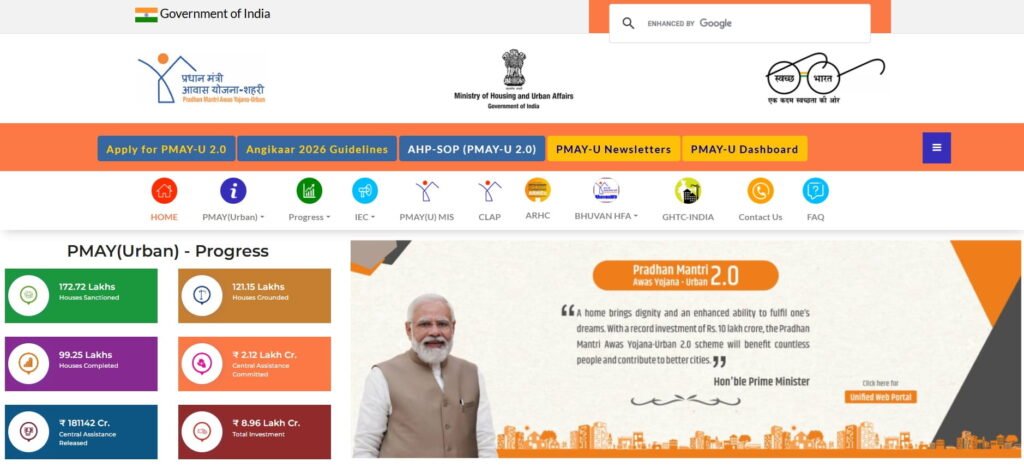
Step 2: The applicant will be required to undergo an eligibility check for the scheme by entering their annual income and choosing the relevant scheme vertical as per their needs, whether it is BLC, AHP, ARH, or ISS.
Step 3: Once the eligibility check is completed, the applicant must give consent for Aadhaar authentication and complete the required verification, which typically involves receiving and entering an OTP sent to the Aadhaar-linked mobile number.
Step 4: Fill in all personal details including the applicant’s name exactly as per Aadhaar, date of birth, gender, religion, marital status, father’s and mother’s name, contact details and email address, employment and income details, household category such as EWS, LIG, or MIG, current address, proposed house address, and complete family member details.
Step 5: Upload the required documents, including Aadhaar details, bank account information, and, where applicable, land ownership documents.
Step 6: Submit the application and note down the application reference number for future tracking of the Pradhan Mantri Awas Yojana application status.
Applicants are advised to read all official instructions carefully before proceeding. The application portal typically displays official instructions for PMAY-U 2.0 in both English and Hindi, and applicants are encouraged to read them carefully, since understanding which vertical applies to their situation before proceeding is critical, as the choice generally cannot be changed later.
Monitoring, Transparency, and Accountability
To ensure that funds are used properly and that construction actually takes place as claimed, the scheme relies on modern digital monitoring tools. All houses sanctioned under PMAY-U 2.0 are geo-tagged and digitally monitored at multiple construction stages, to ensure real-time tracking of construction progress, prevention of duplication or misuse of funds, and timely completion with accountability. This digital-first approach has been one of the defining features distinguishing the current phase of the scheme from earlier housing programs, which often struggled with verification and leakage of benefits.
The Angikaar 2026 Campaign and Recent Developments
As the scheme has matured, the government has also launched targeted campaigns to accelerate specific components of the programme. One of the most significant recent developments is the Angikaar 2026 national campaign, which focuses on fast-tracking 11 lakh Beneficiary-Led Construction homes and integrating solar infrastructure under the PM Surya Ghar: Muft Bijli Yojana directly into newly approved PMAY units. This integration of housing and renewable energy infrastructure reflects a broader effort to make PMAY homes not just structurally sound but also more sustainable and cost-effective to run in the long term for beneficiary families.
Pradhan Mantri Awaas Yojana – Gramin (PMAY-G)
While the urban component of PMAY tends to receive significant media attention because of its scale of investment in cities, the rural component of the scheme, PMAY-Gramin, is equally significant, if not larger, in terms of the sheer number of houses it aims to construct. PMAY-Gramin is designed to give financial assistance to families without a pucca house in rural areas so that they can build or buy one, and it forms the rural counterpart of PMAY-Urban.
Selection of Beneficiaries Under Pradhan Mantri Awas Yojana -G
Unlike the urban scheme, which relies on individual online applications and an eligibility calculator, the rural scheme largely identifies beneficiaries through survey-based data. Pradhan Mantri Awas Yojana -Gramin selects beneficiaries from Socio Economic Caste Census data and the Awaas+ survey list, which are then verified by the local gram sabhas. This process is intended to ensure that assistance reaches genuinely eligible households, particularly those that may not have easy access to digital application systems.
Eligible households under this scheme include those with no house at all, or those living in a kutcha or dilapidated house, provided they are included in the SECC or Awaas+ list, with priority given to Scheduled Caste and Scheduled Tribe households, minorities, freed bonded labourers, widows, and persons with disabilities. This priority-based approach ensures that the most vulnerable sections of rural society are not left behind in the housing rollout.
Financial Assistance Under PMAY-Gramin
The quantum of financial assistance under Pradhan Mantri Awas Yojana -G varies depending on the terrain and difficulty of the area in which the beneficiary resides. PMAY-Gramin provides ₹1.20 lakh for houses constructed in plain areas, and ₹1.30 lakh for houses constructed in hilly or otherwise difficult areas.
This direct financial assistance is not typically released as a single lump sum. Instead, assistance is paid out in instalments that are tied to the progress of construction, and this progress is verified using geo-tagged photographs uploaded at each stage, ensuring transparency in the disbursement process.
Convergence With Other Government Schemes
One of the more thoughtful design features of Pradhan Mantri Awas Yojana -Gramin is its convergence with other flagship rural welfare schemes, which helps beneficiaries meet the additional costs associated with building a house beyond just materials. Beneficiaries also receive support under convergence arrangements, including around 90 to 95 days of wages under the Mahatma Gandhi National Rural Employment Guarantee Act for construction-related labour, along with assistance for constructing toilets under the Swachh Bharat Mission.
This convergence model ensures that a Pradhan Mantri Awas Yojana -G beneficiary is not just given money to build four walls and a roof, but is supported in building a functional home with sanitation facilities, while also being compensated for the labour that goes into construction, which might otherwise be an unaffordable burden for many rural households living at the margins of poverty.
Scale of the Rural Housing Mission
The scale of the rural component of PMAY remains extraordinarily large. As noted earlier, of the three crore new houses envisaged under the extended PMAY framework running from Financial Year 2024-25 to 2028-29, two crore houses are targeted for construction in rural areas alone, compared to one crore in urban areas.
The rural target specifically has been reported at 4.95 crore houses under the extended PMAY-G framework, reflecting the scheme’s continuing focus on addressing the substantial rural housing deficit that still exists across the country.
How to Apply and Check the Beneficiary List?
For urban applicants, tracking the Pradhan Mantri Awas Yojana status of an application and checking eligibility is done primarily through the official PMAY-U web portal. Prospective applicants and existing beneficiaries are encouraged to check their city’s eligibility on the official PMAY portal before the next beneficiary list is published. Through the official government portal, applicants can check their eligibility, submit their application, upload the required documents, and track their application status at any stage of the process.
For rural applicants, since selection is largely survey-driven rather than application-driven, checking one’s status typically involves verifying whether the household’s name appears on the SECC or Awaas+ list published for the relevant gram panchayat, which can usually be confirmed through the local gram sabha or the Pradhan Mantri Awas Yojana -Gramin online portal using details such as the registration number or the head of household’s name.
Why Pradhan Mantri Awas Yojana Matters: Broader Socio-Economic Impact?
Beyond the numbers and the financial mechanics, Pradhan Mantri Awas Yojana has had a wide-ranging impact on Indian society. Access to a pucca house improves health outcomes by reducing exposure to extreme weather, contaminated water, and unsafe living conditions that are common in kutcha housing. It also enhances the safety and dignity of women and children, particularly in households where inadequate housing previously meant a lack of privacy or secure storage for belongings.
The Pradhan Mantri Awas Yojana strong emphasis on women’s ownership of property under the urban vertical, and its priority given to widows and persons with disabilities under the rural vertical, reflects a broader policy intent to use housing as a tool for social equity, not merely shelter. Home ownership also often serves as a gateway to accessing formal credit in the future, since a legally owned property can be used as collateral, thereby integrating previously excluded families into the formal financial system.
The convergence of PMAY-G with MGNREGA and Swachh Bharat Mission, and the newer integration of Pradhan Mantri Awas Yojana -U with the PM Surya Ghar solar rooftop scheme, also illustrate a shift in policy thinking, from viewing housing as an isolated welfare deliverable, to viewing it as one node within a broader network of interconnected government schemes that together aim to improve rural and urban standards of living.
Challenges and Considerations
Despite its scale and ambition, a programme of this size inevitably faces implementation challenges. Ensuring accurate identification of genuinely eligible beneficiaries, particularly in rural areas where survey data can sometimes be outdated, remains an ongoing task for local administrations. Land availability for landless beneficiaries under the BLC vertical, timely disbursement of instalments linked to construction milestones, and coordination between multiple stakeholders such as State governments, Urban Local Bodies, and private developers under the AHP vertical, are all areas that require sustained administrative attention.
Additionally, since the scheme evolves periodically through new guidelines, revised income slabs, and updated subsidy amounts, applicants are strongly advised to always verify the latest rules directly from official government sources before applying, rather than relying solely on older information that may no longer be applicable.
Pradhan Mantri Awas Yojana – Conclusion
Pradhan Mantri Awas Yojana represents one of the most ambitious social welfare undertakings in independent India’s history, aiming to fundamentally alter the housing landscape for millions of economically disadvantaged families across both rural and urban India. From its original 2015 vision of a pucca house for every family, to its current, expanded second phase targeting three crore additional homes by 2029, backed by a budget outlay exceeding three lakh crore rupees, the scheme continues to evolve in scope and ambition.
Whether through the Beneficiary-Led Construction vertical for those with their own land, the Affordable Housing in Partnership vertical for those without, the newly emphasised Affordable Rental Housing vertical for urban migrants and working women, or the Interest Subsidy Scheme for those seeking to make a home loan more affordable, Pradhan Mantri Awas Yojana -Urban 2.0 offers multiple pathways suited to different family circumstances. Meanwhile, Pradhan Mantri Awas Yojana -Gramin continues to address the housing needs of rural India through direct financial assistance, convergence with employment and sanitation schemes, and a survey-based beneficiary identification process designed to reach the most vulnerable households first.
For families considering applying under the scheme, the most important first step remains verifying eligibility through the official government portals, gathering the necessary Aadhaar and bank account documentation in advance, and carefully selecting the vertical that best matches their specific housing situation, since this choice generally cannot be reversed once the application is submitted. As Pradhan Mantri Awas Yojana continues its rollout through 2029, it is set to remain a defining pillar of India’s approach to inclusive urban and rural development, moving the country steadily closer to its long-standing vision of Housing for All.
Official Sources
| OFFICIAL SITE | CLICK HERE |
| CLSS Awas Portal (CLAP) | CLICK HERE |
| Apply for Pradhan Mantri Awas Yojana – Urban | CLICK HERE |
| Contact Number | 011-23060484, 011-23063620, 011-23063567, 011-23061827 |
FAQ’s on Pradhan Mantri Awas Yojana 2026
What is the Pradhan Mantri Awas Yojana (PMAY) 2026?
Pradhan Mantri Awas Yojana (PMAY) 2026 is a flagship housing scheme of the Government of India aimed at providing affordable, permanent houses to eligible urban and rural families. The scheme offers financial assistance and interest subsidies to help eligible beneficiaries purchase, construct, or improve their homes.
Who is eligible to apply for Pradhan Mantri Awas Yojana 2026?
Eligibility depends on factors such as household income, property ownership, and category. Generally, the applicant must not own a permanent house anywhere in India and must fall under eligible income groups—such as EWS (Economically Weaker Section), LIG (Low Income Group), MIG-I, or MIG-II—in accordance with the latest government guidelines.
What financial benefits are available under PMAY 2026?
Eligible beneficiaries can receive financial assistance for house construction or an interest subsidy on home loans under the Credit Linked Subsidy Scheme (if applicable under current government rules). The exact subsidy amount depends on the applicant’s category and the latest official guidelines.
How can I apply for Pradhan Mantri Awas Yojana 2026?
Applicants can apply online via the official Pradhan Mantri Awas Yojana portal or submit their applications at Common Service Centres (CSCs), banks, or authorized government offices. Required documents typically include Aadhaar, proof of income, proof of address, bank account details, and other supporting documents.
How can I check my PMAY application status?
You can track your application status online by visiting the official Pradhan Mantri Awas Yojana website and entering your Assessment ID, application number, or registered mobile number. Offline applicants can also inquire at the office where they submitted their application.
Can I apply for PMAY if I already own a house?
In most cases, no. This scheme is primarily intended for families that do not own a permanent house anywhere in India. However, specific exemptions or revised eligibility criteria may apply under updated government notifications; therefore, applicants should verify the latest rules before applying.