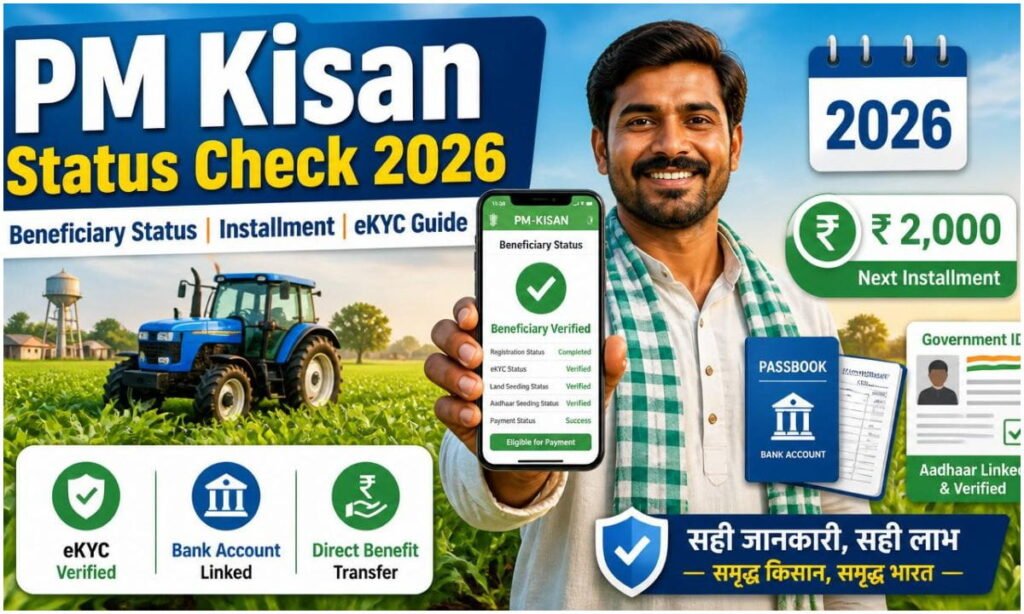
PM Kisan Status Check 2026: The Pradhan Mantri Kisan Samman Nidhi (PM-KISAN) scheme continues to be one of the largest direct income support programmes for farmers anywhere in the world. Launched by the Government of India to supplement the financial needs of landholding farmer families, the scheme transfers ₹6,000 every year to eligible beneficiaries in three equal instalments of ₹2,000 each, paid out roughly every four months through Direct Benefit Transfer straight into Aadhaar-seeded bank accounts.
As 2026 progresses, millions of farmers across the country are once again checking their PM Kisan Status Check 2026, tracking the latest instalment, and making sure their eKYC is complete so that payments are not delayed or blocked. This guide walks through everything a farmer or family member needs to know this year: how the scheme works, how to check your beneficiary status online, how the beneficiary list works village by village, how to complete eKYC through every available method, what to do if your payment is stuck, and answers to the questions farmers ask most often.
What Is PM-KISAN and Why It Matters?
PM Kisan 2026 is a central sector scheme, meaning it is fully funded by the central government rather than shared with the states. Its core purpose is to give farming families a small but dependable cushion of income that can be used for agricultural inputs such as seeds, fertiliser, and equipment, as well as for meeting general household and farming-related expenses. Because the money arrives directly in a bank account rather than through any intermediary, the scheme is designed to be transparent and largely free from leakage.
The PM Kisan Yojana 2026 covers landholding farmer families, defined as a family unit of husband, wife, and their minor children who own cultivable land as per state and Union Territory land records. Identification of beneficiaries is done at the state and UT level based on these land records, which is why accurate, updated land documentation matters so much for eligibility.
Certain categories of people are excluded from the scheme because they fall into a higher economic status bracket. This includes institutional landholders, along with several other categories such as former and current holders of constitutional posts, current and former ministers, mayors, MPs, MLAs, and similarly placed officeholders, as well as serving or retired officers and employees of central and state government departments and their attached offices above a certain pay scale, income tax payees in the last assessment year, and professionals such as doctors, engineers, lawyers, and chartered accountants who are registered with their professional bodies and practising. The idea behind these exclusions is to keep the scheme targeted toward genuinely small and marginal farming households.
The Instalment Cycle: How and When Payments Arrive?
PM-KISAN instalments follow a fixed four-month cycle, released across three periods each year:
- April to July
- August to November
- December to March
This predictable rhythm helps farmers plan ahead for major agricultural activities, since they broadly know when the next tranche of support is likely to arrive, even though the exact release date depends on government scheduling and is usually announced only shortly beforehand.
In 2026, the cycle has already moved through several rounds. The 22nd instalment was released in March 2026, with the Prime Minister formally releasing the funds from an event in Guwahati, Assam. In that round, more than ₹18,640 crore was transferred directly into the bank accounts of over 9.32 crore farmer families through Direct Benefit Transfer.
The PM Kisan 23rd instalment followed in the next cycle, released on 20 June 2026. Under this round, the government transferred ₹18,880 crore to more than 9.44 crore eligible farmers through Direct Benefit Transfer. As with every instalment, only those beneficiaries who had completed their eKYC and whose Aadhaar was correctly seeded with their bank account received the ₹2,000 payment directly into their account. Farmers who had not completed these verification steps at the time of disbursement would have seen their payment held back until the requirements were fulfilled.
Given the established four-month pattern, the PM Kisan 24th instalment 2026 following the June 2026 release would be expected sometime in the August to November 2026 window, though farmers should always rely on the official PM-KISAN portal or verified government announcements for the confirmed date rather than assuming a fixed schedule, since actual release dates can shift depending on administrative and logistical factors.
Why Your Payment Might Be Delayed or Rejected?
Before diving into the status-check process, it helps to understand the most common reasons a farmer’s instalment does not arrive on time. Almost all of them come down to one of a handful of issues:
Incomplete eKYC. This is by far the most common reason for a missed or delayed payment in the current cycle. The government has made eKYC mandatory for every beneficiary, and it must effectively be kept current, since a lapse can freeze future disbursements until it is resolved.
Aadhaar not seeded with the bank account. Even if eKYC is done, if your Aadhaar number is not correctly linked to the specific bank account registered with PM-KISAN, the transfer can fail or be rejected by the banking system.
Land record mismatch. Since eligibility is verified against state land records, any mismatch between your PM-KISAN registration details and the official land record, such as a change in ownership, a spelling difference in the name, or an unmutated inheritance, can cause your name to be excluded from the beneficiary list.
Name or demographic mismatches. Differences between the name, date of birth, or other details on your Aadhaar card and the details on your PM-KISAN registration can trigger a rejection during verification.
Pending state government verification. After a farmer applies or after periodic re-verification drives, applications sometimes sit with the state government for approval before being forwarded for payment. Until this step, sometimes shown on the portal as “Rft Signed by State Government,” is completed, the payment cannot proceed.
Bank account issues. A closed, frozen, or inactive bank account, or one where the IFSC or account number on record is outdated, will also block a transfer.
Most of these issues are correctable, and in most cases a missing name from a village list is simply a data error rather than a permanent rejection. Once the underlying issue is fixed, whether that is updating a mobile number, correcting a spelling, or completing eKYC, the name is typically restored in the next update cycle.
How to Check Your PM Kisan Status Online?
Checking your PM Kisan Status Check 2026 takes only a few minutes if you have your registration number, or your Aadhaar number and registered mobile number, on hand. Here is the step-by-step process using the official portal.
Step 1: Visit the official PM-KISAN portal.
Go to pmkisan.gov.in using any browser on your phone or computer.

Step 2: Locate the Farmers Corner section.
On the homepage, find the “Farmers Corner” panel, which houses most of the tools farmers need, including status checks, eKYC, and the beneficiary list.
Step 3: Click on “Know Your Status.”
This is the main tool for checking your individual beneficiary status, including your instalment history and eKYC status.

Step 4: Enter your registration number.
If you already have your PM-KISAN registration number, enter it directly. If you do not know it, click the “Know Your Registration Number” link nearby, and you will be able to retrieve it by entering your Aadhaar-linked mobile number or your Aadhaar number.
Step 5: Verify using OTP.
An OTP will be sent to your Aadhaar-registered mobile number. Enter this OTP to proceed.
Step 6: View your status.
Once verified, the portal will display your complete status, including your instalment history, the date your most recent instalment was transferred, the bank account it was credited to, your eKYC PM Kisan Status 2026, your Aadhaar-seeding status, and your land-seeding status. This “Know Your Status” module effectively gives you a single consolidated view of everything the government has on file for your application.
If your last transaction shows as successful, the portal will typically display the specific date the amount was credited along with the bank details it went to. If a payment failed or is pending, the status will usually indicate the reason, such as a pending eKYC or a bank account issue, which helps you know exactly what needs fixing.
Checking Status Through the PM-KISAN Mobile App
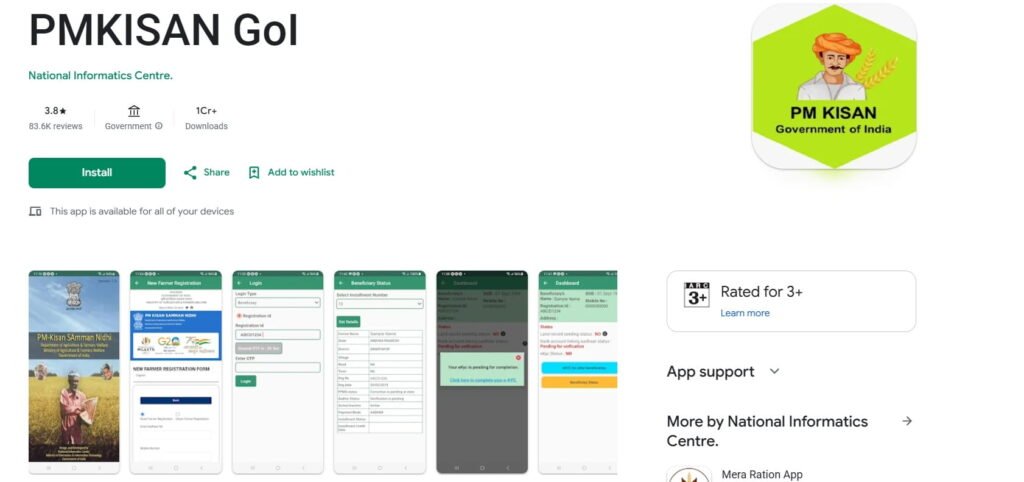
For farmers who find it easier to use a smartphone app than a browser, the PM-KISAN mobile app, available on the Play Store, offers the same status-check functionality along with the option to complete face-authentication eKYC directly from home. This is particularly useful for beneficiaries whose registered mobile number is not linked to their Aadhaar, since the app’s face authentication route does not depend on receiving an OTP.
Checking Status Through a Common Service Centre or Bank
Farmers who are not comfortable with digital tools, or who run into repeated errors online, can visit their nearest Common Service Centre, sometimes also referred to as a Jan Seva Kendra or State Seva Kendra. The CSC operator can look up the status on the farmer’s behalf and, importantly, can also help resolve common errors such as a mismatched Aadhaar link or incomplete eKYC on the spot using biometric verification. Some banks also assist customers in checking PM-KISAN status, though CSCs remain the more consistently reliable offline option, especially in rural areas with lower smartphone penetration.
How to Check the PM Kisan Beneficiary List by Village ?
Separate from checking your individual status, PM-KISAN also publishes a full beneficiary list that can be viewed village by village. This is useful both for confirming your own inclusion and for a village-level view of who else has been approved.
Step 1: Go to the Beneficiary List page on the PM-KISAN portal, found within the Farmers Corner section.
Step 2: Select your location details.
You will need to choose your State, District, Sub-district, Block, and Village from drop-down menus.
Step 3: Click “Get Report.”
The system will then display the full beneficiary list for that village, showing all approved farmers.

Step 4: Look for your name.
Scan the list for your name and cross-check the details shown against your own records.
If your name does not appear on the list, this does not necessarily mean permanent rejection. As noted earlier, missing names are frequently the result of simple data errors such as a pending verification step, an unmutated land record, or an eKYC gap, rather than a deliberate exclusion. In such cases, farmers are generally advised to first review the eligibility rules to rule out an actual disqualification, and if the omission genuinely looks like an error, to raise a grievance through the PM-KISAN portal’s grievance redressal mechanism, or to approach the local agriculture department or CSC for correction. Once the underlying issue is fixed, the name is typically added back in the next list-update cycle.
PM Kisan eKYC: Why It Is Mandatory and How to Complete It ?
Since 2022, eKYC has been a compulsory requirement for every PM-KISAN beneficiary, whether newly registered or already receiving instalments for years. The purpose of eKYC is straightforward: it uses Aadhaar-based authentication to confirm that the person receiving the benefit is a real, verified individual, which helps the government prevent impersonation, duplicate registrations, and fraudulent claims, and ensures that public money reaches only genuine, eligible farmers.
Farmers who do not complete eKYC will not receive their instalment, even if they are otherwise fully eligible in every other respect. Because of this, eKYC status is one of the very first things worth checking whenever an instalment seems delayed.
There are three official ways to complete PM-KISAN eKYC, and farmers can choose whichever suits their situation best.
Method 1: OTP-Based eKYC (Online, via Portal or App)
This is the fastest method and works best for farmers whose mobile number is linked to their Aadhaar.
- Visit the official PM-KISAN portal at pmkisan.gov.in, or open the PM-KISAN mobile app.
- Go to the Farmers Corner section and click on the “eKYC” option.
- Enter your Aadhaar number and click Search or Submit.
- Enter the mobile number linked to your Aadhaar when prompted, and request an OTP.
- Enter the OTP you receive within its validity window.
- Once the OTP is verified, your eKYC will be completed and the portal will update your status, usually reflected within about 24 hours.
Method 2: Biometric eKYC at a Common Service Centre
This route is designed for farmers whose mobile number is not linked to Aadhaar, or who face repeated OTP failures.
- Visit your nearest Common Service Centre or State Seva Kendra, carrying your Aadhaar card and your PM Kisan registration number.
- Inform the operator that you want to complete PM Kisan eKYC.
- The operator will complete the process using fingerprint or iris-based biometric authentication.
- The operator will confirm completion and may provide a reference or acknowledgement number for your records.
This method is generally considered the most reliable option for older beneficiaries or those in areas with lower smartphone penetration, since it does not rely on receiving an SMS OTP at all.
Method 3: Face Authentication via the Mobile App
Introduced as a more accessible digital alternative, face authentication works for any farmer with a smartphone, even if their mobile number is not Aadhaar-linked.
- Download both the PM Kisan mobile app and the Aadhaar Face RD app from the Play Store.
- Open the PM Kisan app and log in using your registered mobile number.
- Go to the eKYC or beneficiary status section within the app.
- Select the face authentication option and enter your Aadhaar number.
- Use your phone’s camera to complete the face scan as prompted.
- Once your face is successfully matched against Aadhaar records, your eKYC is confirmed, generally without any further waiting period.
Government updates through 2026 have positioned face authentication as an increasingly important primary method, largely because it sidesteps the most frequent point of failure in the OTP route: a mobile number that is no longer active or was never properly linked to Aadhaar in the first place.
Checking Your eKYC Status
You can confirm whether your eKYC has already been completed in a couple of ways. On the “Know Your Status” page, your beneficiary record will display an eKYC status field, generally shown as a clear “Done” or “Pending” indicator. Alternatively, if you simply try to start the eKYC process again on the portal and it shows a message that eKYC is already completed, you can take that as confirmation. Farmers can also check status through the eKYS module on the portal or via Kisan-eMitra, the PM Kisan KISAN AI chatbot designed to answer common queries.
Note that after successfully completing eKYC, it can take up to 24 hours for the change to be reflected in your beneficiary status, so it is worth waiting a day before assuming the process failed.
Common eKYC Problems and How to Fix Them ?
Even with three different methods available, farmers regularly run into a handful of recurring issues. Here is how to work through the most common ones.
OTP not received. This usually happens because the mobile number being used is not actually the one linked to your Aadhaar. Double-check which number is Aadhaar-registered; if you are unsure, you can verify this through the UIDAI website. If the correct number is genuinely not receiving the OTP, wait two to three minutes and try the “Resend OTP” option before switching methods. If it still fails, move to face authentication through the app, or visit a CSC for biometric verification instead.
OTP expires before you can enter it. Most OTPs are valid for around ten minutes. If yours expires, simply request a fresh one and enter it promptly.
Server is slow or times out. This is especially common around the time an instalment is about to be released, when traffic on the portal spikes sharply. If you are facing this, try again during off-peak hours, such as early morning or late evening, rather than repeatedly retrying during a busy window.
Mobile number has changed since Aadhaar was linked. If you switched SIM cards or changed your number and never updated it with Aadhaar, OTP-based eKYC simply will not work for you until that link is fixed. In the meantime, face authentication or CSC-based biometric verification will work regardless of which number is currently active on your phone.
Name mismatch between Aadhaar and PM Kisan records. If your name is spelled differently, or details do not otherwise match between the two records, the verification can fail. In this case, it is worth getting the discrepancy corrected either in your Aadhaar details or your PM Kisan registration, whichever is inaccurate, before trying again.
Putting It All Together: A Practical Checklist
For farmers who want a simple routine to follow each cycle, the following checklist covers the essentials:
- First, a few days before an instalment is expected, based on the general four-month cycle, check your status on the “Know Your Status” page using your registration number and OTP verification.
- Second, confirm that your eKYC status shows as complete. If it does not, complete it immediately using whichever of the three methods, OTP, biometric, or face authentication, best fits your situation, rather than waiting until the last moment.
- Third, verify that your Aadhaar is correctly seeded with the specific bank account registered under PM Kisan, since a valid eKYC alone will not help if the account linkage itself is wrong.
- Fourth, cross-check your name against your village’s beneficiary list to confirm you remain listed as approved, and note any change in status compared to the previous cycle.
- Fifth, if anything looks incorrect, whether a missing name, a rejected application, or an unclear payment status, raise it through the portal’s grievance mechanism or visit your nearest CSC or block-level agriculture office promptly, since corrections typically only take effect in the next scheduled update cycle rather than instantly.
- Sixth, keep your Aadhaar-linked mobile number active and updated any time you change SIM cards, since so many of the recurring problems farmers face trace back to an outdated or disconnected mobile number.
Final Thoughts
PM Kisan remains a vital, dependable source of support for crores of farming families across India, and the government’s continued emphasis on eKYC, Aadhaar seeding, and accurate land records reflects an effort to make sure that support reaches genuine beneficiaries with as little delay or leakage as possible. For an individual farmer, staying on top of the process is fairly simple in practice: check your status ahead of each expected instalment, keep your eKYC current using whichever method works best for you, make sure your Aadhaar and bank details are correctly linked, and address any discrepancy in the beneficiary list promptly rather than waiting.
Following this routine each cycle is generally enough to ensure that the ₹2,000 instalment arrives on time, without the last-minute scramble that many farmers otherwise face when an eKYC lapse or a data mismatch is only discovered after a payment has already been missed.
Official Sources
| PM KISAN PORTAL | CLICK HERE |
| PM KISAN MOBILE APP DOWNLOAD | CLICK HERE |
| PM KISAN YOJANA BENEFICIARY LIST | CLICK HERE |
| PM KISAN YOJANA NEW FARMER REGISTRATION | CLICK HERE |
| PM KISAN E-KYC FORM DOWNLOAD | CLICK HERE |
| PM KISAN YOJANA BENEFICIARY STATUS | CLICK HERE |
PM Kisan Status 2026 – Frequently Asked Questions
How much money does PM Kisan provide, and how often?
Eligible farmer families receive ₹6,000 per year, paid in three equal instalments of ₹2,000 each, released roughly every four months.
Is PM Kisan eKYC compulsory for every beneficiary?
Yes. eKYC has been mandatory for all PM Kisan beneficiaries since 2022, and it must be kept current. Payments are held back for anyone whose eKYC has lapsed or was never completed, regardless of how long they have already been receiving benefits.
What if I do not know my PM Kisan registration number?
Use the “Know Your Registration Number” option on the portal, which will retrieve it for you once you enter your Aadhaar-linked mobile number or Aadhaar number.
My name is missing from my village’s beneficiary list. Does that mean I have been rejected?
Not necessarily. In most cases, a missing name reflects a data error, such as a pending land-record update or an incomplete eKYC, rather than a permanent disqualification. Review your eligibility, and if you believe the omission is a mistake, raise a grievance through the portal so it can be corrected in the next update.
Can I complete eKYC if my mobile number is not linked to Aadhaar?
Yes. Use the face authentication method through the PM-KISAN mobile app, or visit a Common Service Centre for biometric verification. Both routes work without needing to receive an SMS OTP.
How soon after completing PM Kisan eKYC will my status update?
Typically within about 24 hours. If it has been longer and your status still shows as pending, it is worth checking again the next day before assuming something went wrong.
Who is not eligible for PM Kisan even if they own farmland?
Institutional landholders, current and former holders of certain constitutional and government posts, serving and retired higher-scale government employees, income tax payees from the last assessment year, and practising professionals such as doctors, engineers, lawyers, and chartered accountants are excluded, since the scheme is targeted at the broader base of small and marginal farming families rather than those in a higher economic bracket.
What should I do if my payment failed even though my PM Kisan eKYC is complete?
Check whether your Aadhaar is correctly seeded with your registered bank account, and confirm the account itself is active and correctly recorded on the portal. If everything appears correct but the payment still failed, visit a CSC or raise a grievance on the portal for further investigation.