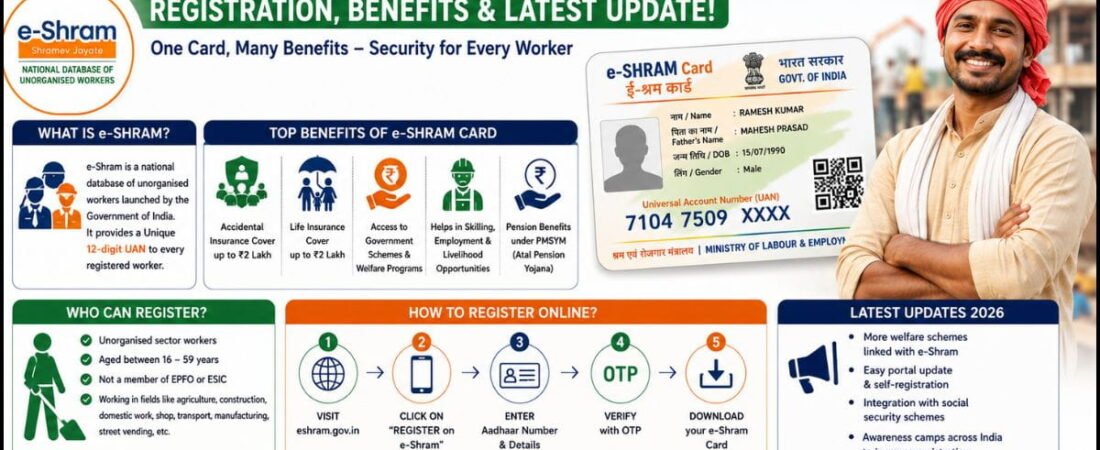
e-Shram Card 2026: India’s workforce is overwhelmingly unorganised. Millions of people — daily wage labourers, domestic workers, street vendors, farm hands, construction workers, gig and platform workers, home-based artisans, and small shopkeepers — work outside the formal system of provident fund and employee insurance coverage. For decades, this vast segment of the workforce had no centralised identity, no unified database, and consequently very limited access to targeted government welfare schemes, insurance cover, or pension benefits. To close this gap, the Ministry of Labour and Employment launched the e-Shram portal in August 2021, with the aim of creating the National Database of Unorganised Workers (NDUW). Every worker who registers on this portal receives an e-Shram Card carrying a lifetime 12-digit Universal Account Number (UAN), which becomes their permanent identity within the unorganised workforce ecosystem.
By 2026, the e-Shram Card initiative has matured considerably. More than 30 crore workers have registered on the portal, the scheme has been extended to gig and platform workers, and it now works as an important gateway to link workers with insurance, pension, disaster relief, and health coverage schemes. This article provides an exhaustive, up-to-date guide on everything you need to know about the e-Shram Card in 2026 — what it is, who should register, the complete registration process, required documents, benefits, common misconceptions, and the latest policy updates.
What Is the e-Shram Card?
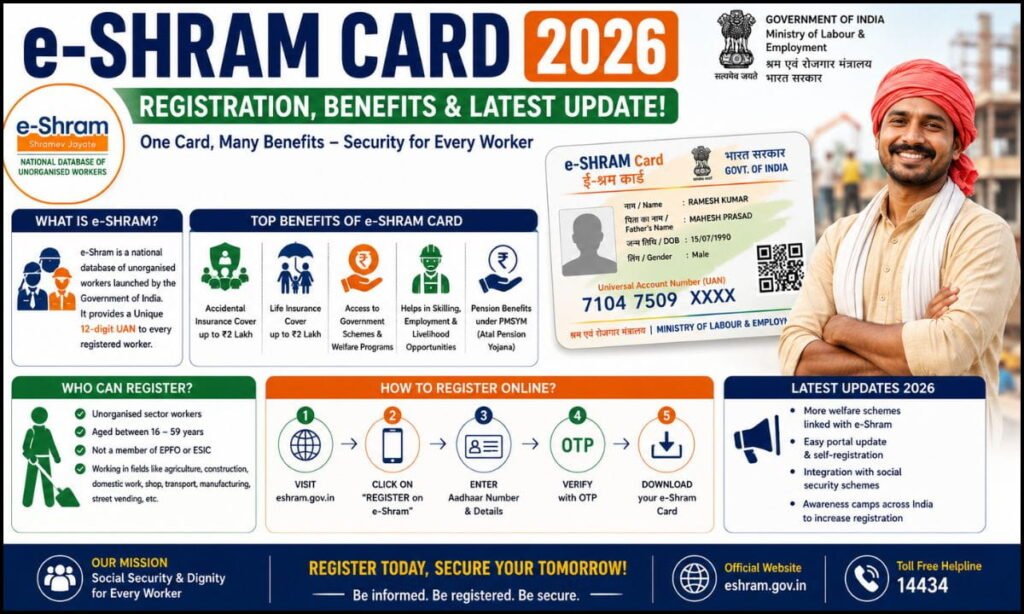
The e-Shram Card is a free identity document issued by the Ministry of Labour and Employment to workers in the unorganised sector. When a worker registers on the eshram.gov.in portal, their personal, occupational, educational, skill, and family details are recorded in the National Database of Unorganised Workers. In return, the worker receives a card bearing a unique 12-digit UAN.
This UAN is portable and permanent — it remains valid for life and does not change even if the worker changes their occupation, employer, or location. The card essentially functions as proof that a person is a recognised unorganised worker, making it easier for the government to identify, verify, and directly transfer benefits to genuine beneficiaries under various welfare and social security schemes. The portal itself is managed by the Ministry of Labour and Employment and was developed to consolidate what were previously scattered, state-specific or sector-specific worker databases into a single national system.
Objectives Behind the e-Shram Initiative
The e-Shram Card scheme was introduced with several clear goals in mind:
- Creating a Unified National Database: Prior to e-Shram, there was no single database that could capture details of all unorganised workers across India. Different states and sectors maintained fragmented records, if any at all.
- Enabling Direct Benefit Transfer (DBT): With Aadhaar and bank account linkage, the government can transfer financial assistance directly into a worker’s account without intermediaries, reducing leakages and delays.
- Providing Social Security Coverage: Registered workers become eligible for accident insurance, and the database is designed to be linked in the future with additional pension and health coverage schemes.
- Improving Targeting of Welfare Schemes: By having verified data on occupation, skill level, and location, the government can design and target schemes more precisely to workers who genuinely need them.
- Portability of Benefits: Since the UAN is valid nationwide, a worker who migrates from one state to another for employment does not lose access to the benefits associated with their registration.
- Formal Recognition for Gig and Platform Workers: As India’s digital economy expands, the government has moved to bring gig workers — delivery riders, cab drivers on aggregator platforms, and similar categories — into the same national database, giving this fast-growing segment formal recognition for the first time.
Who Is Eligible to Register for an e-Shram Card in 2026?
Eligibility for the e-Shram Card is fairly broad, since it is meant to cover nearly the entire unorganised workforce of the country. The core eligibility conditions are as follows:
- Age: The applicant must be between 16 and 59 years of age.
- Sector of Work: The applicant must be working in the unorganised sector. This is an extremely wide category and includes, among others:
- Agricultural labourers, farmers without formal registration, and sharecroppers
- Construction workers, masons, painters, and daily wage labourers
- Domestic workers and house helps
- Street vendors, hawkers, and small shopkeepers
- Migrant workers
- Rickshaw pullers, auto and taxi drivers not affiliated with any formal transport company
- Home-based workers such as tailors, weavers, and handicraft artisans
- Fishermen and workers engaged in allied agricultural activities like dairy, poultry, and animal husbandry
- Gig and platform workers, including delivery partners and app-based cab drivers, who have been progressively brought under the scheme’s coverage
- Not a Member of Formal Social Security Schemes: The applicant must not be an active member of the Employees’ Provident Fund Organisation (EPFO), the Employees’ State Insurance Corporation (ESIC), or the National Pension System (NPS) as a government employee. Since these schemes already provide formal social security cover, individuals contributing to them are considered part of the organised sector and are not eligible for e-Shram registration.
- Not an Income Tax Payer: Individuals who file income tax returns as taxpayers are excluded from registering, since the scheme is specifically targeted at economically vulnerable unorganised workers.
- Aadhaar-Linked Mobile Number: While not strictly a matter of “eligibility,” having a mobile number linked to Aadhaar is practically necessary for smooth self-registration through OTP verification.
There is no minimum income threshold for registration, and no registration fee is charged at any stage of the self-registration process on the official portal.
Documents Required for e-Shram Card Registration
The beauty of the e-Shram registration process lies in its simplicity. Unlike many government schemes that require multiple certificates, e-Shram registration needs only a minimal set of documents:
- Aadhaar Number – This is the primary identity document required for registration and is mandatory.
- Aadhaar-Linked Mobile Number – Required to receive the OTP for identity verification during self-registration.
- Bank Account Details – Including the bank account number and the IFSC code, since this account will be used for any future direct benefit transfers.
- Basic Personal Details – Such as name, date of birth, address, educational qualification, and details of occupation or skill category.
- Family Details (optional but recommended) – Details of nominees or family members can be added to the profile, which may be relevant for insurance claim purposes in case of an eventuality.
No income certificate, caste certificate, employer letter, or photograph upload is required for basic registration, which makes the process considerably faster and more accessible than most other government scheme applications.
Step-by-Step e-Shram Card Registration Process (Self-Registration)
Registering for an e-Shram Card online is designed to be a quick, largely self-service process. Here is the complete, detailed step-by-step procedure:
Step 1: Visit the Official e-Shram Portal
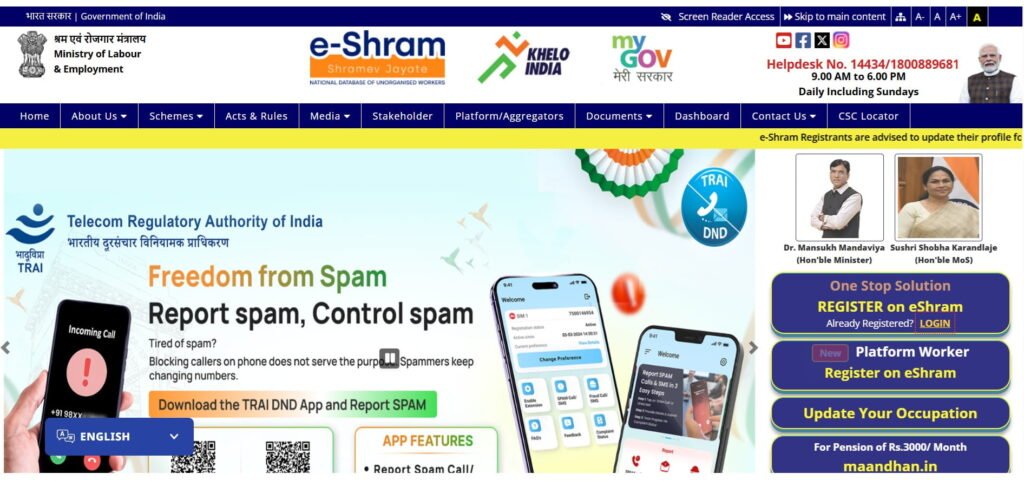
Open a web browser and go to the official website: eshram.gov.in. This is the only official portal for e-Shram registration, and applicants should be cautious of unofficial websites or mobile apps that claim to offer the same service, especially ones that ask for payment.
Step 2: Click on “Register on e-Shram”
On the homepage, locate and click the “Register on e-Shram” (or “e-Shram par Register Karein”) option, which will take you to the self-registration page.
Step 3: Enter Your Aadhaar-Linked Mobile Number
Enter your mobile number that is linked to your Aadhaar card, along with the captcha code displayed on screen. Confirm that you are not an EPFO or ESIC member and not an income tax payer, as prompted by the declaration on the page.
Step 4: Verify With OTP
Click “Send OTP.” An OTP will be sent to your registered mobile number. Enter this OTP in the verification box to proceed.
Step 5: Enter Aadhaar Details
Enter your 12-digit Aadhaar number. You will then be asked to verify your identity again, typically through another Aadhaar-linked OTP, to fetch your demographic details (name, date of birth, gender, and address) directly from the Aadhaar database.
Step 6: Fill in Personal Details
Review and, if necessary, update your personal details such as name, address, and category. You will also need to fill in details regarding your marital status, educational qualification, and any nominee details for insurance purposes.
Step 7: Add Occupational and Skill Details
This is one of the most important sections of the form. Select your occupation from the pre-defined list of categories (construction worker, domestic worker, street vendor, driver, agricultural labourer, gig worker, and so on) and provide details of any specific skills you may have. This information helps the government match you with relevant skill development and employment schemes in the future.
Step 8: Enter Bank Account Details
Provide your bank account number and IFSC code. This step is critical, since all direct benefit transfers, insurance payouts, and future scheme benefits will be routed to this account. It is strongly advised to double-check these details before submission, as errors here are one of the most common reasons benefit transfers fail to reach the intended worker.
Step 9: Review and Submit
Carefully review all the details you have entered across each section. Once satisfied, submit the form.
Step 10: Card Generation
Upon successful submission, your e-Shram Card is generated instantly, along with your unique 12-digit UAN. You can immediately download this card in PDF format from the portal itself.
Most people find that, from start to finish, the entire self-registration process takes approximately 10 to 15 minutes if all details and documents are readily available.
What If Your Mobile Number Is Not Linked to Aadhaar?
If your mobile number is not linked to your Aadhaar, the standard OTP-based self-registration route will not work. In such cases, you have the following alternatives:
- Visit a Common Service Centre (CSC): A CSC operator can complete your registration using biometric authentication (fingerprint or iris scan) instead of an OTP.
- Visit a State Seva Kendra (SSK): Many states have their own citizen service centres that also facilitate e-Shram registration using biometric verification.
- Update Your Mobile Number With Aadhaar First: Alternatively, you can visit your nearest Aadhaar Seva Kendra to link or update your mobile number, after which you can proceed with the standard self-registration process online.
While registration on the official portal remains free, CSC operators may charge a small, government-prescribed service or facilitation fee for helping with the process in person.
How to Download Your e-Shram Card (UAN Card)?
If you have already registered but need to download your e-Shram Card again — for instance, if you lost the original PDF — you can do so easily:
- Visit eshram.gov.in.
- Click on the “Already Registered?” option, typically labelled “Update” or “Download UAN Card.”
- Enter your registered mobile number or your 12-digit UAN.
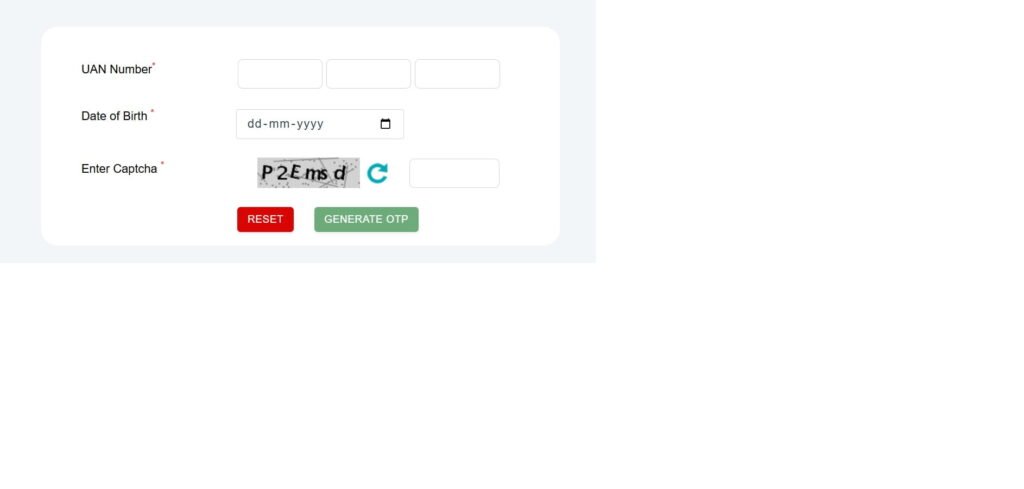
- Verify using the OTP sent to your mobile number.
- Once logged in, select the “Download UAN Card” option to get your card in PDF format.
How to Update Your Profile?
Life circumstances change, and it’s important to keep your e-Shram profile updated so that benefits reach you without interruption. To update your details:
- Log in to the portal using your mobile number or UAN and verify with OTP.
- Navigate to the “Update Profile” section.
- Make changes to details such as your address, mobile number, bank account information, or occupation category.
- After entering the new details, click the “Update” button at the bottom of the page.
Your card will be updated instantly with the new information, and you can download the revised version immediately.
The single most important detail to keep current is your bank account information. Outdated or incorrect bank details are consistently the leading reason why direct benefit transfers or insurance payouts fail to reach registered workers, so it’s worth periodically confirming that your linked account is active and correctly recorded.
How to Check Your e-Shram Registration and Benefit Status?
To check whether your registration is active or whether you are on a current beneficiary list for a specific scheme:
- Visit the official portal and click on “Already Registered? Update.”
- Enter your mobile number and verify using the OTP received.
- Once logged in, your profile will display your registration status and any linked scheme information.
Benefits of the e-Shram Card
The e-Shram Card offers a combination of immediate benefits and gateway access to broader welfare schemes. It is important to have a clear and accurate understanding of what the card currently offers, since a fair amount of misinformation circulates about its benefits.
- Accident Insurance Cover
One of the most concrete and immediate benefits of e-Shram registration is accident insurance coverage of up to ₹2 lakh under the Pradhan Mantri Suraksha Bima Yojana (PMSBY), linked automatically for many registered workers. This cover typically includes:
- ₹2 lakh in case of death due to an accident
- ₹2 lakh in case of total and permanent disability due to an accident
- ₹1 lakh in case of partial disability due to an accident
This insurance cover has, in many cases, been provided free of cost for the first year to registered workers as part of the scheme’s onboarding benefits.
- National Database Registration and Lifetime Identity (UAN)
Simply being part of the National Database of Unorganised Workers is itself a significant benefit. It gives workers, many of whom previously had no formal identity within any labour or welfare database, a permanent, portable, and nationally recognised identity through their UAN — one that stays valid for life, regardless of job changes, employer changes, or relocation.
- Gateway to Government Welfare Schemes
The e-Shram database is increasingly being used by the government to identify and target beneficiaries for a range of welfare schemes. Registered workers are often prioritised or pre-verified for schemes relating to:
- Health insurance coverage, including efforts to link a significant number of e-Shram registered workers with the Pradhan Mantri Jan Arogya Yojana (Ayushman Bharat) for cashless hospitalisation benefits
- Old-age pension schemes, offering monthly pension support after the age of 60 for eligible categories of unorganised workers
- Skill development and vocational training programmes
- Employment exchange and job-matching services, since occupation and skill data captured during registration can be used to connect workers with relevant opportunities
- Disaster Relief Direct Benefit Transfer (DBT)
An important, though less publicised, benefit of e-Shram registration is its role during disaster relief operations. When the government activates disaster relief measures — for instance, during cyclones, floods, heat waves, or crop failures — registered workers in the affected areas can, in many cases, receive direct benefit transfers automatically, without needing to file a fresh application. This works because the government uses the existing e-Shram and Aadhaar-linked bank account data to identify and credit affected workers swiftly. This mechanism has already been used during several state-level relief operations in recent years.
- Recognition for Gig and Platform Workers
With the evolving labour codes recognising platform-based work, gig workers such as delivery riders and app-based drivers who registered early on e-Shram have generally been the first to be identified and considered when new worker-welfare measures for this category have been rolled out. Registering early, even before a specific new benefit is announced, positions a worker to be recognised as soon as the benefit becomes available.
- Facilitates Access to Credit and Formal Financial Inclusion
Since e-Shram registration requires and validates a linked bank account, it indirectly supports financial inclusion goals, helping bring unorganised workers further into the formal banking system, which can be useful when applying for small loans, government-backed credit schemes, or other financial products aimed at low-income workers.
- No Registration Cost and Minimal Documentation
Because registration requires only Aadhaar and a bank account, with no income certificate, caste certificate, or employer verification, it removes many of the traditional bureaucratic barriers that have historically kept unorganised workers out of government databases and welfare programmes.
Clearing Up Common Misconceptions About e-Shram Benefits
Given the scheme’s popularity, a considerable amount of misinformation circulates, particularly on social media and through unofficial messaging forwards. It is important for workers to be aware of the following clarifications:
- There is no regular monthly cash payment under e-Shram in 2026. Any message, app, or website claiming that registered workers automatically receive a fixed monthly amount simply for holding an e-Shram Card is false.
- The one-time ₹1,000 payment was a COVID-19 relief measure from 2021 and is not a recurring or ongoing benefit. It should not be confused with any current scheme.
- Registration does not automatically guarantee pension or health insurance enrolment. While e-Shram data is used to identify and prioritise potential beneficiaries for schemes like old-age pension or Ayushman Bharat, actual enrolment into these schemes typically requires meeting the specific eligibility criteria of that scheme and, in some cases, a separate application or verification step.
- Registration is completely free on the official portal. Any individual, app, or website asking for a registration fee, “processing charge,” or advance payment to guarantee benefits should be treated with suspicion, and such claims should be reported.
Latest Updates on e-Shram Card in 2026
Several developments have kept the e-Shram ecosystem evolving through 2026:
- Over 30 Crore Registrations: As of 2026, more than 30 crore workers have registered on the e-Shram portal, making it one of the largest worker databases in the world. States such as Uttar Pradesh, Bihar, and West Bengal continue to lead in total registrations, reflecting both the size of their unorganised workforce and sustained state-level registration drives.
- Extension to Gig and Platform Workers: With the recognition of platform-based work under updated labour codes, the government has been actively working to bring gig workers — delivery partners, ride-hailing drivers, and similar categories — onto the e-Shram database, issuing them identity cards and formally acknowledging their role in the digital economy.
- Linkage With Ayushman Bharat (PM-JAY): A notable ongoing effort has focused on linking close to one crore e-Shram registered workers with the Pradhan Mantri Jan Arogya Yojana, granting them access to cashless hospitalisation benefits of up to ₹5 lakh per year, thereby combining India’s two major welfare databases for greater impact.
- State-Level Registration Drives: Several states have run focused registration and verification drives to ensure that eligible workers, especially those who registered early but never completed profile verification, actually receive pension and other associated benefits. For example, special drives dedicated to verifying pension eligibility have been carried out in states like Karnataka during defined windows in early 2026.
- Improved Disaster Relief Integration: The use of e-Shram and Aadhaar-linked bank data for automatic disaster relief transfers has been expanded and refined, reducing the need for affected workers to file fresh claims during emergencies.
- Continued Emphasis on Data Accuracy: With the database now exceeding 30 crore entries, the government has placed increasing emphasis on workers updating outdated bank account, address, and mobile number details, since inaccurate data remains the most common reason legitimate benefits fail to reach registered workers.
How e-Shram Card Differs From Other Worker-Focused Schemes?
It’s useful to understand where the e-Shram Card fits relative to other, sometimes confused, government identity and welfare instruments:
- e-Shram vs. Aadhaar: Aadhaar is a universal identity document for all Indian residents, used for general identification purposes. The e-Shram Card, in contrast, is specifically an occupational and social security identity for unorganised workers, built using Aadhaar as its verification backbone.
- e-Shram vs. Ayushman Bharat Card: The Ayushman Bharat Card provides direct health insurance coverage of up to ₹5 lakh for hospitalisation. The e-Shram Card, by itself, does not provide health insurance directly, but the government has been working to link eligible e-Shram registered workers with Ayushman Bharat coverage.
- e-Shram vs. EPFO/ESIC: EPFO and ESIC are formal social security systems meant for organised sector employees with a registered employer contributing on their behalf. e-Shram is meant precisely for those who fall outside this formal system, that is, unorganised sector workers without an employer-based provident fund or insurance contribution.
Why Every Eligible Worker Should Register Without Delay?
A recurring theme across state-level and national experience with e-Shram is that early registration consistently benefits workers when new schemes or relief measures are introduced. Consider, for example, how delivery riders who had already registered on e-Shram were positioned to be recognised first when recent labour code changes began formally acknowledging platform workers — rather than those who had yet to register at all.
The broader lesson holds true across categories of unorganised work: register as early as possible, keep your profile details — especially your bank account and mobile number — accurate and up to date, and do not wait for a specific benefit to be announced before creating your record in the national database. Once a worker is part of the system, they are automatically positioned to benefit from future announcements, drives, and scheme linkages without needing to scramble to register at the last moment.
e-Shram Card – Helpline and Support
For any assistance related to registration, updates, or general queries about the e-Shram scheme, workers can make use of the following official support channels:
- Official Website: eshram.gov.in
- National Toll-Free Helpline: 14434
Workers are strongly advised to rely only on this official portal and helpline number for registration and related queries, and to be cautious of third-party apps, websites, or individuals asking for payment in exchange for registration, updates, or “guaranteed” benefit approval, since the entire self-registration process is free of cost.
e-Shram Card Conclusion
The e-Shram Card represents one of the most far-reaching efforts by the Indian government to formally recognise, register, and protect the interests of the country’s vast unorganised workforce. By 2026, with over 30 crore workers already registered, the scheme has firmly established itself as the backbone of a national worker identity system, one that increasingly connects to insurance, pension, health coverage, and disaster relief mechanisms.
For any unorganised worker who has not yet registered for e-Shram Card — whether a construction labourer, a domestic worker, a street vendor, a farmer, or a gig economy delivery partner — the process takes only about ten to fifteen minutes, requires nothing more than an Aadhaar-linked mobile number and a bank account, and costs nothing at all.
Given the growing range of benefits and schemes being linked to the e-Shram database each year, registering promptly and keeping your profile details accurate is one of the simplest and most valuable steps an unorganised worker in India can take to secure their long-term financial and social security.
Official Sources
| e-Shram Card Official Website | CLICK HERE |
| e-Shram Card Registration | CLICK HERE |
| e-Shram Card Download | CLICK HERE |
| CONTACT NUMBER | 011-23766904 |
e-Shram Card : Frequently Asked Questions
Is there a registration fee for the e-Shram Card?
No. Self-registration through the official portal, eshram.gov.in, is completely free. Only Common Service Centres may charge a small, prescribed facilitation fee for in-person assistance.
Can I register for e-Shram Card if I already have a job in the organised sector?
No. The e-Shram Card scheme is specifically designed for unorganised sector workers. If you are an active member of EPFO, ESIC, or NPS as a government employee, or if you file income tax returns as a taxpayer, you are not eligible to register.
What is the UAN, and why is it important?
The Universal Account Number is a unique, permanent 12-digit number assigned to every registered worker. It remains valid for life, regardless of changes in employer, occupation, or place of residence, and serves as your primary identifier for accessing linked welfare benefits.
Does the e-Shram Card guarantee a monthly pension?
Not automatically. The e-Shram Card and database are used to identify and connect eligible workers to pension schemes for the unorganised sector, but actual pension enrolment generally involves meeting that specific scheme’s eligibility conditions, which may include age and contribution requirements.
What should I do if I don’t receive the OTP during e-Shram Card registration?
This usually means your mobile number is not properly linked to your Aadhaar. In such cases, visit a nearby Common Service Centre or State Seva Kendra, where e-Shram Card registration can be completed using biometric verification instead.
Can gig workers like delivery riders and cab drivers register for e-Shram Card?
Yes. The government has been actively extending e-Shram Card registration to gig and platform workers, recognising their growing presence in the economy and working towards issuing them formal identity cards under the scheme.
How often should I update my e-Shram profile?
There is no fixed schedule, but it is advisable to update your profile promptly whenever your mobile number, address, or bank account details change, since outdated information is the most common reason for missed benefits.