
PM Fasal Bima Yojana 2026: Farming in India has always been a gamble with nature. A farmer can prepare the soil perfectly, sow the best seeds, and follow every recommended practice, yet a single unseasonal hailstorm, an unexpected drought, or a sudden flood can wipe out an entire season’s earnings within hours. For a country where agriculture still supports the livelihoods of a very large share of the population, this vulnerability translates directly into household debt, distress sales of land, and in the worst cases, complete financial ruin for farming families.
It was to address exactly this problem that the Government of India launched the Pradhan Mantri Fasal Bima Yojana, commonly known by its abbreviation PMFBY, on 18 February 2016 under the Ministry of Agriculture and Farmers Welfare. The scheme was designed with a simple but powerful idea at its core: farmers should be able to insure their crops against natural risks by paying only a small, fixed share of the premium, while the government absorbs the much larger remaining cost. In the years since its launch, PMFBY has grown into one of the largest crop insurance programs anywhere in the world, and it continues to be actively implemented for both the Kharif and Rabi cropping seasons.
This PM Fasal Bima Yojana 2026 article explains, in complete detail, how the scheme works, who can apply, the step-by-step application process both online and offline, how much premium a farmer growing crops on one hectare of land can expect to pay, how the sum insured and compensation amount are calculated, and what farmers need to keep in mind to make sure their claims are not rejected.

What Exactly Is PM Fasal Bima Yojana?
PM Fasal Bima Yojana is a crop insurance scheme that protects farmers financially when their notified crops suffer yield losses because of unavoidable natural risks. These risks include drought, flood, hailstorm, cyclone, pest attacks, plant disease, landslide, and, in more recent updates to the scheme, localized risks such as damage from wild animals and inundation of paddy fields.
The PM Fasal Bima Yojana works on the principle of shared responsibility. The farmer contributes a small, capped percentage of the total sum insured as their premium, and the rest of the actuarial premium, which can otherwise be quite expensive, is paid jointly by the Central Government and the respective State Government, usually on a fifty-fifty basis in most states. This structure ensures that even small and marginal farmers, who form the overwhelming majority of India’s farming community, can afford comprehensive insurance cover for their crops.
Over the years, the scheme has insured crore of farmers every season and has paid out substantial claim amounts whenever natural calamities have struck different parts of the country. The total insured area under the scheme runs into hundreds of lakh hectares annually, making it one of the largest agricultural risk management programs in the world by both farmer enrollment and geographic coverage.
Who Can Apply for PM Fasal Bima Yojana?
The PM Fasal Bima Yojana is open to all farmers who grow notified crops in notified areas, regardless of the size of their landholding. This includes:
Small and marginal farmers as well as large landholders. Owner-cultivators who farm their own land. Tenant farmers and sharecroppers, provided they can furnish a valid tenancy or crop-sharing agreement, since land ownership is not a mandatory requirement for enrollment.
There are two broad categories of farmers under the scheme, and the application process differs slightly between them.
- The first category is loanee farmers, meaning those who have taken a crop loan or hold a Kisan Credit Card, commonly referred to as a KCC, from a bank, cooperative society, or Primary Agricultural Credit Society, known as a PACS. For these farmers, enrollment used to be compulsory, but since 2020 the scheme has been made voluntary even for loanee farmers. That said, banks typically still enroll KCC holders automatically for the notified crops in their area unless the farmer specifically opts out within the prescribed deadline. The premium in such cases is directly debited from the farmer’s loan account.
- The second category is non-loanee farmers, meaning those who cultivate crops without taking any institutional loan. These farmers must proactively apply for the scheme themselves, either online through the official portal or offline through their bank, a Common Service Centre, or an insurance company’s local office.
Documents Required for PM Fasal Bima Yojana 2026 Enrollment
Before starting the PM Fasal Bima Yojana 2026 application process, it helps to keep the following documents ready, since incomplete or mismatched documentation is one of the most common reasons applications get rejected or delayed.
- An Aadhaar card is mandatory for identity verification. A bank passbook or bank account details, ideally linked with Aadhaar, so that any claim amount can be directly credited. Land ownership records, such as the Record of Rights, also known as RoR, or Khasra and Khatauni copies, or a Land Possession Certificate depending on the state.
- Tenant farmers and sharecroppers need a valid tenancy agreement or a certificate from local revenue authorities in place of ownership documents. A sowing certificate or self-declaration confirming the crop that has actually been sown, since coverage is tied to specific notified crops.
- Crop and area details, meaning the exact crop grown and the area under cultivation expressed in hectares. A recent passport-size photograph.
- A registered and active mobile number, since OTP verification is required for online enrollment and status updates are often sent through SMS.
- Loanee farmers generally do not need to submit these documents separately, since their bank already has this information on file and handles the enrollment on their behalf.
Step-by-Step Application Process: Online Method
The government has built a dedicated National Crop Insurance Portal for PM Fasal Bima Yojana 2026, accessible at pmfby.gov.in, which allows non-loanee farmers to enroll themselves without visiting a bank branch in person. The process typically works as follows.
- First, the farmer visits the official portal and looks for the Farmer Corner section on the homepage. Within this section, there is an option to apply for crop insurance as a guest farmer if it is the farmer’s first time using the portal.
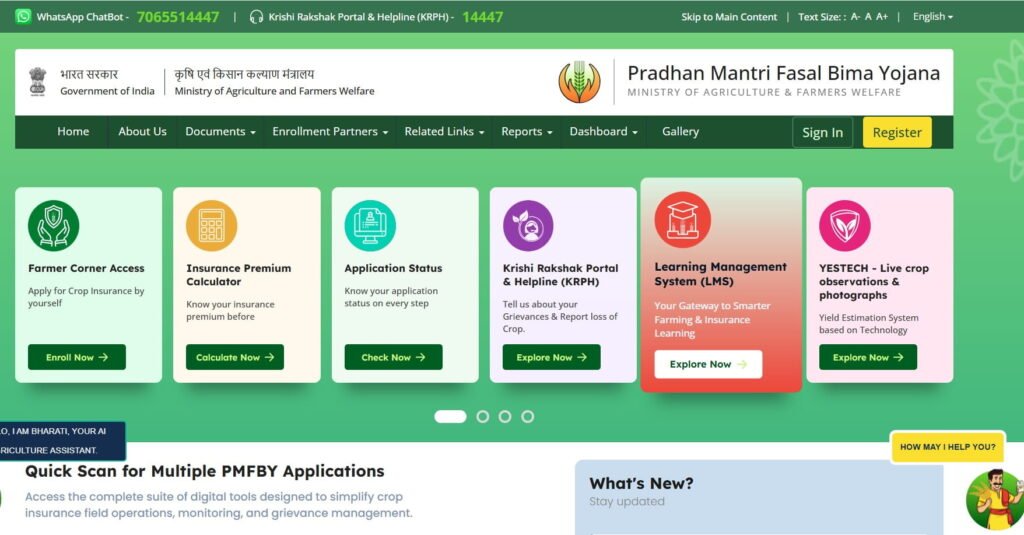
- Second, the farmer registers by entering basic details such as their name, address, and mobile number. Once this information is submitted, an OTP is sent to the registered mobile number for verification, and after successful verification, a login account is created for the farmer.
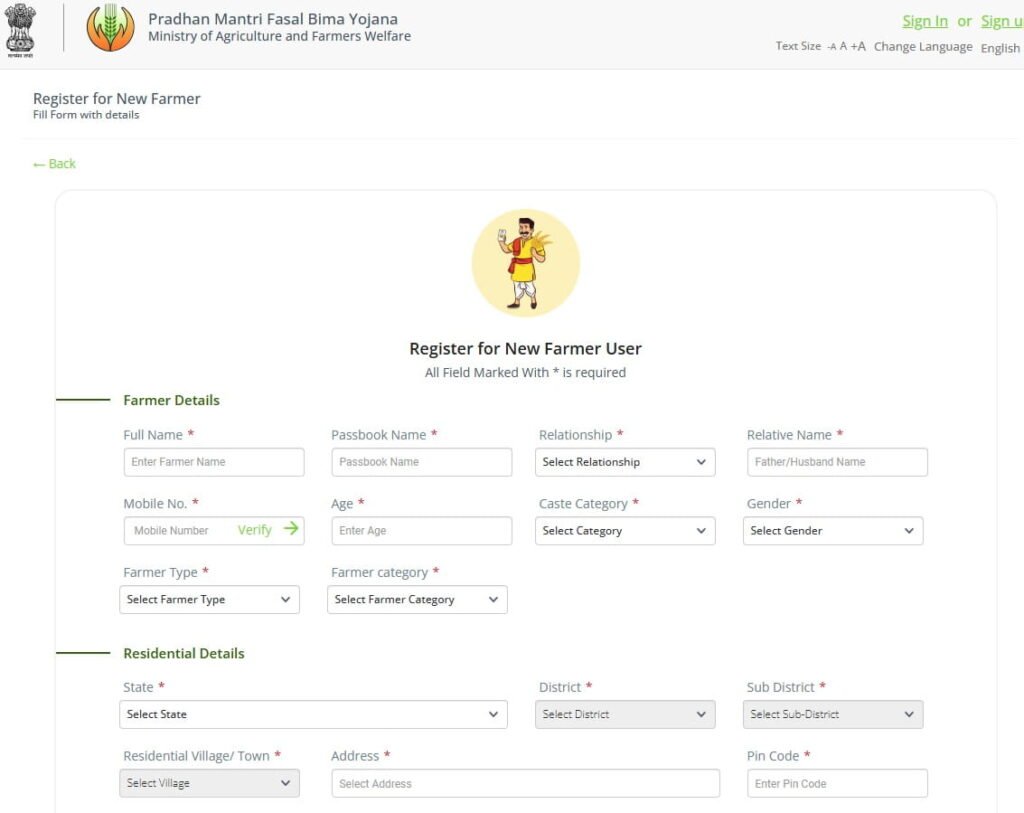
- Third, after logging into the dashboard, the farmer selects the relevant season, meaning either Kharif or Rabi for the current year, and chooses the Pradhan Mantri Fasal Bima Yojana scheme from the list of available options.
- Fourth, the farmer fills in land details, including the survey number or Khasra number as recorded in their land documents, and specifies which notified crop has been sown on that plot.
- Fifth, the farmer enters the area under cultivation in hectares. This is a critical step because the sum insured and the premium the farmer needs to pay are both calculated based on this area multiplied by the per-hectare rates notified by the state government for that particular crop and district.
- Sixth, once all details are entered, the portal automatically calculates the total sum insured and the exact premium amount payable by the farmer, based on the applicable premium rate for that crop and season.
- Seventh, the farmer makes the payment online through the available payment gateway options.
- Eighth, after the payment is successfully processed, the farmer should download and safely save the insurance policy certificate generated by the portal. This document contains important details such as the policy number, the sum insured, and the name of the insurance company handling that particular district and crop combination, all of which are needed later if a claim has to be filed.
Farmers can also use the Crop Insurance mobile application, which supports many of the same functions as the web portal, including enrollment, checking application status, and reporting crop losses, and which is particularly useful for farmers who may not have easy access to a computer but do have a smartphone.
Step-by-Step Application Process: Offline Method
For farmers who prefer not to use the online portal, or in areas where internet connectivity is unreliable, PMFBY can also be accessed offline.
- A farmer can visit the nearest bank branch, particularly if the bank already provides them a crop loan or Kisan Credit Card facility. In such cases, bank staff can help complete the enrollment directly.
- Alternatively, farmers can visit a Common Service Centre, known widely as a CSC, which are set up across rural India specifically to help citizens access government services, including crop insurance enrollment.
- Farmers can also approach the local office of the insurance company that has been empanelled for their district and crop, or contact the local agriculture department office, which usually has updated information on notified crops, deadlines, and the empanelled insurer for that season.
- In every case, the same set of documents mentioned earlier needs to be submitted, along with the completed application form and the premium amount, which is calculated the same way whether the farmer applies online or offline.
Pradhan Mantri Fasal Bima Yojana – State – Wise Apply Online Link
| State / UT | Online Apply Link | Remarks |
| Andhra Pradesh | https://pmfby.gov.in | Apply through PMFBY National Portal |
| Arunachal Pradesh | https://pmfby.gov.in | National Portal |
| Assam | https://pmfby.gov.in | National Portal |
| Bihar | https://pmfby.gov.in | National Portal |
| Chhattisgarh | https://pmfby.gov.in | National Portal |
| Goa | https://pmfby.gov.in | National Portal |
| Gujarat | State Portal (No direct NCIP enrollment) | Farmers enroll through the Gujarat Government portal. |
| Haryana | https://pmfby.gov.in | National Portal |
| Himachal Pradesh | https://pmfby.gov.in | National Portal |
| Jharkhand* | Check State Notification | PMFBY participation depends on current state notification. |
| Karnataka | State Portal (No direct NCIP enrollment) | Farmers enroll through the Karnataka Government portal. |
| Kerala | https://pmfby.gov.in | National Portal |
| Madhya Pradesh | https://pmfby.gov.in | National Portal |
| Maharashtra | https://pmfby.gov.in | National Portal |
| Manipur | https://pmfby.gov.in | National Portal |
| Meghalaya | https://pmfby.gov.in | National Portal |
| Mizoram | https://pmfby.gov.in | National Portal |
| Nagaland | https://pmfby.gov.in | National Portal |
| Odisha | https://pmfby.gov.in | National Portal |
| Punjab | Check State Notification | State implementation varies each season. |
| Rajasthan | https://pmfby.gov.in | National Portal |
| Sikkim | https://pmfby.gov.in | National Portal |
| Tamil Nadu | https://pmfby.gov.in | National Portal |
| Telangana | Check State Notification | State implementation varies. |
| Tripura | https://pmfby.gov.in | National Portal |
| Uttar Pradesh | https://pmfby.gov.in | National Portal |
| Uttarakhand | https://pmfby.gov.in | National Portal |
| West Bengal | Check State Notification | PMFBY implementation varies; state may run its own scheme. |
| Andaman & Nicobar Islands | https://pmfby.gov.in | National Portal |
| Chandigarh | https://pmfby.gov.in | National Portal |
| Dadra & Nagar Haveli & Daman & Diu | https://pmfby.gov.in | National Portal |
| Delhi | https://pmfby.gov.in | National Portal |
| Jammu & Kashmir | https://pmfby.gov.in | National Portal |
| Ladakh | https://pmfby.gov.in | National Portal |
| Lakshadweep | https://pmfby.gov.in | National Portal |
| Puducherry | https://pmfby.gov.in | National Portal |
PM Fasal Bima Yojana 2026 – State Wise List
| State / Union Territory | Last Date to Apply — Kharif 2026 |
|---|---|
| Odisha | 31 July 2026 (officially notified) |
| Madhya Pradesh | 31 July 2026 |
| Maharashtra | 31 July 2026 |
| Uttar Pradesh | 31 July 2026 |
| Rajasthan | 31 July 2026 |
| Karnataka | 31 July 2026 |
| Chhattisgarh | 31 July 2026 |
| Haryana | 31 July 2026 |
| Himachal Pradesh | 31 July 2026 |
| Uttarakhand | 31 July 2026 |
| Andhra Pradesh | 31 July 2026 |
| Telangana | 31 July 2026 |
| Tamil Nadu | 31 July 2026 (may vary by crop/district) |
| Kerala | 31 July 2026 (may vary by crop/district) |
| Assam | 31 July 2026 |
| Tripura | 31 July 2026 |
| Sikkim | 31 July 2026 |
| Goa | 31 July 2026 |
| Manipur, Meghalaya, Mizoram, Nagaland, Arunachal Pradesh | Generally 31 July 2026, subject to state notification |
| Jammu & Kashmir / Ladakh | As per state/UT notification; historically end-July to mid-August |
| Punjab | Not applicable — scheme not implemented; state relies on SDRF/NDRF relief |
| West Bengal | Not applicable — state runs Bangla Shasya Bima instead |
| Bihar | Not applicable — state runs Bihar Rajya Fasal Sahayata Yojana instead |
| Gujarat | Not applicable for Kharif 2026 unless a fresh state notification is issued |
| Jharkhand | Subject to current-season state notification; participation has varied |
How Much Premium Does a Farmer Pay for One Hectare?
This is usually the first and most practical question on every farmer’s mind, and the good news is that the structure is designed to be as simple and predictable as possible. The premium rate that a farmer pays is fixed as a percentage of the sum insured, and this percentage depends only on the season and type of crop, not on the farmer’s landholding size, location, or any individual risk factor. The rates are as follows.
- For Kharif season food and oilseed crops, such as paddy, maize, bajra, soybean, and groundnut, the farmer’s premium is capped at 2 percent of the sum insured.
- For Rabi season food and oilseed crops, such as wheat, gram, mustard, and barley, the farmer’s premium is capped at 1.5 percent of the sum insured.
- For annual commercial and horticultural crops, such as cotton, sugarcane, and various fruits and vegetables where notified, the farmer’s premium is capped at 5 percent of the sum insured.
The remaining actuarial premium, which insurance companies would otherwise charge based on the real risk profile of that crop and region, is paid as a subsidy shared between the Central Government and the State Government, typically on an equal fifty-fifty basis for most states, though some special category states and union territories receive a different sharing ratio with a larger central contribution.
To understand what this actually means in rupee terms for one hectare, it helps to look at a worked example. The sum insured per hectare, technically called the Scale of Finance, is not a fixed national number. It is notified separately by each state government for each district and each crop, based on the average cost of cultivation in that specific area. As a rough illustration, though actual figures vary by state and district, if the notified sum insured for wheat in a particular district is around Rs. 40,000 per hectare, then a Rabi season farmer growing wheat on exactly one hectare would pay a premium of 1.5 percent of Rs. 40,000, which works out to approximately Rs. 600.
Similarly, if a Kharif season crop like paddy or soybean has a notified sum insured of somewhere between Rs. 35,000 and Rs. 80,000 per hectare depending on the district, a farmer insuring one hectare would pay 2 percent of that sum insured, which could range anywhere from roughly Rs. 700 to Rs. 1,600 depending on the specific district’s notified rate for that crop.
For commercial and horticultural crops where the sum insured per hectare tends to be considerably higher because the cost of cultivation itself is higher, the 5 percent premium rate would naturally translate into a larger absolute rupee amount, even though the percentage the farmer pays remains capped.
It is worth stressing that these figures are illustrative rather than universal, because the exact sum insured for any given crop is set district by district based on local cultivation costs and is published in the state government’s official notification for each season. Farmers should always verify the precise Scale of Finance applicable to their specific crop and district either on the official PMFBY portal or by checking with their district agriculture office, since the same crop can have a meaningfully different sum insured value in two neighboring districts.
How the Sum Insured Is Calculated?
The sum insured, which represents the maximum amount a farmer can potentially receive as compensation, is calculated using a simple formula: the notified Scale of Finance per hectare for that particular crop and district, multiplied by the area under cultivation expressed in hectares.
So if a farmer is cultivating two hectares of wheat and the notified Scale of Finance for wheat in that district is Rs. 40,000 per hectare, the total sum insured for that farmer’s plot would be Rs. 80,000. On this amount, the farmer’s premium share at the 1.5 percent Rabi rate would be Rs. 1,200, while the government subsidy would cover the remaining actuarial premium.
This formula-based approach means that the premium amount scales directly with the area a farmer cultivates. A farmer with five hectares of the same crop would pay roughly five times the premium of a farmer with one hectare, since the total sum insured itself scales proportionally, even though the percentage rate applied remains identical for both farmers. There is also a minimum eligible area under the scheme, generally around 0.10 hectare, below which enrollment for that particular plot is not permitted.
How Compensation or Claim Amount Is Calculated?
Understanding how much a farmer can actually receive if their crop fails is just as important as understanding the premium. PMFBY uses what is called an Area Yield Index approach for widespread calamities like drought, and a separate approach for localized risks like hailstorm or flood affecting just a few farms.
For widespread yield losses, the compensation is based on a comparison between the Threshold Yield, which is essentially the expected average yield for that crop in that area based on historical data, and the Actual Yield, which is assessed through Crop Cutting Experiments conducted by the state agriculture department after harvest.
A useful way to picture this is through a simple worked example. Suppose a farmer in Uttar Pradesh cultivates two hectares of wheat, with a sum insured of Rs. 40,000 per hectare, giving a total sum insured of Rs. 80,000. If the Threshold Yield for that district is 30 quintals per hectare, but the Crop Cutting Experiment after the season shows the actual yield came down to only 15 quintals per hectare, this represents a 50 percent shortfall against the threshold. The compensation formula then works out as the shortfall percentage multiplied by the sum insured, meaning 50 percent of Rs. 80,000, which equals Rs. 40,000 credited directly to the farmer’s bank account.
For localized risks such as hailstorm, landslide, or inundation that affect only specific farms within a notified area rather than the entire region, and for post-harvest losses due to unseasonal rain within a specified period after harvesting, a different and generally faster assessment process applies. In these cases, the farmer or a group of affected farmers must report the loss individually, and the assessment is done on an individual farm basis rather than waiting for area-wide yield data.
This is where one of the most important operational rules of the scheme comes in: the 72-hour reporting rule. Any farmer who suffers localized crop damage due to a covered risk must report the loss within 72 hours of the event occurring, either through the Crop Insurance mobile application, the official PMFBY portal, the toll-free helpline number, or by directly informing the concerned insurance company or the nearest agriculture or revenue department office. Missing this 72-hour window can seriously jeopardize the farmer’s ability to claim compensation, even if the crop damage itself was genuine and significant, so this is a deadline that farmers should treat with real urgency rather than treating it as a formality.
Checking Application Status and the Beneficiary List
After enrollment, farmers can check their application status at any time using their application number, policy number, or registered mobile number, either through the official portal or the mobile application. It generally takes about 7 to 10 days after registration for the status to update, and if the status still shows as pending even after around 15 days, farmers are advised to contact their insurance company directly or call the dedicated PM Fasal Bima Yojana 2026 helpline for assistance.
Separately, each season the government publishes what is known as the PM Fasal Bima Yojana beneficiary list, which is essentially the official record of farmers who have been approved and insured under the scheme for that particular Kharif or Rabi season. Farmers can check whether their name appears on this list as a way of confirming their enrollment has gone through successfully, in addition to checking the individual application status.
Recent Additions and Updates to the PM Fasal Bima Yojana
Crop insurance schemes are periodically updated to close gaps that farmers and administrators identify over successive seasons, and PM Fasal Bima Yojana has seen a few notable additions in recent cycles. These include newer add-on covers for risks such as damage caused by wild animals, which is particularly relevant for farmers cultivating land near forest areas, tiger reserves, or known elephant corridors, and specific inundation cover for paddy fields in flood-prone states.
The PM Fasal Bima Yojana 2026 has also increasingly incorporated technology-based yield assessment methods, using satellite imagery and drone-based estimation alongside traditional Crop Cutting Experiments, with the stated aim of making yield assessment faster and more transparent, and consequently making claim settlement quicker for farmers.
PM Fasal Bima Yojana – Common Problems Farmers Face and How to Avoid Them?
A meaningful share of the difficulties farmers report with PM Fasal Bima Yojana are avoidable with a bit of care during enrollment and after a loss event.
- Application rejection is frequently caused by mismatches between the land records submitted and the details already on file, or by incorrect bank account information. Farmers should always double-check that scanned documents are clear and that names, account numbers, and land record numbers exactly match across every document submitted.
- Premium payment deducted but no receipt generated is usually a temporary server-side issue rather than a lost payment, and in most cases resolves itself within 24 to 48 hours as the portal’s status updates, though it is reasonable to follow up with the bank or insurance company if the receipt still has not appeared after that window.
- Missed claims due to late reporting is one of the most heartbreaking and entirely preventable problems, since farmers sometimes wait several days after a hailstorm or flood event before reporting the damage, not realizing that the 72-hour rule is strictly enforced.
- Keeping the toll-free helpline number and the mobile application easily accessible, and reporting immediately after any visible crop damage rather than waiting to assess the full extent of the loss, meaningfully improves the odds of a successful claim.
- Missing the enrollment deadline entirely rules out coverage for that season, with no exceptions typically made for late applications, so farmers should treat the notified cut-off date for their state, crop, and season as an absolutely firm deadline rather than an approximate guideline.
Why this PM Fasal Bima Yojana 2026 Matters?
Beyond the mechanics of premiums and payouts, PM Fasal Bima Yojana represents a fairly significant shift in how agricultural risk is shared in India. Historically, when a crop failed, the entire financial burden fell on the individual farming household, often pushing families into high-interest informal debt just to survive until the next season.
By spreading part of that risk across the insurance pool and government subsidy, the PM Fasal Bima Yojana gives farmers a more predictable financial floor to fall back on, which in turn can also make farmers somewhat more willing to invest in better seeds, fertilizers, and irrigation, since a single bad season is less likely to be financially catastrophic.
That said, the PM Fasal Bima Yojana is not without its critics and limitations. Some farmers and farmer organizations have pointed out that the area-based yield assessment approach can sometimes feel disconnected from an individual farmer’s actual experience, since two neighboring farms within the same assessment unit could have quite different actual outcomes yet receive the same area-based payout.
There have also been periodic concerns in various states about delays in claim settlement and disputes over the accuracy of Crop Cutting Experiments. The government has responded to some of these concerns over time by making the scheme voluntary, introducing technology-assisted yield estimation, and tightening timelines for PM Fasal Bima Yojana claim settlement, but farmers and observers continue to track how well these improvements work in practice season after season.
PM Fasal Bima Yojana 2026 – Practical Checklist Before Applying
Before the enrollment deadline for any given season, it is worth farmers running through a short mental checklist. Confirm whether the crop being grown is actually a notified crop for that specific district and season, since coverage under PM Fasal Bima Yojana only applies to crops officially notified by the state government for each area. Confirm the exact enrollment deadline for that state and crop, since these dates vary and do not get extended for individual late applicants.
Gather Aadhaar, bank passbook, land records or tenancy agreement, and a recent photograph well ahead of time. Decide whether to apply online through the portal or mobile application, or offline through a bank, Common Service Centre, or insurance company office, based on personal convenience and internet access. After enrollment, download and safely store the policy certificate, since the policy number on this certificate is needed for any future status check or claim. Save the toll-free helpline number and keep the mobile application installed, so that in the event of crop damage, the loss can be reported within the mandatory 72-hour window without any last-minute scramble to find the right contact details.
Conclusion
The PM Fasal Bima Yojana continues to be one of the most consequential support systems available to farmers in India, precisely because it addresses the single biggest source of financial anxiety in agriculture: the unpredictability of nature. By capping what farmers themselves have to pay at just 2 percent for Kharif crops, 1.5 percent for Rabi crops, and 5 percent for commercial and horticultural crops, while the government absorbs the much larger remaining share of the actuarial premium, the scheme makes meaningful crop insurance genuinely affordable even for the smallest landholders. For a farmer cultivating a single hectare, this can mean paying just a few hundred to a little over a thousand rupees for a season, in exchange for coverage that could run into tens of thousands of rupees in genuine crop loss compensation.
At the same time, the scheme rewards farmers who stay organized and informed. Keeping documents ready, applying within the notified deadline, understanding how the sum insured and premium for one’s own district and crop are actually calculated, and above all remembering the strict 72-hour rule for reporting localized damage, are all things well within a farmer’s own control, and each of them can make the difference between a smooth claim settlement and a frustrating rejection. Farmers who are unsure about any part of the process are always better served by verifying details directly on the official PM Fasal Bima Yojana portal or with their local agriculture office rather than relying on word of mouth, since the specific sum insured, premium, and deadlines for any given crop can differ meaningfully from one district to another.
PM Fasal Bima Yojana – OFFICIAL SOURCES
| PM Fasal Bima Yojana | CLICK HERE |
| PM Fasal Bima Yojana Operational Guidelines | CLICK HERE |
| PM Fasal Bima Yojana – Farmer Login | CLICK HERE |
| PM Fasal Bima Yojana – Farmer Registration | CLICK HERE |
PM Fasal Bima Yojana 2026 – Frequently Asked Questions
Is it mandatory for every farmer to enroll in PM Fasal Bima Yojana 2026? No. Since 2020, enrollment has been made voluntary for all farmers, including those who hold a Kisan Credit Card or have taken a crop loan. Loanee farmers who do not wish to be enrolled must submit a declaration opting out within the timeline specified by their bank, otherwise they are enrolled automatically by default.
No. Since 2020, enrollment has been made voluntary for all farmers, including those who hold a Kisan Credit Card or have taken a crop loan. Loanee farmers who do not wish to be enrolled must submit a declaration opting out within the timeline specified by their bank, otherwise they are enrolled automatically by default.
Can a farmer insure more than one crop in the same season?
Yes. If a farmer cultivates multiple notified crops, such as wheat on one plot and gram on another during the same Rabi season, each crop and area combination can be enrolled and insured separately, with the sum insured and premium calculated independently for each.
Does the premium percentage change based on the size of the farmer’s landholding?
No. The percentage rate itself, 2 percent for Kharif, 1.5 percent for Rabi, and 5 percent for commercial and horticultural crops, remains the same regardless of whether a farmer owns one hectare or ten hectares. Only the total rupee amount of the premium changes, since it scales with the sum insured, which in turn scales with the area cultivated.
What happens if a farmer’s crop loss is caused by their own negligence rather than a natural calamity?
PM Fasal Bima Yojana 2026 is designed to cover losses arising from notified natural risks such as drought, flood, hailstorm, pest attack, and disease. Losses caused purely by poor farming practices, negligence, or risks that are not part of the notified list for that crop and district are generally not eligible for compensation under the scheme.
Can tenant farmers who do not own land still apply?
Yes. Tenant farmers and sharecroppers are eligible to enroll under PM Fasal Bima Yojana 2026, provided they can produce a valid tenancy agreement or a certificate recognized by the local revenue authority confirming they are cultivating the land, even though they are not the registered owners.
How quickly are claims usually settled after a loss is reported?
Claim settlement timelines depend on the nature of the loss. For localized damage reported within the mandatory 72-hour window, assessment and settlement tend to move relatively faster since only the individual affected farm needs to be surveyed. For widespread, area-based yield losses, settlement typically has to wait until the Crop Cutting Experiments are completed after harvest and the shortfall against the Threshold Yield is officially calculated, which can take longer since it depends on data collected across the whole notified area rather than a single farm.
What is the toll-free helpline number for PM Fasal Bima Yojana related queries?
Farmers can call 14447 for queries related to enrollment status, premium payment issues, or reporting crop loss, in case the mobile application or web portal is not accessible or convenient at that moment.