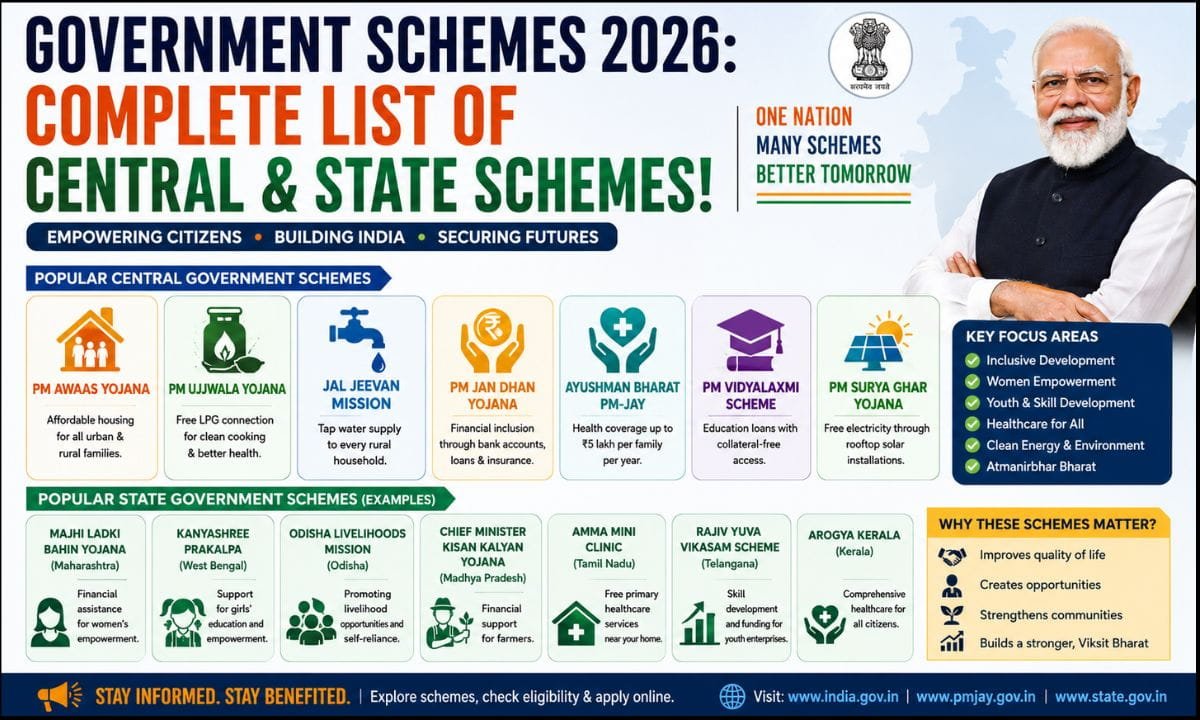
Government Schemes 2026: India runs one of the largest welfare architectures in the world. Every year, the Central Government and the twenty-eight State Governments together roll out, revise, and expand hundreds of schemes that touch nearly every aspect of a citizen’s life — the food on the table, the roof over the head, the fuel in the kitchen, the money in the bank account, the health card in the wallet, and the skills in the hands of the youth. With the Union Budget 2026-27 presented on 1 February 2026 by Finance Minister Nirmala Sitharaman, and with several state governments having rolled out their own budgets through the year, 2026 has turned into a year of consolidation, digitisation, and expansion for India’s welfare state.
This article brings together, in one place, a comprehensive and updated overview of the major Central Sector Schemes, Centrally Sponsored Schemes, and flagship State Government Schemes that are active and relevant in 2026. It covers objectives, eligibility, benefits, budget outlays, and the latest updates for each, so that citizens, students, exam aspirants, and researchers get a single, structured reference.
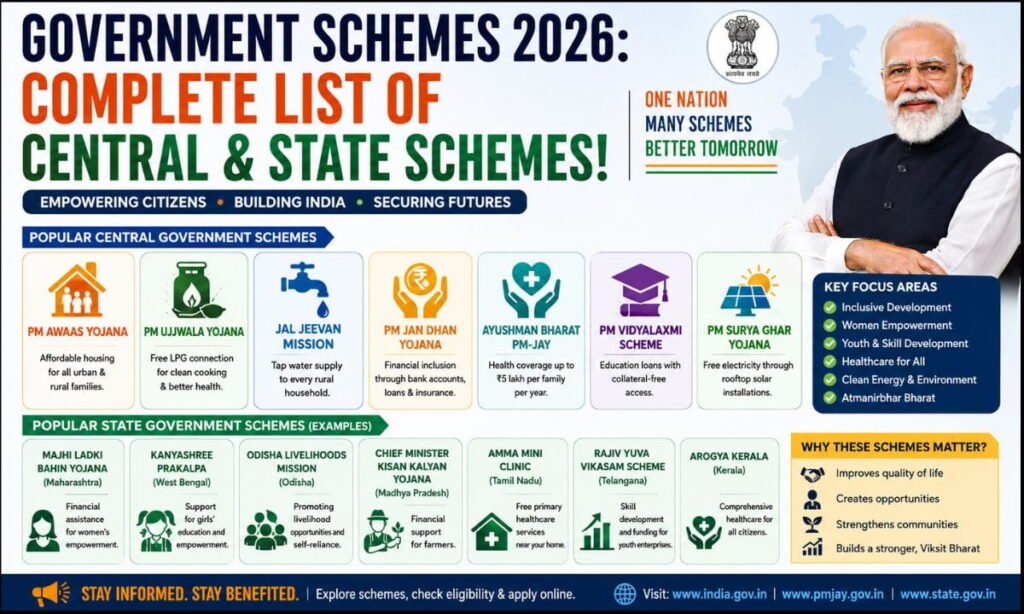
Government Schemes 2026 Classification
Before diving into the list, it helps to understand how these schemes are categorised, because the terminology is used constantly by ministries and in government communication.
Central Sector Schemes (CS) are schemes that are fully funded by the Union Government and implemented directly by central ministries or their agencies. These usually address national priorities such as space research, defence modernisation, or income support that needs a uniform national design, like PM-KISAN.
Centrally Sponsored Schemes (CSS) are funded jointly by the Centre and the states, in varying ratios (commonly 60:40 or 90:10 for special category states), and implemented by state governments. Programmes such as the National Health Mission, Samagra Shiksha, and MGNREGA fall in this category.
State Sector Schemes are designed, funded, and implemented entirely by individual state governments to address local priorities. Because state governments change more frequently and respond to local political and economic needs, this is the layer of governance where you see cash-transfer schemes for women, farm loan waivers, and local scholarship programmes that vary widely from Kerala to Uttar Pradesh to Odisha.
As per the latest budget estimates for 2026-27, the allocation for Central Sector schemes alone is estimated at around ₹6.67 lakh crore, reflecting the scale of direct central spending on welfare and development.
Central Government Schemes 2026: Ministry-Wise Overview
Agriculture and Farmer Welfare
PM-KISAN (Pradhan Mantri Kisan Samman Nidhi) remains India’s largest direct income-support programme for farmers. Launched on 24 February 2019, it provides ₹6,000 per year to landholding farmer families, split into three equal instalments of ₹2,000 every four months (April–July, August–November, December–March). As of 2026, over 11 crore farmers receive this benefit, making it the largest direct cash-transfer scheme for farmers anywhere in the world. To keep receiving instalments, farmers must complete annual e-KYC through OTP or biometric verification at a Common Service Centre, and their Aadhaar must be linked to a verified bank account.
A Farmer ID under the AgriStack and Digital Agriculture Mission has now become mandatory for new registrations in fourteen states, including Uttar Pradesh, Maharashtra, Bihar, Madhya Pradesh, Gujarat, Rajasthan, Karnataka, and Tamil Nadu. Income-tax payees, institutional landholders, and serving or retired government employees above a certain pay level are excluded from the scheme.
PM Fasal Bima Yojana (PMFBY) continues as the flagship crop insurance scheme, protecting farmers against yield losses due to natural calamities, pests, and diseases, with a low uniform premium borne largely by the government.
Kisan Credit Card (KCC) offers farmers collateral-free loans of up to ₹3 lakh at a subsidised interest rate of around 4% per annum for timely repayment, and remains linked to PM-KISAN records for faster verification.
PM Kisan Maandhan Yojana provides a monthly pension of ₹3,000 to small and marginal farmers after they turn 60, based on a modest monthly contribution during their working years.
Bharat-VISTAAR, a new multilingual AI-based advisory platform announced in the 2026-27 Budget, aims to integrate agricultural data and provide customised crop advisory to farmers directly on their phones, marking a shift toward technology-driven extension services.
A loan-linked subsidy scheme for private veterinary professionals was also announced in Budget 2026-27 to expand animal husbandry infrastructure and improve rural veterinary access.
Health and Family Welfare
Ayushman Bharat PM-JAY (Pradhan Mantri Jan Arogya Yojana) is the world’s largest government-funded health assurance scheme, offering cashless hospitalisation cover of ₹5 lakh per family per year at over 30,000 empanelled government and private hospitals. Families identified through the SECC 2011 database are automatically eligible, and more than 43.5 crore Ayushman cards have been issued so far, with over 12 crore vulnerable families covered. A major expansion, the Ayushman Vay Vandana Card, now covers all senior citizens aged 70 and above universally, regardless of income, giving them an additional cover of ₹5 lakh that does not need to be shared with the rest of the family. Senior citizens already covered under CGHS, ECHS, or CAPF health schemes can choose to continue with those or switch to PM-JAY.
PM Rahat Scheme, officially launched on 14 February 2026, is a newer addition that provides every road accident victim in India free cashless medical treatment of up to ₹1.5 lakh for the first seven days after the accident, regardless of who was at fault, aiming to reduce preventable deaths from delayed treatment.
Ayushman Bharat Health Infrastructure Mission continues to fund the creation of Health and Wellness Centres across rural and urban India, bringing primary care, diagnostics, and free medicines closer to citizens.
Janaushadhi Kendras, run under the Pradhan Mantri Bhartiya Janaushadhi Pariyojana, continue to expand, selling generic medicines at 50-80% lower cost than branded alternatives.
Budget 2026-27 also announced three new All India Institutes of Ayurveda and upgrades to AYUSH pharmacies to train more skilled AYUSH personnel, reflecting a continued push toward traditional and integrative medicine infrastructure.
Housing for All
Pradhan Mantri Awas Yojana (PMAY), split into PMAY-Urban and PMAY-Gramin, remains one of the flagship missions of the government. Under PMAY-Gramin, the original target of 2.95 crore rural houses was expanded to 4.95 crore under an extension running through 2026, backed by a total outlay of about ₹3.06 lakh crore for FY25-FY29. More than 2.82 crore rural houses have already been completed, with sanctioned numbers exceeding 3.85 crore.
PMAY-Urban 2.0, launched in August 2024, targets the construction of one crore additional urban houses over five years, backed by an investment of about ₹10 lakh crore, including a government subsidy component of roughly ₹2.30 lakh crore. It operates through four verticals: Beneficiary-Led Construction (BLC), Affordable Housing in Partnership (AHP), In-Situ Slum Redevelopment, and the Credit Linked Subsidy Scheme (CLSS), which provides interest subsidies on home loans ranging between 4% and 6.5% depending on the income category (EWS, LIG, or MIG). For FY 2026-27, PMAY has received a budget of around ₹85,522 crore, with a new MIG-II income category added to widen eligibility for the urban middle class. The scheme also gives preference to female ownership or co-ownership of the constructed property, a design feature intended to promote women’s asset ownership.
Financial Inclusion and Insurance
Pradhan Mantri Jan Dhan Yojana (PMJDY), launched in August 2014, remains the backbone of India’s financial inclusion strategy. As of late 2025, more than 56 crore bank accounts have been opened under the scheme, with women accounting for over 55% of beneficiaries, and more than ₹2.73 lakh crore currently deposited across these zero-balance accounts. Twenty-seven states and union territories have achieved 100% household banking coverage. PMJDY accounts act as the gateway to a bundle of related schemes:
- Pradhan Mantri Jeevan Jyoti Bima Yojana (PMJJBY) — a renewable one-year life insurance cover of ₹2 lakh for a nominal annual premium.
- Pradhan Mantri Suraksha Bima Yojana (PMSBY) — accidental death and disability cover at an even lower annual premium.
- Atal Pension Yojana (APY) — a guaranteed pension scheme targeted mainly at unorganised sector workers such as domestic help, gardeners, and delivery workers, offering a fixed monthly pension between ₹1,000 and ₹5,000 after the age of 60, based on contributions made.
Pradhan Mantri Mudra Yojana (PMMY) provides collateral-free loans of up to ₹10 lakh (Shishu, Kishor, and Tarun categories) to non-corporate, non-farm micro and small enterprises through MUDRA, a subsidiary of SIDBI. Since its inception in 2015, over 57 crore loans worth more than ₹40 lakh crore have been disbursed, making it a central pillar of India’s micro-entrepreneurship push.
Clean Energy and Rooftop Solar
PM Surya Ghar: Muft Bijli Yojana is one of the most talked-about schemes of 2026. Launched on 13 February 2024 with a total outlay of ₹75,021 crore, the scheme aims to install rooftop solar systems in one crore households, giving each household up to 300 units of free electricity every month. A household can receive a subsidy of up to ₹78,000 depending on system size, disbursed directly into the bank account within 30 days of successful installation and net-meter commissioning.
The application process runs entirely online: registration, a feasibility check by the local electricity distribution company (DISCOM), vendor selection from a registered panel, installation, net-meter application, and inspection. As of April 2026, over 5.79 lakh collateral-free solar loans worth more than ₹10,900 crore have been sanctioned through the JanSamarth portal, and states such as Rajasthan, Gujarat, Maharashtra, and Tamil Nadu are leading in installations. Budget 2026-27 has allocated roughly ₹22,000 crore for the scheme this fiscal year, with a stated goal of near-saturation coverage by early 2027.
Skill Development, Entrepreneurship, and Traditional Trades
PM Vishwakarma Yojana, launched on 17 September 2024, offers end-to-end support to traditional artisans and craftspeople working in eighteen identified trades such as carpentry, blacksmithing, pottery, and tailoring. Beneficiaries receive a toolkit incentive of ₹15,000, skill training with a stipend, and collateral-free loans of up to ₹3 lakh in two tranches at a concessional interest rate. A related component gives women and tailors ₹15,000 specifically to purchase sewing machines and equipment, alongside training support.
PM SVANidhi supports urban street vendors with working-capital loans, starting at ₹10,000 for the first loan and rising up to ₹50,000 for a third loan, with an interest subsidy of about 7% for timely repayment, helping vendors formalise their business and build a credit history.
Skill India Digital and the National Apprenticeship Training Scheme (NATS) continue to expand vocational training, with the 2026-27 Budget allocating around ₹1,250 crore for NATS, matching the revised estimate of the previous year.
Lakhpati Didi is a flagship women’s livelihood mission under which members of Self-Help Groups (SHGs) are trained and supported to build sustainable incomes exceeding ₹1 lakh a year. Announced by the Prime Minister in his Independence Day speech of 2023, the scheme’s target has since been expanded to 3 crore Lakhpati Didis. As of early 2026, roughly 1.5 crore women have already achieved this status, with another 3 crore approaching the threshold, out of a total SHG membership of around 9 crore women nationally.
Education and Human Capital
The Union Budget 2026-27 allocated a total of ₹1,39,289.48 crore to the education sector — the highest ever — with ₹83,562.26 crore going to school education and ₹55,727.22 crore to higher education. Key announcements include the creation of a high-powered Education to Employment and Enterprise Standing Committee, tasked with aligning the education system with labour-market needs and positioning India as a 10% share holder in the global services market by 2047. Three new National Institutes of Pharmaceutical Education and Research (NIPER), one new National Institute of Design (NID), and five new university townships were also announced. The government continues to expand digital learning infrastructure, virtual labs, and blended-learning platforms in colleges and universities, alongside teacher-training reforms aligned with the National Education Policy (NEP) 2020.
PM Vidyalaxmi Scheme offers a collateral-free education loan of up to ₹10 lakh for students pursuing higher education at recognised institutions, aiming to remove the financial barrier to quality education.
Samagra Shiksha Abhiyan remains the umbrella Centrally Sponsored Scheme covering school education from pre-primary to senior secondary level, integrating erstwhile schemes like Sarva Shiksha Abhiyan and Rashtriya Madhyamik Shiksha Abhiyan.
PM USHA (Pradhan Mantri Uchchatar Shiksha Abhiyan), which funds state higher education institutions, saw its allocation revised downward this year, even as overall higher education spending rose.
Women and Child Development
Mission Vatsalya is the umbrella scheme providing a digital and physical framework for child protection, covering children in difficult circumstances such as orphans or those in conflict with the law.
Sukanya Samriddhi Yojana (SSY) remains a hugely popular small-savings scheme for the girl child, offering a high, government-guaranteed interest rate on deposits made until the daughter turns 18, and maturing when she turns 21.
Beti Bachao Beti Padhao continues its awareness and enforcement work around the girl child’s survival, protection, and education, alongside data-monitoring of the child sex ratio.
PM Matru Vandana Yojana provides cash incentives to pregnant and lactating mothers to encourage better nutrition and health-seeking behaviour during pregnancy and after childbirth.
Tribal, SC/ST, and Minority Welfare
Dharti Aaba Janjatiya Gram Utkarsh Abhiyan, a mission worth roughly ₹79,156 crore, aims to achieve saturation coverage of essential government services across more than 63,000 tribal-majority villages and Aspirational Districts, benefiting over 5 crore tribal citizens.
Adarsh Gram Yojana funds the holistic development of villages with a majority Scheduled Caste population, using up to ₹20 lakh per village for identified development activities.
Governance, Digital, and Infrastructure
Mission Karmayogi continues its work to reform civil-services training, aiming to bring uniformity in training standards across Central Training Institutions and build individual, institutional, and process-level capacity in government.
SVAMITVA Scheme, run by the Ministry of Panchayati Raj, uses drone surveys to map rural residential land and issue formal property cards to village households, giving rural residents legal title to their property for the first time.
National Logistics Policy (NLP) aims to cut India’s logistics costs from around 13-14% of GDP to single digits, closer to 8-9%, by 2030, making Indian goods more globally competitive.
The 2026-27 Budget also announced a ₹12.2 lakh crore public capital expenditure outlay, an Infrastructure Risk Guarantee Fund to de-risk large projects and speed up execution, plans for twenty new national waterways to be operationalised over the next five years, and new ship-repair ecosystems to be developed in Varanasi and Patna.
Labour, Employment, and Social Security
Mahatma Gandhi National Rural Employment Guarantee Act (MGNREGA) continues as India’s largest rural employment guarantee programme, legally entitling every rural household to a minimum of 100 days of unskilled manual work per year at a notified wage rate. It remains one of the largest Centrally Sponsored Schemes by budget outlay and acts as a safety net during agricultural lean seasons and rural distress.
e-Shram Portal is the national database for unorganised workers — including migrant labourers, gig and platform workers, street vendors, and domestic help — who receive a Universal Account Number (UAN) after registration. This UAN increasingly acts as the eligibility gateway for accident insurance cover, pension schemes, and targeted welfare benefits for informal-sector workers, a segment that makes up close to 90% of India’s workforce.
Employees’ State Insurance (ESI) Scheme and the Employees’ Provident Fund Organisation (EPFO) continue to provide health insurance, disability, and retirement benefits to organised-sector workers, with the government periodically announcing wage-threshold revisions and interest-rate declarations on PF balances.
Atal Beemit Vyakti Kalyan Yojana offers a relief payment to insured workers who lose their jobs involuntarily, funded through the ESI corpus.
National Pension Scheme for Traders and Self-Employed Persons (NPS-Traders) and the broader PM Shram Yogi Maandhan Yojana extend a guaranteed monthly pension of ₹3,000 after the age of 60 to unorganised-sector workers and small traders who contribute a modest monthly amount during their working years, mirroring the design of PM Kisan Maandhan for the farming community.
Startups, MSMEs, and Industry
Startup India continues to provide tax exemptions, easier compliance, and funding support through the Fund of Funds for Startups (FFS), while Make in India and the Production Linked Incentive (PLI) Schemes across sectors like electronics, pharmaceuticals, textiles, and semiconductors keep driving manufacturing investment and import substitution.
Credit Guarantee Scheme for Micro and Small Enterprises (CGTMSE) continues to give collateral-free credit access to small businesses, complementing PM Mudra loans at a slightly higher loan-ceiling tier.
One District One Product (ODOP) and the PM Formalisation of Micro Food Processing Enterprises (PMFME) scheme support local and regional food and craft industries in scaling up and accessing formal credit and markets.
State Government Schemes 2026: Flagship Examples
While central schemes provide the national framework, state governments run their own high-visibility welfare programmes, many of them centred on direct cash transfers to women, which have become one of the defining policy trends across Indian states in the last three years.
Madhya Pradesh — Mukhyamantri Ladli Behna Yojana: Launched in March 2023 for women aged 21-60 not paying income tax and owning less than five acres of land, the scheme now provides ₹1,250 per month directly into beneficiaries’ bank accounts, with the state government having proposed further increases to ₹1,500 in later phases.
Maharashtra — Mukhyamantri Ladki Bahin Yojana: Provides ₹1,500 per month to eligible women and has become one of the largest such schemes by number of beneficiaries. The state government has repeatedly reaffirmed the scheme will continue, alongside plans for women-led credit societies and interest-free loans to help women start small businesses.
Odisha — Subhadra Yojana: Launched on 17 September 2024 for women aged 21-60, this scheme provides ₹10,000 annually in two instalments of ₹5,000 each, paid on Raksha Bandhan and International Women’s Day, adding up to a total of ₹50,000 over five years (2024-2029) for each beneficiary, benefiting more than one crore women in the state.
Chhattisgarh — Mahtari Vandan Yojana: Provides ₹1,000 per month to women aged 21-60, aimed at economic empowerment and support for child-rearing and health expenses.
Himachal Pradesh — Indira Gandhi Pyari Behna Sukh-Samman Nidhi Yojana: Offers ₹1,500 per month to women aged 18-59, intended to reduce their financial dependence on other family members.
Karnataka — Gruha Lakshmi Yojana: A flagship scheme of the state government providing monthly financial assistance to women heads of households, part of a broader set of five guarantee schemes that also include free electricity units and travel benefits for women on state transport buses.
West Bengal — Lakshmir Bhandar: Provides monthly cash assistance to women from economically weaker sections, with a higher amount for women from Scheduled Caste and Scheduled Tribe households.
Telangana — Mahalakshmi Yojana and Gruha Jyothi: Combine free bus travel for women, subsidised LPG cylinders, and a monthly income-support component as part of the state’s broader six-guarantee welfare framework.
Uttar Pradesh — Mukhyamantri Udyogini Yojana and Kanya Sumangala Yojana: Support women entrepreneurs with subsidised loans and provide staged financial assistance to girl children from birth through higher education, respectively. The state’s 2026-27 budget also raised vocational-education funding by 88%, added fourteen new medical colleges, and announced two Chief Minister Model Composite Schools in every one of its seventy-five districts.
Andhra Pradesh, Kerala, and Tamil Nadu run extensive self-help-group ecosystems — SERP, Kudumbashree, and Mission Shakti respectively — that feed directly into the central Lakhpati Didi target and provide microfinance, skill training, and market linkages to rural women.
This is far from an exhaustive list — nearly every state runs its own version of a farmer income-support scheme, a girl-child scholarship programme, an old-age or widow pension, and a health-insurance top-up scheme layered on top of Ayushman Bharat. The common thread across most of these state schemes in 2026 is the shift toward direct benefit transfer (DBT) into Aadhaar-linked bank accounts, replacing older methods of in-kind distribution.
Union Budget 2026-27: The Big Picture
Presented on 1 February 2026, the Union Budget 2026-27 organised its scheme announcements around five broad priorities: economic growth through manufacturing, MSMEs, and logistics; employment and skilling through healthcare, tourism, and creative-industry job creation; agriculture and rural livelihoods through high-value crops, fisheries, and AI-based farm advisory; inclusive and regional development targeting women, youth, persons with disabilities, and Tier-2/Tier-3 cities; and sustainability through clean energy, inland waterways, and eco-tourism. Detailed eligibility conditions, application procedures, and documentation requirements for newly announced schemes are notified separately by the respective implementing ministries as the year progresses, and beneficiaries can typically apply through the MyScheme portal or the relevant ministry’s dedicated website once guidelines are released.
How to Check Eligibility and Apply: The Common Digital Backbone?
A defining feature of India’s scheme ecosystem in 2026 is convergence onto a small number of digital portals:
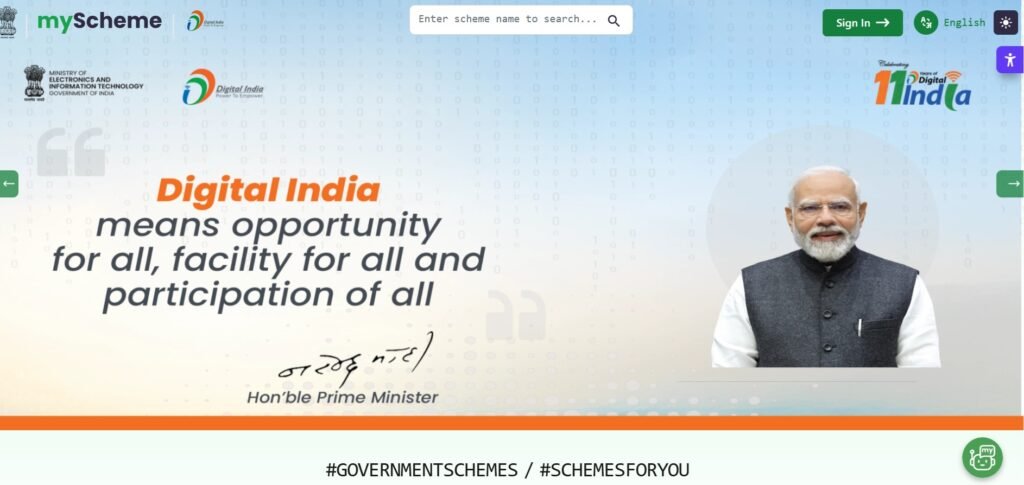
- myScheme.gov.in functions as a single search-and-discovery portal where a citizen can enter basic details and get a personalised list of central and state schemes they may be eligible for.
- pmkisan.gov.in for PM-KISAN status checks, e-KYC, and beneficiary lists.
- beneficiary.nha.gov.in and the Ayushman App for PM-JAY eligibility checks and card downloads.
- pmaymis.gov.in and pmayg.nic.in for PMAY-Urban and PMAY-Gramin beneficiary lists respectively.
- JanSamarth Portal for collateral-free loan applications under PM Surya Ghar, PM Vishwakarma, PM Mudra, and education loan schemes.
- e-Shram Portal for unorganised-sector worker registration, which acts as an eligibility gateway for several labour welfare schemes.
Across nearly all these platforms, the common requirements are an Aadhaar-linked mobile number, a bank account seeded with Aadhaar, and completed e-KYC — making these three steps the single most important thing a citizen can do to ensure uninterrupted access to whichever scheme they qualify for.
Conclusion
The government schemes landscape in 2026 reflects a clear direction: consolidation of existing flagship programmes rather than a proliferation of brand-new ones, deeper digitisation of application and disbursal processes, a sharpened focus on women-centred direct cash transfers at the state level, and a national push to connect education and skilling directly to employment outcomes. For farmers, PM-KISAN and crop insurance remain the anchor; for the poor and lower-middle class, Ayushman Bharat and PMAY continue to be the biggest levers of relief; for households transitioning to clean energy, PM Surya Ghar is reshaping how electricity is consumed and paid for; and for women across states, monthly cash-transfer schemes have become the most politically significant and financially substantial welfare intervention of the decade. Whether at the central or state level, the throughline connecting almost every scheme discussed here is Direct Benefit Transfer — money moving straight into Aadhaar-linked bank accounts, with e-KYC as the new gatekeeper of India’s welfare state.
Given how frequently instalment dates, budget allocations, and eligibility rules are revised through the year, readers should treat this article as a structured reference point and verify current details — installment dates, exact subsidy amounts, and state-specific eligibility criteria — on the official government portals listed above before applying.
Official Sources
| Pradhan Mantri Awaas Yojana-Gramin | CLICK HERE |
| PMAY(Urban) | CLICK HERE |
| Ayushman Bharat | CLICK HERE |
| NHA Official Site | CLICK HERE |
FAQ’s on Government Schemes 2026
What are the government schemes for 2026?
Government schemes for 2026 are welfare and development programs launched by central and state governments. Their objective is to provide eligible citizens with financial assistance, healthcare, education, housing, employment, agricultural support, and social security benefits.
How can I check if I am eligible for a government scheme?
Eligibility criteria vary by scheme and may depend on factors such as age, income, occupation, place of residence, gender, caste, or economic status. You should review the specific eligibility conditions of the scheme before applying.
What documents are generally required to apply for government schemes?
Most schemes require the following basic documents:
Aadhaar Card
PAN Card (where applicable)
Income Certificate
Proof of Residence
Bank Account Details
Mobile Number
Passport-sized Photograph
Additional documents may be required depending on the specific scheme.
Can I apply for schemes from both the central and state governments?
Yes. If you meet the eligibility criteria, you can apply for schemes from both central and state governments. Some benefits can be combined, while in other cases, there may be restrictions based on the program’s rules.
How can I apply for government schemes in 2026?
Applications can generally be submitted online via government portals or offline—depending on the scheme—at Common Service Centers (CSCs), district offices, banks, or other authorized government departments.
What are some of the most popular government schemes for 2026?
Some well-known schemes include:
Pradhan Mantri Awas Yojana (PMAY)
Ayushman Bharat PM-JAY
PM Jan Dhan Yojana
PM Ujjwala Yojana
Jal Jeevan Mission
PM Surya Ghar Yojana
PM Kisan Samman Nidhi
State-specific schemes for education, healthcare, pensions, and farmer welfare.